When to Upgrade to Conveyorized Powder Coating | Powder-X
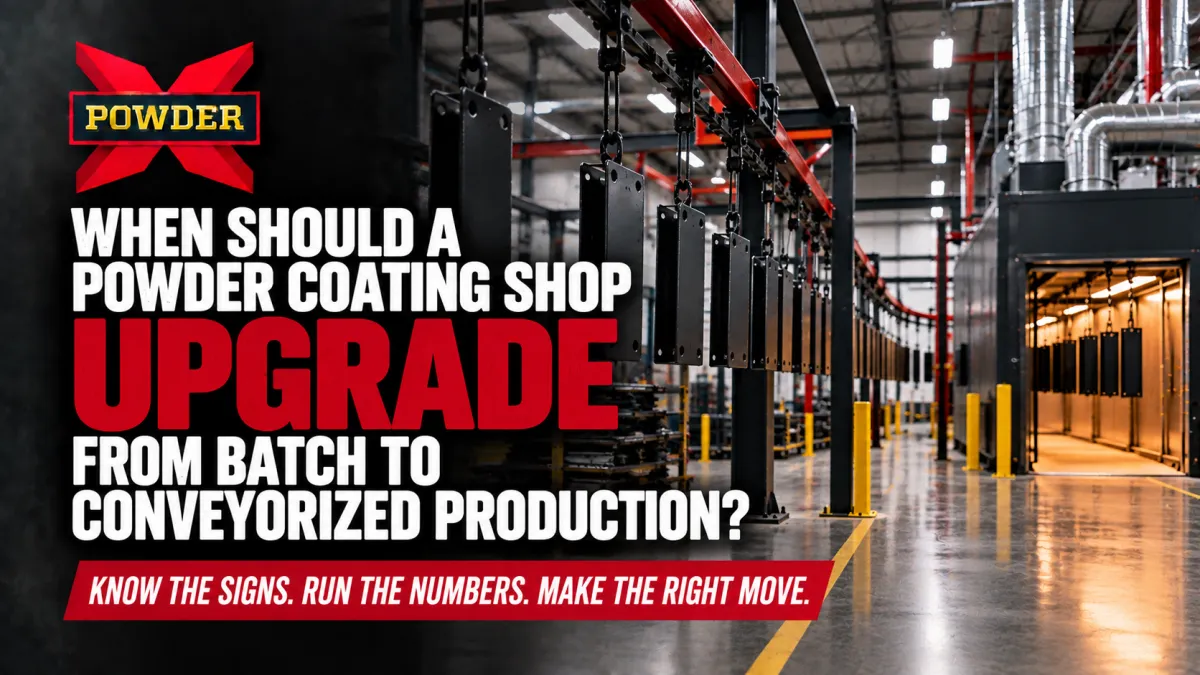
When Should a Powder Coating Shop Upgrade from Batch to Conveyorized Production?
Growth creates a good problem.
More customers. More parts. More repeat orders. More production.
Eventually, though, a powder coating shop can reach the point where the same batch system that helped build the business starts struggling to keep up with it.
That doesn't automatically mean it's time for a conveyor.
At Powder-X, the decision should come down to something much more practical:
Has production become consistent enough that continuous processing will make the business more efficient and profitable?
The goal isn't to graduate from batch because conveyorized equipment looks more advanced. It's to upgrade when the work justifies the investment.
Batch Powder Coating Can Take a Business a Long Way
Batch systems are incredibly useful because they're flexible.
Parts can be loaded onto racks or carts, moved through preparation and coating, placed into the oven and processed in individual batches. That works particularly well for job shops, custom coaters and manufacturers handling changing part sizes, colors and production schedules.
Powder-X's training material describes smaller professional coaters as commonly operating with batch capabilities while they build volume, customers and business structure. Powder Coach's Playbook Final E…
And there's nothing wrong with staying batch.
If a shop can meet production requirements, maintain quality and make good money with the equipment it already owns, a conveyor doesn't automatically improve the business.
The right system is the one that fits the work.
What Changes With Conveyorized Powder Coating?
A conveyorized system changes the way parts move through production.
Instead of employees manually moving individual carts or racks between stages, parts can travel continuously on a conveyor through processes such as pretreatment, dry-off, powder application and curing.
That can create a much more predictable rhythm.
Parts enter.
Parts move.
Parts come out finished.
For the right operation, that continuous flow can dramatically increase throughput and reduce some of the handling associated with batch production.
But conveyorized production also creates a more interconnected system.
Pretreatment, application, cure, conveyor speed, part spacing and production scheduling all have to work together.
You're no longer buying individual pieces of equipment. You're engineering a production process.
Sign #1: Production Volume Is Consistently Outgrowing the Batch System
This is the most obvious sign.
The booth stays busy. The oven stays full. Racks are waiting. Employees are constantly moving carts. Overtime is increasing, and production still struggles to keep pace with demand.
At that point, the batch system may be approaching its practical capacity.
Notice the word consistently.
One huge order doesn't necessarily justify an automated line.
Neither does one busy month.
The stronger case is when demand has become repeatable enough that the business can reasonably expect to use the additional capacity.
Powder-X's business material describes larger coaters as operations handling thousands of parts with advanced fixtures, equipment and stronger production controls as they grow. Powder Coach's Playbook Final E…
Don't automate for a production spike. Automate for sustainable production demand.
Sign #2: Repeat Work Is Becoming a Large Part of the Business
Conveyors love repetition.
If a shop coats the same parts—or similar families of parts—day after day, continuous production starts becoming much more attractive.
The operator already knows the pretreatment requirements. Racking becomes standardized. Gun settings become predictable. Cure requirements are known. Part spacing can be established.
Compare that with a shop coating a trailer frame, then 15 wheels, then a railing, then four completely different fabricated assemblies.
A batch system may be far better suited to that variety.
Powder-X's Powder Coach's Playbook identifies repeat work as especially valuable because efficiency improves as the same jobs move through production again and again. Powder Coach's Playbook Final E…
The more predictable the work becomes, the easier it is to build a predictable production system around it.
Sign #3: Material Handling Is Becoming the Bottleneck
Sometimes the powder application isn't the problem.
Moving the parts is.
Employees push racks to preparation. Then to the booth. Then to the oven. Then out to cooling. Someone has to find the next cart. Another rack is blocking the aisle. The oven is ready, but the correct load hasn't arrived yet.
That's labor.
It's also lost production time.
As discussed in Powder-X's shop-layout guide, a bottleneck is simply the step that limits the speed of everything else in the process.
If employees are spending more and more time moving work instead of producing work, conveyorized material handling may create significant value.
A conveyor can establish a controlled path and pace for the parts.
But don't assume the conveyor fixes every bottleneck.
If pretreatment can't keep up, the conveyor won't magically make preparation faster.
Sign #4: The Oven Is Becoming a Traffic Jam
Batch ovens work in cycles.
Load the oven. Heat the parts. Cure them. Unload. Load again.
As production increases, those cycles can become a limiting factor.
Coated racks begin waiting outside the oven. The booth slows because there's nowhere to put another finished rack. Employees start rearranging work just to keep the process moving.
That's when continuous curing can become worth evaluating.
In a properly designed conveyorized system, parts move through the curing oven at a controlled rate designed around the required cure process.
But cure requirements still matter.
The powder manufacturer's Technical Data Sheet and actual part-metal temperature remain critical. Conveyor speed has to provide enough time for the part to reach the required temperature and satisfy the cure schedule.
A faster conveyor doesn't help if the coating isn't properly cured.
Sign #5: Labor Is Being Consumed by Repetitive Movement
Automation shouldn't be evaluated as simply:
“How many people can this eliminate?”
That's usually too simplistic.
The better question is:
“Where is labor being used, and could those hours create more value somewhere else?”
Employees manually loading and unloading equipment, pushing carts and repeating the same movements hundreds of times may represent an opportunity for automation.
Conveyorized production can reduce certain repetitive handling requirements while allowing employees to focus more attention on loading, unloading, inspection, process control, touch-up and quality.
Automation often doesn't eliminate the need for skilled people.
It changes what those people spend their time doing.
Sign #6: Production Consistency Is Becoming Harder to Maintain
As batch production gets busier, variation can creep in.
One rack waits longer than another.
One operator moves faster.
Parts get staged differently.
Oven loads vary.
Production schedules become more complicated.
A conveyor creates a defined pace.
When properly designed, part spacing, line speed, application and cure become more repeatable.
That's one reason larger coating operations rely on stronger production controls as volume increases. Powder-X's training material specifically connects large-scale coating efficiency with advanced fixtures, equipment, quality control and optimized material use. Powder Coach's Playbook Final E…
The financial value isn't only more parts per hour.
Repeatability can reduce variation, rework and uncertainty.
Color Changes Can Complicate the Decision
High production volume alone doesn't automatically make conveyorized production the right answer.
Look at the color mix.
An operation running thousands of similar parts in one or a few colors is a very different candidate from a job shop changing colors constantly throughout the day.
Frequent color changes can introduce cleaning time, scheduling challenges and powder-recovery considerations.
This doesn't mean conveyorized systems can't handle multiple colors.
They absolutely can.
It means color-change frequency needs to be included in the ROI calculation instead of being discovered after the equipment is installed.
Make Sure Pretreatment Can Grow With Production
One of the easiest ways to create an expensive bottleneck is to increase coating capacity without increasing preparation capacity.
Powder-X training describes a clear difference between common batch preparation and automated production, where automated systems may use multi-stage washing and conversion-coating processes as part of continuous production. Powder Coach's Playbook Final E…
If the conveyor can move 500 parts but the preparation process can only supply 200 properly prepared parts, the operation hasn't created a 500-part system.
It has created a 200-part system with unused capacity.
The entire process has to scale together.
Space and Building Requirements Matter
A conveyorized system needs room.
The conveyor has to travel through the process. Pretreatment equipment, dry-off, powder application, cure, loading and unloading all need to be considered.
Ceiling height, columns, utilities, building shape, material flow and expansion space can affect what's practical.
Powder-X's market analysis specifically identifies space requirements and initial capital investment as challenges companies face when developing in-house powder coating capability. Powder coating market analysis
That's why the transition should be planned before equipment is placed.
A conveyor isn't something that should simply be squeezed into whatever floor space remains.
Run the Financial Calculation
Ultimately, the upgrade needs to make financial sense.
Start by identifying what conveyorized production is expected to improve:
Additional profitable production capacity + labor efficiency + reduced handling + material/process savings + reduced rework = estimated annual financial benefit
Then compare that with the total investment required to make the transition.
A simple starting point is:
Total Conveyorized System Investment ÷ Estimated Annual Financial Benefit = Approximate Payback Period
But there's another number worth calculating:
What is staying batch currently costing the business?
If the shop is turning away profitable production, paying significant overtime, extending lead times or losing repeat customers because capacity is maxed out, doing nothing has a cost too.
That's opportunity cost.
And sometimes it's the number that changes the entire conversation.
Don't Upgrade Just Because the Shop Is Busy
Busy isn't enough.
Before moving from batch to conveyorized production, Powder-X would want to understand the work behind that busyness.
Is the volume repeatable?
Are customers committed?
Are the parts compatible with continuous processing?
How frequently do colors change?
Where is the current bottleneck?
How much additional sellable production would a conveyor actually create?
Does the facility support it?
What is the expected payback?
The Powder Coach's Playbook emphasizes that growing coating businesses eventually face important decisions about expansion, capital investment, resource utilization and organizational structure. Powder Coach's Playbook Final E…
The goal isn't simply to grow.
It's to grow under control.
Sometimes the Best Move Is an Intermediate Step
The jump doesn't always need to be from a basic batch operation to a fully automated production line.
A shop may be able to increase capacity by improving racking, adding batch oven capacity, changing material handling, upgrading application equipment or eliminating another bottleneck first.
For some businesses, those improvements may buy years of additional productive life from a batch operation.
For others, they'll reveal that the business has genuinely reached the point where continuous production is the next logical step.
That's why the equipment decision comes after the production analysis.
The Powder-X Takeaway
A shop should consider upgrading from batch to conveyorized powder coating when production has become high enough, consistent enough and repeatable enough that continuous processing creates measurable financial value.
Look for sustained capacity problems. Repeat production. Excessive material handling. Oven bottlenecks. Rising labor requirements. Quality variation. Lost orders. Longer lead times.
Then run the numbers.
A batch system isn't something a business should be in a hurry to outgrow.
And a conveyor isn't a trophy for becoming a bigger powder coater.
It's a production tool.
When the work, facility and financial return all support the move, conveyorized production can open an entirely different level of capacity.
Until then, the smartest system may still be the one already making money.
Ready To Build A Powder Coating System The Right Way?
Whether you are starting your first powder coating business, bringing finishing in-house, or upgrading an existing operation, Powder-X can help you choose a batch system built around your goals.
From ovens and booths to complete systems, training, technical support, and long-term guidance, our team is here to help you make a smart investment in equipment that is designed to perform.
Contact Powder-X today to speak with one of our coating specialists and start building a powder coating operation with confidence.


