Batch vs. Automated Powder Coating Systems | Powder-X
Batch vs. Automated Powder Coating Systems: Which Is Right for Your Operation?
One of the biggest decisions you'll make when building or expanding a powder coating operation is whether you need a batch system or an automated powder coating system.
The answer isn't simply that automation is better because it's faster. And a batch system isn't automatically the better choice because it costs less.
The right system depends on what you're coating, how many parts you're producing, how often those parts change, your labor requirements, available space, and—most importantly—whether the numbers make sense.
At Powder-X, we look at it this way:
Don't buy automation because you can. Automate when your production justifies it.
What Is a Batch Powder Coating System?
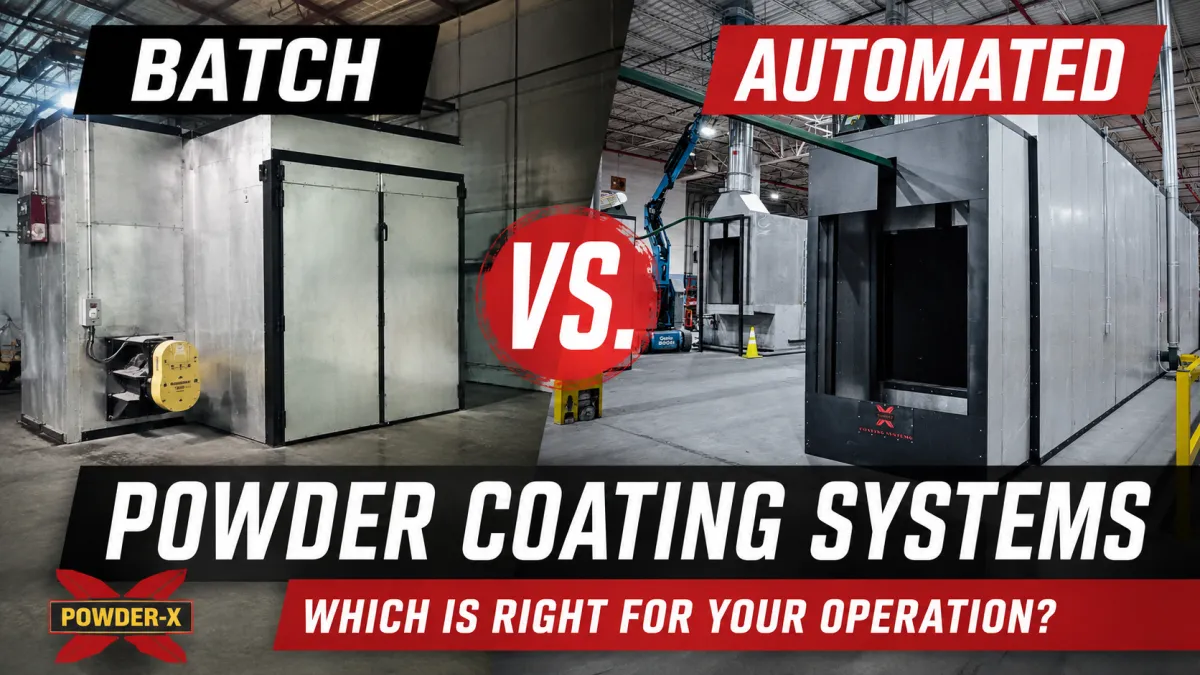
A batch system processes parts in individual groups rather than continuously moving them through a production line. Parts are typically prepared, manually coated in a booth, moved into a curing oven, cured, and then removed for the next batch.
The biggest advantage is flexibility.
If you're coating wheels this morning, fabricated railings this afternoon, and a completely different product tomorrow, a batch system can adapt to that changing workload.
That flexibility is one reason smaller and growing coating businesses commonly operate with batch capabilities and professional-grade equipment.
Batch systems can be especially attractive when you have:
Low to moderate production volume
Frequently changing part sizes or shapes
Many different colors
Custom or one-off jobs
Limited floor space
A need to keep the initial investment manageable
For a job shop with a constantly changing schedule, flexibility can be more valuable than raw speed.
What Is an Automated Powder Coating System?
An automated system is designed around continuous production. Parts typically move on a conveyor through pretreatment, drying, powder application, curing, and cooling.
Instead of moving individual batches from one process to another, the product keeps moving.
That's where automation becomes powerful.
If you're coating hundreds or thousands of similar parts, manually handling every part through every stage can become a bottleneck. Large coating operations rely on more advanced equipment, fixtures, production controls, and optimized material use to efficiently handle high volumes.
Automation can help increase throughput, reduce manual handling, and reduce labor dependency. Powder-X's market analysis specifically identifies automated and semi-automated systems as an option manufacturers are considering to improve efficiency and scalability.
But here's the important part:
Automation only pays when you have enough work to feed it.
An automated line sitting idle isn't productive. It's expensive floor space.
Production Volume Should Drive the Decision
This is where we tell customers to start.
How many parts do you need to coat today?
More importantly, how many will you need to coat tomorrow?
If your workload varies dramatically from day to day, batch processing may give you the flexibility you need. If you're producing the same or similar parts all day, every day, automation becomes much more interesting.
Think of it like choosing between a pickup truck and a freight train.
The pickup is flexible. You can change destinations, loads, and schedules easily.
The freight train is built to move a tremendous amount of material efficiently—but it works best when you know exactly where you're going and have enough freight to justify the train.
Automation is about repeatability and volume. Batch is about flexibility.
Don't Ignore Your Product Mix and Color Changes
Volume isn't the only consideration.
A manufacturer coating the same part in the same color thousands of times has a very different operation from a job shop spraying ten colors across twenty different types of parts.
Color changes take time, and your application equipment affects that time. Box-feed systems can make frequent color changes easier, while hopper-feed equipment can provide very consistent powder flow but generally requires more cleaning when changing colors.
The same principle applies to the entire system.
If your product mix constantly changes, flexibility matters.
If your product is highly repeatable, efficiency matters.
Neither one is automatically better. They're different business models.
Pretreatment Changes Too
Moving from batch production to automation can also change how parts are prepared.
The Powder Coach's Playbook notes that batch systems often use a degreasing process followed by an appropriate cleaner/coater or conversion-coating process. Automated systems commonly use more structured wash stages, such as alkaline cleaning followed by conversion coating and rinsing. Exact chemistry should always be determined with the appropriate chemical supplier.
This is why an automated powder coating system is more than putting automatic guns in front of a conveyor.
You're designing a complete production process.
Pretreatment, drying, application, curing, conveyor speed, part spacing, labor, and material handling all have to work together.
What About Labor?
Automation doesn't necessarily mean eliminating people.
It means using people differently.
Instead of having employees manually move parts between every stage, labor may shift toward loading and unloading, system monitoring, quality control, maintenance, powder management, and production supervision.
For manufacturers struggling with labor availability or trying to increase production without increasing headcount at the same rate, that can be a major advantage.
But skilled operators and training still matter. Automation cannot compensate for a poorly designed process or a team that doesn't understand powder coating.
Equipment can automate movement. It cannot automate knowledge.
When Does Automation Make Financial Sense?
This is the question that matters.
Automation deserves serious consideration when your current process is limiting production, labor costs are increasing, demand is consistent, and the additional throughput can produce enough savings or revenue to justify the investment.
Your calculation should include more than equipment price. Consider labor savings, increased production capacity, reduced handling, improved consistency, floor-space requirements, maintenance, utilities, and the additional revenue that greater throughput could create.
The Powder-X buyer profile is heavily ROI-driven, with scalability, operating cost, training, and long-term efficiency among the major decision factors when investing in equipment.
That's exactly how this decision should be made.
Don't ask whether automation is faster. Ask whether faster makes you more money.
So, Which Powder Coating System Is Right for You?
A batch powder coating system may be the better fit if you have varied work, frequent color changes, lower or moderate volume, limited space, or need flexibility as your business grows.
An automated powder coating system becomes more attractive when production is high and consistent, parts are repeatable, throughput is becoming a bottleneck, or reducing manual handling can create a measurable financial return.
And there is plenty of room between the two.
A growing operation doesn't necessarily have to jump from manual batch coating directly into a massive automated line. Modular and semi-automated approaches can allow manufacturers to increase capacity as demand develops. Powder-X market research specifically identifies scalable equipment as an important consideration for companies bringing coating in-house.
Build for the Work You Have—and the Work You're Going After
At Powder-X, we don't believe the goal is to sell you the biggest system that fits inside your building.
The goal is to build the right system for your operation.
Look at your largest parts. Look at production volume. Look at your product mix, color changes, available labor, floor space, and realistic growth projections.
Then run the numbers.
A properly designed batch system can be incredibly profitable. A properly justified automated system can completely change the production capacity of a manufacturing operation.
The mistake is assuming one is automatically better than the other.
Buy for the process. Build for realistic growth. Automate when the numbers tell you it's time.
If you're trying to determine whether batch, semi-automated, or fully automated powder coating equipment makes sense for your operation, talk with Powder-X about your parts, production requirements, facility, and growth plans.
We'll start with the work—not the equipment.
Ready To Build A Powder Coating System The Right Way?
Whether you are starting your first powder coating business, bringing finishing in-house, or upgrading an existing operation, Powder-X can help you choose a batch system built around your goals.
From ovens and booths to complete systems, training, technical support, and long-term guidance, our team is here to help you make a smart investment in equipment that is designed to perform.
Contact Powder-X today to speak with one of our coating specialists and start building a powder coating operation with confidence.


