Do You Need to Blast Metal Before Powder Coating? | Powder-X
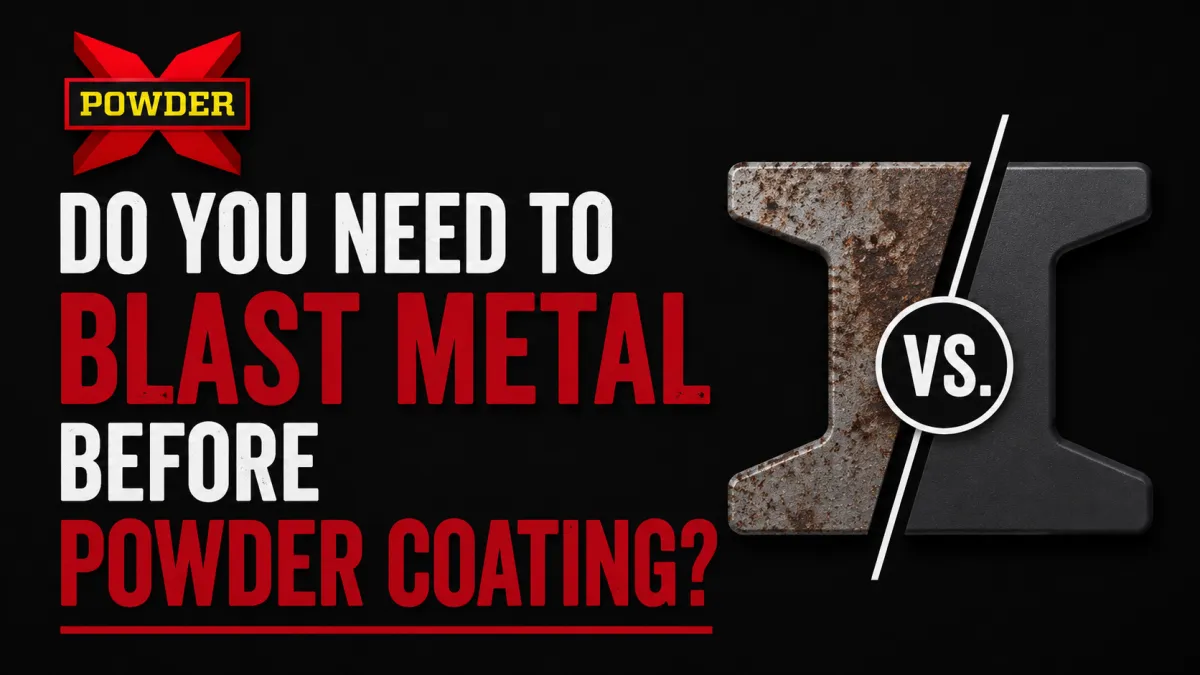
Do You Need to Blast Metal Before Powder Coating?
One of the most common pieces of advice in powder coating is also one of the most misunderstood:
“You have to blast every part before you powder coat it.”
No, you don’t.
Blasting can be an important part of surface preparation, but it isn’t automatically required for every piece of metal that goes through your shop. In fact, blasting a part that doesn’t need it can add labor, cost, and another opportunity to create problems.
The better question isn’t, “Do I need to blast this?”
It’s:
“What does this metal need before I coat it?”
That distinction can save you a lot of unnecessary work.
What Does Blasting Actually Do?
Media blasting is a form of mechanical surface preparation. It physically removes material from the surface and creates a profile in the metal.
That makes blasting extremely useful when you need to remove things such as:
Rust
Mill scale
Old paint or failing coatings
Heavy surface contamination
Certain physical imperfections
But here’s the important part: not every part has those problems.
Powder-X teaches surface preparation as two different categories: mechanical preparation and chemical pretreatment. Some parts require both. Others may only require proper chemical pretreatment.
That’s why “blast everything” is too simple of an answer.
When Should You Blast Before Powder Coating?
If the substrate has something on it that prevents you from getting to a clean, stable surface, mechanical preparation may be necessary.
Rust is a good example. Rust needs to be removed before coating.
Mill scale is another. You can apply powder over mill scale and get the powder to stick—but your powder is only attached as securely as the mill scale underneath it. If that mill scale releases from the steel, your beautiful powder coating is coming with it.
The same principle applies to an old, failing coating.
Think of it like installing a new floor over rotten subflooring. The new floor might look fantastic when you're finished, but you haven't fixed the foundation.
You're only as good as what you're coating over.
That is where blasting earns its keep.
Does New Metal Need to Be Blasted?
Not necessarily.
This is where a lot of powder coaters spend money and labor they may not need to spend.
Imagine you're coating new fabricated steel parts. There is no rust. There is no mill scale. There is no old coating. There are only light manufacturing oils and normal surface contamination.
Do you automatically need to blast every one of those parts?
No.
A properly designed chemical pretreatment process can clean the surface and provide the etching and conversion coating needed for the finishing process. That's how manufacturers coat enormous volumes of parts without individually blasting every component.
The goal isn't to blast the metal.
The goal is to properly prepare the metal.
Those are not always the same thing.
Be Careful Blasting Oily Parts
There is another reason you shouldn't automatically send every part into the blast cabinet.
Let's say a new metal part has oil on its surface.
You blast it.
Where did the oil go?
You may have driven contamination into the surface instead of properly removing it. Then you put that part into a curing oven and heat it.
Now that contamination can come back out and create finish problems.
That's why the condition of the substrate needs to determine the process—not a blanket rule that every part gets blasted.
Blasting Does NOT Replace Chemical Pretreatment
This may be the most important point in this entire article.
Blasting and chemical pretreatment do different jobs.
Blasting can remove rust, mill scale, old coatings and other unwanted material while creating a mechanical profile.
What blasting does not provide by itself is the chemical conversion layer used to improve corrosion protection.
And corrosion protection matters because coating failures frequently begin underneath the coating—not on top of it.
A properly selected chemical pretreatment can remove light oils, prepare the substrate and establish a conversion coating between the metal and the powder. That layer helps improve the coating system's resistance to corrosion.
So if you blast a part and think, “It's clean bare metal. I'm ready to powder coat,” you may be skipping an important part of the process.
Mechanical preparation isn't automatically chemical pretreatment.
When Blasting and Chemical Pretreatment Work Together
For a part that requires blasting, the process generally looks more like this:
Mechanical preparation → Chemical pretreatment → Drying → Powder application → Cure
For example, imagine you're coating a rusty steel component.
Blasting removes the rust and unstable material. Chemical pretreatment then prepares the newly exposed substrate and provides the appropriate conversion coating. Once the part is properly rinsed and completely dry, you're ready to move into powder application.
That's a complete process.
Blasting alone is only one step.
What About Used or Refurbished Parts?
Used parts deserve additional attention because you don't always know their history.
Oil, grease and other contaminants can become trapped in or below the surface. Castings can present similar problems due to trapped contaminants and manufacturing residues.
In those situations, a prebake or outgassing step may be appropriate.
But order matters.
If you're trying to drive hidden contamination to the surface, do that before your final cleaning and pretreatment so you can remove what comes out. Baking after cleaning only to bring contamination back to the surface defeats the purpose.
A Simple Way to Decide Whether to Blast
Before automatically blasting a part, inspect the substrate.
Does it have rust, mill scale, an existing coating, weld spatter, heavy grime, or another physical condition that needs to be removed?
If yes, mechanical preparation may be necessary.
If you're dealing with clean new metal and light oils, a properly designed chemical pretreatment process may be all that's required.
And if you're coating to a customer specification, corrosion requirement, or recognized finishing standard, that specification takes priority.
This isn't about doing less prep.
It's about doing the right prep.
Surface Preparation Is Where Good Powder Coating Starts
You can have an expensive powder gun, a beautiful booth and a perfectly sized curing oven. None of that can rescue a coating system built on a bad foundation.
At Powder-X, we look at a properly finished part through three basic requirements:
Appearance. Adhesion. Corrosion protection.
Surface preparation has a direct impact on all three.
That is why blindly following a rule like “blast everything” misses the bigger picture.
Sometimes blasting is absolutely necessary.
Sometimes it isn't necessary at all.
The professional approach is understanding why you're performing each step.
So, Do You Need to Blast Metal Before Powder Coating?
Not always.
Blast when the condition of the substrate requires mechanical preparation—such as removing rust, mill scale, old coatings or other physical surface problems.
But don't confuse blasting with the entire pretreatment process.
The objective isn't to blast every part. The objective is to create the right foundation for the coating you're asking to perform.
Get the foundation right, and everything that follows gets easier.
That's one of the principles behind Powder-X training: understanding the complete powder coating process instead of memorizing steps without understanding why you're doing them. Powder-X has been providing powder coating equipment and training since its founding by Joey Golliver in 2000.
Ready To Give Your Powder Coating Business The Head Start It Deserves?
Whether you are just starting out in the world of powder coating, or a seasoned professional looking to expand your system, Powder-X can help you build and choose a system that will reach and exceed your goals.
From ovens and booths to complete systems, training, technical support, and long-term guidance, our team is ready to help you make a smart investment in equipment made to perform.
Contact Powder-X today to speak with one of our experts and start building a powder coating operation with confidence.


