Should You Bring Powder Coating In-House? ROI Guide
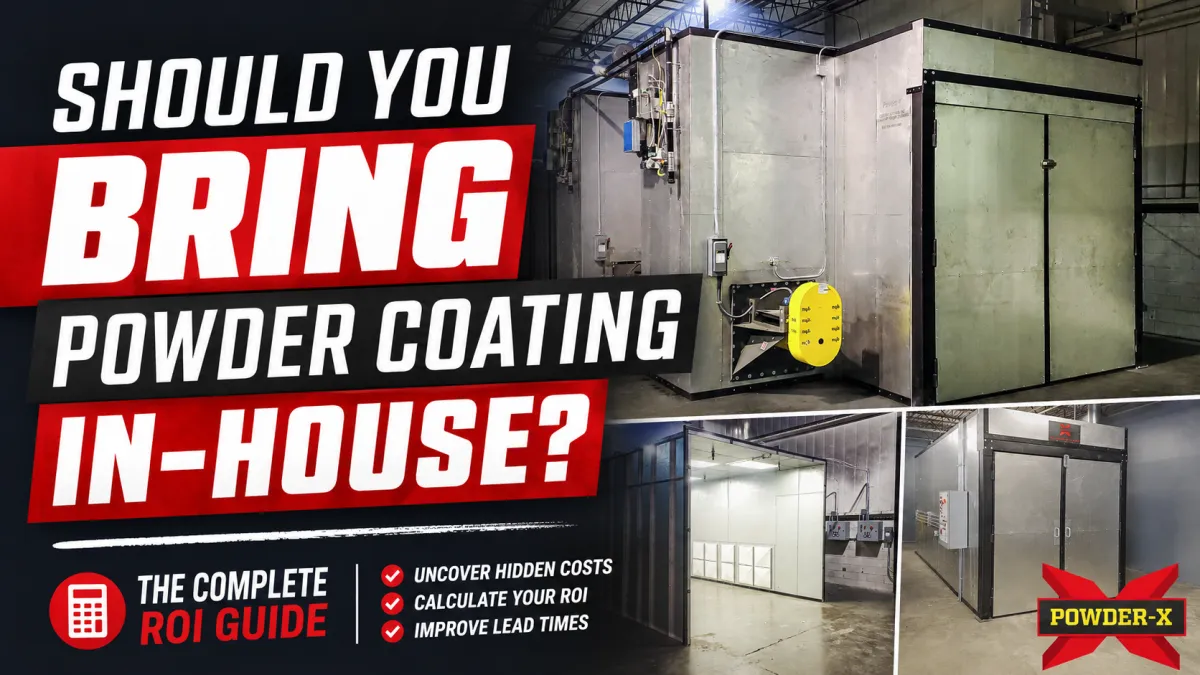
Should You Bring Powder Coating In-House? The Complete ROI Guide
If a company is regularly sending parts out for powder coating, there is one question that often gets overlooked:
What is outsourcing powder coating actually costing the business?
Not just the invoice from the coater—but the full picture.
Freight. Handling. Rush charges. Rework. Scheduling delays. Production waiting on outside lead times. And the margin paid to another company to perform a process that may eventually be done internally.
When all of that is added together, the real cost of outsourcing is often much higher than it appears on paper.
At a certain point, the question shifts from:
“Can we afford to bring powder coating in-house?”
to
“Can we afford to keep outsourcing it?”
That is where ROI becomes important.
What Bringing Powder Coating In-House Actually Means
Bringing powder coating in-house means moving the finishing process from a third-party vendor into the company’s own facility.
A complete system may include a spray booth, curing oven, application equipment, compressed air preparation, part preparation tools, material handling, and trained operators.
Some operations are best suited for a batch system. Others may eventually require semi-automated or fully automated solutions. The right setup depends entirely on production needs.
The key point is simple:
The system should be designed around the business—not the other way around.
That means understanding:
Part size and complexity
Monthly coating volume
Required finish quality
Current outsourcing cost
Production flow and scheduling impact
Only after those factors are clear does equipment selection make sense.
Why Companies Move Powder Coating In-House
Most companies do not explore in-house powder coating because they want new equipment.
They do it because outsourcing is creating business pressure.
The most common drivers are cost control, quality consistency, faster lead times, and production flexibility. At the same time, concerns usually include equipment cost, training, space, and implementation complexity.
Each of these factors plays directly into ROI.
The Real Cost of Outsourcing
The invoice from a powder coater is only part of the cost.
A more accurate view includes:
Coating fees
Freight and transportation
Packaging and handling
Rush charges
Rework and scrap
Internal time managing vendors
Production delays caused by outside scheduling
Individually, these may seem small. Combined, they can significantly change the financial picture.
In many cases, the true cost of outsourcing is not fully visible until it is calculated annually rather than per job.
A Simple ROI Example
Consider a company spending:
$12,000 per month on powder coating
$1,500 per month on freight and related costs
That equals:
$162,000 per year in outsourcing-related expenses
This does not include delays, internal coordination time, or lost production capacity.
If an in-house system is implemented, those costs do not disappear—but they are replaced with internal operating expenses such as labor, utilities, maintenance, and consumables.
The ROI question becomes:
How much of that $162,000 can be retained after operating costs are applied?
That difference is the potential annual savings.
How to Calculate ROI
A practical approach includes four steps:
First, calculate total annual outsourcing cost using real invoices plus measurable related expenses.
Second, determine the cost of a properly designed in-house system. This is not just an oven or booth—it is a complete system built around production needs. Depending on scale, investment can vary widely.
Third, estimate annual operating costs including labor, powder, utilities, maintenance, and consumables.
Finally, compare:
Annual outsourcing cost – annual in-house operating cost = potential savings
Then:
System investment ÷ annual savings = payback period
This provides a realistic financial baseline for decision-making.
The Opportunity Cost Most Companies Miss
ROI is not only about reducing cost.
It is also about what becomes possible when finishing is no longer outsourced.
In-house powder coating can allow:
Shorter lead times
Faster quoting and delivery
More control over production schedules
Ability to accept rush work
Increased production flexibility
Potential for new revenue streams
These benefits do not always appear in spreadsheets, but they often have a direct impact on growth and competitiveness.
Quality Control and Consistency
Powder coating performance depends on more than application alone. Preparation, grounding, air quality, curing, and process control all affect the final result.
When coating is outsourced, quality control is external. When it is in-house, it becomes part of the company’s own process.
This allows for:
More consistent finishes
Faster issue identification
Direct process control
Reduced back-and-forth on defects
However, this also increases the importance of proper training and process discipline.
Common Concerns
“We don’t know how to powder coat.”
That is expected. Equipment alone does not create capability. Training and process development are part of the investment.
“We don’t have space.”
Space requirements depend on system design. This is why planning must come before purchasing.
“The equipment is too expensive.”
The real comparison is not equipment cost versus zero. It is equipment cost versus current annual outsourcing spend and lost efficiency.
When In-House Powder Coating Makes Sense
In-house systems are typically worth evaluating when:
Outsourcing costs are consistent and significant
Lead times are affecting production
Quality issues are recurring
Rush work is common
Production volume is stable enough to support utilization
Greater control over scheduling is needed
The more of these conditions that apply, the stronger the ROI case becomes.
When Outsourcing Still Makes Sense
Outsourcing may still be the better option when:
Coating volume is low or inconsistent
Parts are highly specialized or oversized
Current vendor performance is strong
Facility limitations prevent installation
Internal staffing is not available for operation
In these cases, outsourcing remains the more efficient choice.
Batch vs. Automated Systems
Lower-volume or variable production often fits batch systems best. Higher-volume, repeatable production may justify semi-automated or fully automated systems.
Automation should only be considered when it solves a measurable production need—not simply as an upgrade.
Final Perspective
The decision to bring powder coating in-house is not about equipment. It is about financial structure, production control, and long-term efficiency.
The key question is not:
“What does the system cost?”
It is:
“What is outsourcing costing the business over time?”
For some companies, outsourcing will remain the right choice. For others, it becomes a hidden cost center that limits growth and control.
The difference comes down to one thing:
The numbers.
Next Step
Powder-X Coating Systems helps manufacturers evaluate whether in-house powder coating makes financial and operational sense based on real production data, not assumptions.
The goal is simple:
Build the system around the business—not the other way around.
Ready To Build A Powder Coating System The Right Way?
Whether you are starting your first powder coating business, bringing finishing in-house, or upgrading an existing operation, Powder-X can help you choose a batch system built around your goals.
From ovens and booths to complete systems, training, technical support, and long-term guidance, our team is here to help you make a smart investment in equipment that is designed to perform.
Contact Powder-X today to speak with one of our coating specialists and start building a powder coating operation with confidence.


