Can You Over-Cure Powder Coating? Signs & Fixes | Powder-X
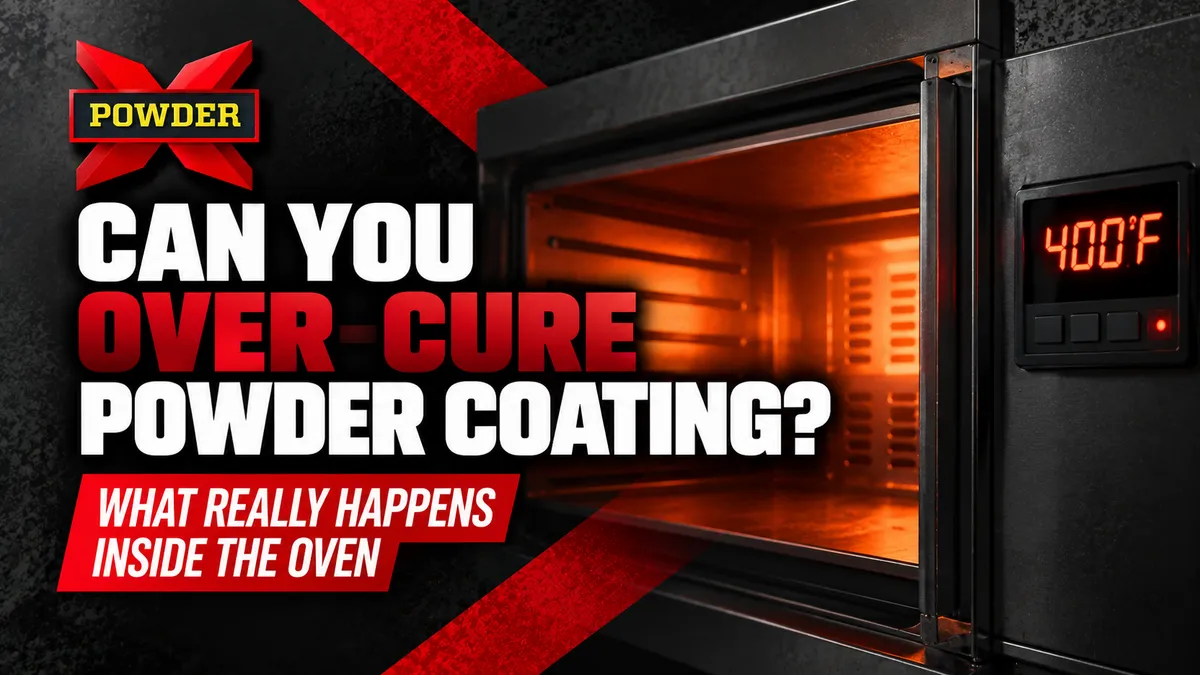
Can You Over-Cure Powder Coating? What Really Happens Inside the Oven
When it comes to curing powder coating, there's a common assumption that leaving a part in the oven a little longer won't hurt anything.
After all, if the powder needs heat to cure, wouldn't more heat or more time make the finish even stronger?
Not necessarily.
Yes, powder coating can be over-cured. And depending on the powder formulation, excessive heat or prolonged exposure can affect the finish's appearance and performance.
At Powder-X, proper curing is one of the fundamentals of a reliable coating process. The goal isn't to leave parts in the oven as long as possible. It's to give the coating the correct amount of heat for the correct amount of time.
What Actually Happens When Powder Coating Cures?
Powder coating doesn't simply dry like conventional paint.
When a typical thermosetting powder enters the oven, heat causes the powder particles to melt, flow together and form a continuous film.
As the part continues heating, a chemical reaction called crosslinking takes place.
Think of crosslinking as the coating building a network of connections that gives the finished film its intended properties.
When the powder reaches its specified cure conditions, that process develops the coating's required performance.
But here's the important part:
The oven temperature and the temperature of the metal are not the same thing.
A part sitting inside a 400°F oven doesn't instantly reach 400°F. The metal needs time to heat, and heavier parts generally take longer than thin ones.
That's why proper curing depends on part-metal temperature and the powder manufacturer's cure schedule.
Can Powder Coating Stay in the Oven Too Long?
Yes.
Powder coatings are formulated to perform within specified curing conditions. Some have a relatively forgiving cure window, while others are more sensitive to excessive heat exposure.
Leaving a part in the oven longer than necessary doesn't automatically mean the coating will fail.
But prolonged exposure to high temperatures can eventually cause changes in appearance or performance.
The exact result depends on the powder chemistry, temperature and total time exposed to heat.
More cure isn't automatically better cure.
1. Color Changes and Yellowing
One of the more noticeable signs of excessive heat exposure is discoloration.
White and light-colored powders may develop a yellow or cream-colored appearance when exposed to excessive curing temperatures or prolonged heating.
Other colors may shift in shade or lose some of their original appearance.
This doesn't happen to every powder at the same temperature or exposure time.
Different formulations have different levels of heat stability.
How to prevent it: Follow the powder manufacturer's Technical Data Sheet (TDS) and verify actual part-metal temperature rather than relying only on the oven's display.
2. Changes in Gloss
Over-curing can also affect the coating's gloss.
A finish designed to be glossy may lose some of its shine after excessive heat exposure. Other formulations may experience different appearance changes.
This can be especially frustrating when parts from the same job come out looking slightly different.
If one batch spends significantly longer in the oven than another, curing conditions deserve attention.
How to prevent it: Establish a consistent cure process and avoid unnecessary differences in oven dwell time between comparable loads.
3. Reduced Coating Performance
One of the biggest misconceptions about curing is that additional oven time always improves durability.
It doesn't.
Once a thermosetting coating has reached its intended cure, excessive thermal exposure can eventually contribute to chemical degradation.
Depending on the formulation and severity of exposure, that may affect flexibility, impact resistance or other coating properties.
However, a slightly longer cure doesn't automatically create a brittle coating. The consequences depend on the powder's chemistry and its allowable cure window.
How to prevent it: Use the manufacturer's specified cure conditions and verify performance when changing oven settings or processing unusually heavy parts.
4. Uneven Results Between Different Parts
Imagine an oven loaded with both thin sheet-metal brackets and thick fabricated steel components.
The thin parts may reach the required cure temperature much sooner than the heavy ones.
If the oven cycle is designed only around the thickest component, the lighter parts may experience significantly more time at elevated temperature.
That doesn't necessarily mean they're damaged, but it does create different thermal histories.
This is one reason Powder-X emphasizes understanding part weight, load configuration and production requirements when selecting curing equipment.
How to prevent it: When practical, group parts with similar heating characteristics. For mixed loads, verify that every part receives an acceptable cure without exposing other parts beyond their allowable limits.
How Do You Know if Powder Coating Is Over-Cured?
Appearance can provide clues, but it doesn't tell the whole story.
Yellowing, unexpected color shifts or gloss changes may suggest excessive heat exposure.
However, similar defects can also result from contamination, powder variation or other process problems.
A part can also look acceptable even when its curing history wasn't properly controlled.
The most reliable starting point is to compare the actual cure conditions against the powder manufacturer's specifications.
That means understanding both the temperature the part reached and how long it remained at that temperature.
Where required, appropriate quality-control testing can help confirm that the finished coating meets its performance specifications.
How to Prevent Over-Curing
Preventing over-curing starts with understanding the powder's cure schedule.
For example, a TDS might specify a cure of 10 minutes at 400°F part-metal temperature.
That doesn't mean the part should spend only 10 minutes inside an oven set to 400°F.
It means the coating needs the specified thermal exposure after the part reaches the required temperature.
The full oven cycle also includes the time needed to heat the part.
A temperature probe or oven profiling system can help determine when the metal actually reaches the specified temperature.
For consistent production, Powder-X recommends establishing and documenting appropriate cure cycles for the parts being coated.
That includes accounting for part thickness, material, racking, load density and oven performance.
The goal is a verified cure—not a guessed oven timer.
What If a Part Has Already Been Over-Cured?
First, determine whether the coating was actually exposed beyond the manufacturer's acceptable cure conditions.
A part that spent a few extra minutes in the oven isn't automatically ruined.
If the coating shows discoloration, gloss changes or other unusual characteristics, compare it against an approved sample and the customer's requirements.
For critical applications, appropriate testing may be necessary to determine whether the coating still meets its specifications.
If the finish no longer meets appearance or performance requirements, stripping and recoating may be necessary.
Simply applying another layer of powder won't automatically correct a coating that has been damaged by excessive heat.
The Powder-X Takeaway
Powder coating needs heat to develop its intended properties, but more heat doesn't always produce a better finish.
Excessive curing can cause discoloration, gloss changes and, under sufficiently severe conditions, reduced coating performance.
The solution is to understand the powder manufacturer's cure schedule and verify what's actually happening to the metal inside the oven.
Use the right temperature. Allow the correct cure time. Account for part weight and oven performance.
And don't assume that leaving a part in the oven longer is always safer.
A properly cured finish isn't the one that spent the most time in the oven. It's the one that received the correct cure.
Ready To Build A Powder Coating System The Right Way?
Whether you are starting your first powder coating business, bringing finishing in-house, or upgrading an existing operation, Powder-X can help you choose a batch system built around your goals.
From ovens and booths to complete systems, training, technical support, and long-term guidance, our team is here to help you make a smart investment in equipment that is designed to perform.
Contact Powder-X today to speak with one of our coating specialists and start building a powder coating operation with confidence


