
The Hidden Cost of Powder Coating Rework—and How to Calculate It | Powder-X
The Hidden Cost of Rework in Powder Coating—and How to Calculate It
A bad powder coating job doesn't cost you once.
It can cost you two, three or four times before the part finally leaves the building.
The first coating used powder, labor, pretreatment, compressed air and oven energy. Then somebody finds the defect. Now the part may need to be stripped or blasted, prepared again, recoated, cured again and inspected again.
Meanwhile, the original production schedule keeps moving.
That's why Powder-X teaches that saving a few minutes or a few dollars during the process can turn into hours of rework later.
The visible defect is only part of the problem.
The real cost of rework is everything you have to do twice—plus everything you couldn't do while fixing it.
What Does “Rework” Mean in Powder Coating?
Rework is any additional work required because a part didn't meet the expected finish or performance requirements the first time.
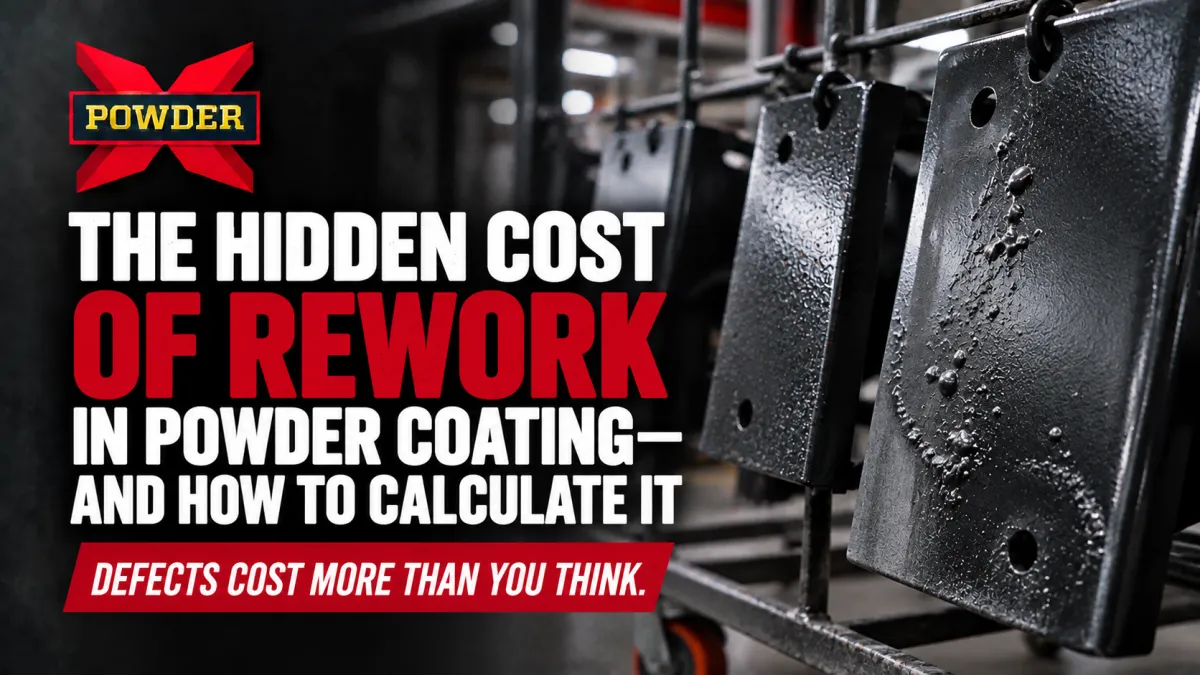
Maybe the coating is peeling. Maybe there are pinholes, fisheyes or excessive orange peel. Maybe coverage is poor in a Faraday area. The color could be wrong. Film thickness could be outside specification. The part may not have been properly cured.
Sometimes the repair is relatively simple.
Other times, you're practically starting over.
The part may need to be stripped back to the substrate, cleaned, pretreated, dried, recoated and cured again.
That's why a $20 mistake rarely costs $20.
The First Hidden Cost Is Labor
Labor is usually where rework becomes expensive quickly.
Suppose a batch fails inspection and requires two additional employee-hours to correct.
Don't calculate that using only the employee's hourly wage.
The business also carries payroll-related costs and overhead, and those employees could have been producing another paying job during those two hours.
If three employees are involved in correcting the problem, the cost grows even faster.
Rework turns productive labor into recovery labor.
The employee is still working.
The business just isn't getting paid a second time for that work.
Then You're Buying the Materials Again
Powder used on a rejected finish has already been consumed.
If the part has to be recoated, you're buying that portion of the coating process again.
Depending on the failure, you may also consume additional pretreatment chemicals, blasting media, masking materials, plugs, stripping chemicals and packaging.
Powder-X training emphasizes controlling coating thickness and application because applying too little can compromise performance while excessive film build can contribute to finish problems such as orange peel.
A little extra powder may not look expensive.
Multiply unnecessary powder consumption across hundreds or thousands of parts, and it becomes real money.
Your Equipment Has to Process the Part Again
Now the part goes back through equipment that already processed it once.
The compressor runs again.
The booth is occupied again.
The oven heats and cures the part again.
Hooks and racks are used again.
Depending on the failure, blasting or stripping equipment may also be involved.
Those machines have operating costs.
More importantly, they have limited capacity.
An oven filled with rework isn't available for the next profitable batch.
That leads to one of the largest hidden costs of all.
Rework Steals Production Capacity
Imagine an oven can process eight production loads during a shift.
Two of today's loads are correcting yesterday's mistakes.
The oven is still busy all day, but only six loads are generating new production.
From the outside, the shop looks busy.
Financially, something very different is happening.
This is opportunity cost: equipment, labor and floor space are being consumed correcting previous work instead of producing new revenue.
For a busy operation, that lost capacity can cost more than the powder that was wasted.
Rework doesn't just increase cost. It can reduce how much money the shop is capable of making.
Rework Can Create a Bottleneck
This connects directly with shop flow.
A rejected batch doesn't politely wait until production slows down.
It gets inserted back into the process.
Now parts may return to stripping or blasting. They need another place in the pretreatment schedule. They return to the booth. They need oven capacity again.
Meanwhile, the next customer's parts are still coming.
Suddenly, racks are waiting. Delivery schedules tighten. Overtime becomes necessary.
One quality problem has now affected jobs that had nothing to do with the original defect.
That's why quality and throughput aren't separate conversations.
Poor quality creates production problems.
Don't Forget the Cost of Stripping
Some powder coating failures can't simply be coated over.
The existing coating may need to be removed before the part can be processed correctly again.
That can add chemical stripping, blasting, additional handling and significant labor.
And after the coating is removed?
You're back at the beginning.
The part still needs to be properly prepared and coated.
This is exactly why Powder-X puts so much emphasis on getting preparation, application and cure correct the first time.
Doing the process correctly can look slower right up until the shortcut creates a failure.
Then it becomes painfully obvious which method was actually faster.
Customer Costs Are Harder to See
Not every rework expense appears on an invoice.
Suppose a customer expected parts Friday.
A coating problem pushes delivery to Tuesday.
Maybe the customer understands.
But what if those parts were needed for their assembly line? What if they miss their own delivery? What if it happens again next month?
The financial impact can become larger than the cost of fixing the coating.
Powder-X's business analysis identifies quality control and lead-time reduction as important reasons manufacturers evaluate their finishing processes.
Customers aren't simply buying a coated part.
They're buying confidence that the part will be finished correctly when they need it.
How to Calculate the Real Cost of Powder Coating Rework
The calculation doesn't need to be complicated.
Start with:
Replacement Materials + Rework Labor + Equipment/Utility Cost + Stripping/Prep Cost + Scrap + Additional Handling + Lost Production Value = True Rework Cost
For example, imagine a failed batch creates:
$150 in additional powder and supplies
$300 in labor
$100 in stripping and preparation
$75 in additional equipment and energy cost
$125 in extra handling, inspection and packaging
The obvious rework cost is already $750.
But suppose fixing that batch also consumes production capacity that could have generated $1,000 in contribution toward overhead and profit.
Now the economic impact could be closer to $1,750.
That's why simply tracking wasted powder doesn't tell the whole story.
Calculate Your Rework Rate Too
Once rework costs are being tracked, calculate how frequently it's happening.
A simple starting point is:
Reworked Parts ÷ Total Parts Produced × 100 = Rework Rate
If 50 out of 1,000 parts require rework:
50 ÷ 1,000 × 100 = 5% rework rate
Then calculate the financial impact.
If those 50 parts average $25 in actual rework cost:
50 × $25 = $1,250
If that happens every month:
$1,250 × 12 = $15,000 per year
And that's before adding lost production capacity if it isn't already included.
Now rework isn't an annoying shop-floor problem.
It's a number on the financial statement.
Find the Cause, Not Just the Defect
Once a shop knows what rework is costing, the next step isn't simply telling operators to "be more careful."
Find out why it's happening.
Was the metal properly prepared?
Was pretreatment controlled?
Was the compressed air clean and dry?
Was the part properly grounded?
Was film thickness correct?
Did the operator follow the powder manufacturer's Technical Data Sheet?
Did the entire part reach the required part-metal temperature for the required cure time?
Powder-X training specifically points out that contaminated compressed air can cause inconsistent powder flow, adhesion problems, fisheyes and other finish defects. It also stresses proper gun setup, film thickness and adherence to the powder manufacturer's application and cure requirements.
Don't just record “part failed.”
Record why.
That's where improvement starts.
Track Rework Like a Business Metric
A simple rework log can become one of the most useful tools in the shop.
Track the job, part, defect, suspected cause, number of affected parts, corrective action, labor hours and estimated cost.
After a few months, patterns may become obvious.
Maybe most failures happen with one substrate.
Maybe one color consistently creates trouble.
Maybe contamination appears after a particular maintenance issue.
Maybe undercure shows up on the heaviest parts.
Maybe a particular rack isn't providing reliable ground.
Without data, every failure feels like a separate problem.
With data, the shop can start identifying the process that's creating the failures.
The Cheapest Rework Is the Rework You Never Create
Speed matters in powder coating.
But speed without process control can become expensive.
Powder-X's training makes the point plainly: cutting a few minutes or a few dollars can result in hours of rework, while the coater focused on quality ultimately has the better opportunity to make money.
That doesn't mean slowing everything down.
It means getting the important things right.
Proper preparation. Clean, dry air. Good grounding. Correct application. Correct film thickness. Proper cure. Inspection. Training.
The fastest part through the shop is the one you only have to coat once.
The Powder-X Takeaway
Rework shouldn't be treated as an unavoidable pile of parts sitting in the corner.
Put a number on it.
Track the additional labor. Track the powder and supplies. Track stripping and preparation. Track equipment time. Track scrap. And when capacity is tight, pay attention to the profitable production displaced by those failures.
Once the true cost becomes visible, investing in better processes, equipment maintenance and operator training starts looking very different.
Because a quality problem isn't only a finish problem.
It's a profitability problem.
Ready To Build A Powder Coating System The Right Way?
Whether you are starting your first powder coating business, bringing finishing in-house, or upgrading an existing operation, Powder-X can help you choose a batch system built around your goals.
From ovens and booths to complete systems, training, technical support, and long-term guidance, our team is here to help you make a smart investment in equipment that is designed to perform.
Contact Powder-X today to speak with one of our coating specialists and start building a powder coating operation with confidence.


