
Faraday Cage Effect in Powder Coating: Causes & Fixes | Powder-X
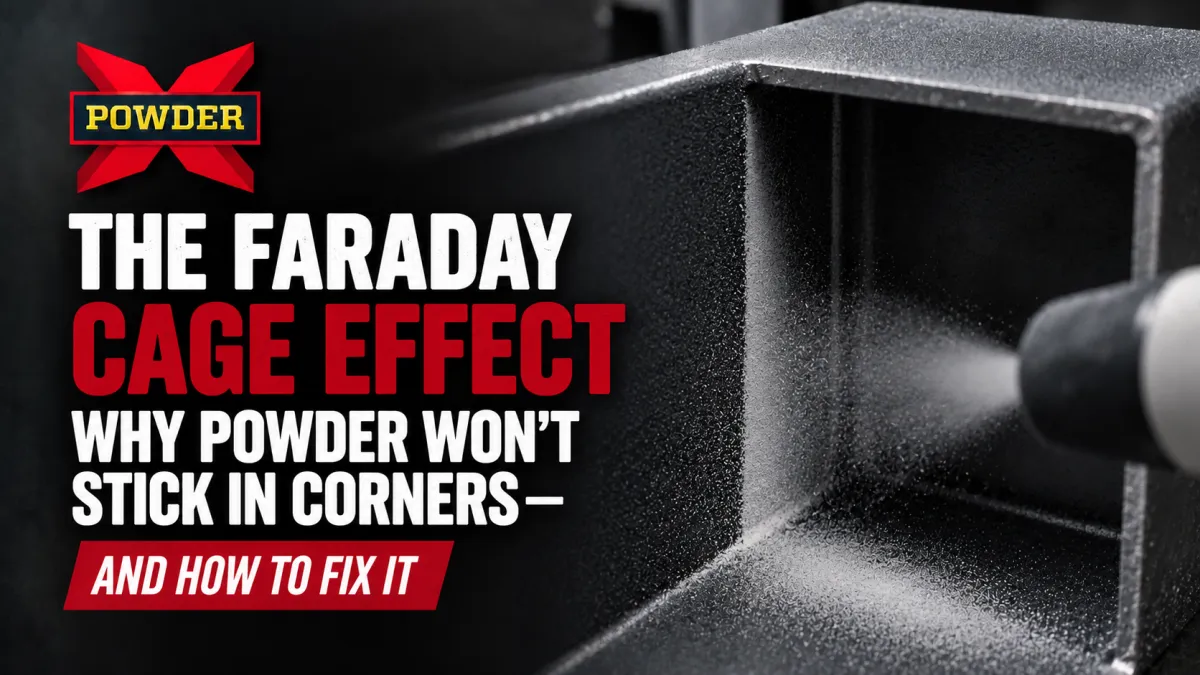
The Faraday Cage Effect: Why Powder Won’t Stick in Corners—and How to Fix It
If you've spent much time behind a powder gun, you've probably experienced this one.
The flat surfaces look great. The outside edges have plenty of powder. But inside a corner, channel or deep recess?
The powder acts like it wants absolutely nothing to do with it.
At Powder-X, we call those difficult areas Faraday areas, and understanding why they happen can save you from piling on more powder, wasting time and still ending up with thin coverage where you need it most.
The good news is that Faraday Cage problems usually aren't solved by simply spraying more.
They're solved by spraying smarter.
What Is the Faraday Cage Effect in Powder Coating?
Powder coating depends on electrostatics. The powder particles receive an electrical charge from the application equipment and are attracted to the grounded metal part.
On a large, relatively flat surface, that process can work beautifully.
Things become more complicated when you're trying to coat the inside of a box, a tight internal corner, a channel or another recessed area.
The charged powder tends to be attracted toward the closer edges and surfaces surrounding the recess instead of traveling all the way into the deepest area. That's the Faraday Cage effect. Our Powder Coach's Playbook describes these areas as inside corners or tight spaces between pieces of metal where charged powder has difficulty penetrating.
Think of it like trying to throw a ball through a doorway while magnets around the doorframe are pulling the ball sideways.
The powder wants the grounded metal. It just isn't necessarily going where you want it to go.
Why Simply Turning Up the kV Can Make It Worse
This is one of the most common mistakes we see.
The corner isn't coating, so the operator thinks:
"I need more electrostatic power."
Then they turn the voltage up.
That can actually make penetration more difficult.
Higher voltage can strengthen the electrostatic field around the edges of the recess, encouraging charged particles to deposit there instead of traveling deeper into the corner. Powder-equipment troubleshooting guidance similarly identifies excessive voltage as one possible cause of poor Faraday-area penetration and recommends reducing voltage or adjusting current control for difficult recesses.
That doesn't mean there's one magic kV setting for every Faraday area.
There isn't.
Part geometry, gun technology, powder, distance, airflow and current all affect the result.
More voltage isn't automatically more coating.
Sometimes the answer is less.
Start With Grounding
Before changing every setting on the gun, check the ground.
Powder-X teaches this over and over because grounding is one of the most important—and most commonly overlooked—parts of electrostatic powder application.
The part needs a reliable electrical path to ground. Dirty hooks, powder buildup, grease and other insulating material can interfere with that path. Our training material specifically emphasizes good grounding for improved wrap and penetration into Faraday areas. Equipment manufacturers likewise identify poor workpiece grounding as a cause of poor penetration into recesses and corners.
So before blaming the powder or the gun, inspect the basics.
A sophisticated powder gun can't compensate for a part that isn't properly grounded.
Coat the Difficult Areas First
Here's one of the simplest Powder-X techniques:
Coat the corners first.
Don't completely build film thickness on all the easy surfaces and then go back hunting for the difficult recesses.
Our training recommends attacking Faraday areas early in the application process.
Get powder into the corners, channels and recessed areas first. Then move onto the easier surfaces.
It's a small change in sequence that can make a surprisingly large difference.
Watch Your Powder Velocity
Electrostatics aren't the only force involved.
You're also moving powder with air.
Too much air can create turbulence and physically blow powder back out of the exact corner you're trying to coat. Too little delivery, on the other hand, may not provide enough powder movement to reach the recess effectively.
That's why the answer isn't simply "turn the air down."
The goal is controlled powder delivery.
Powder-X teaches operators to experiment with bumping the trigger rather than continuously holding it in some difficult corners. This can reduce the amount of air entering the area and help prevent the gun from blowing deposited powder back out.
Industry troubleshooting guidance makes the same broader point: powder velocity that's either too high or too low can hurt recess penetration.
You want enough momentum to reach the area without creating a miniature windstorm inside it.
Gun Position and Distance Matter
Sometimes there's nothing wrong with your equipment settings.
You're simply attacking the corner from the wrong position.
Pay attention to the gun-to-part distance and angle. Move deliberately around complex geometry rather than expecting one spray position to coat every surface.
Our Powder-X material specifically calls out incorrect gun-to-part distance, poor spray pattern and worn or clogged gun components as factors that can compound Faraday problems.
Don't rush the difficult areas.
Let the gun work with the geometry instead of fighting against it.
Try a Different Spray Pattern
The nozzle and spray pattern that work beautifully on a large flat panel may not be ideal for a deep channel.
Different nozzle configurations change the shape and behavior of the powder cloud. Manufacturer troubleshooting guidance recommends evaluating nozzle selection and spray pattern when dealing with poor penetration, including more focused or conical patterns for certain recessed applications.
This is another reason experienced operators don't treat gun settings as permanent.
The correct setup depends on the part in front of you.
Don't Ignore the Powder Itself
Powder condition can make an already difficult Faraday area even harder.
Our Powder-X training notes that excessively fine reclaimed powder may not charge as effectively and recommends paying attention to the balance between virgin and reclaimed material, while confirming the appropriate mixture with the powder supplier.
That means if a process suddenly starts struggling with corners it previously coated successfully, don't automatically assume somebody changed the gun settings.
Look at the entire process.
Powder condition, reclaim mixture, equipment wear, grounding and environmental conditions may all deserve investigation.
What About Hot Flocking?
You'll sometimes hear people recommend heating the part before applying powder to difficult areas.
Powder-X approaches this very cautiously.
Preheating can make powder melt or adhere as it contacts the hot substrate, which may help in exceptionally difficult areas. But it also makes film thickness considerably harder to control and introduces the possibility of heavy buildup, runs and other problems.
Our training specifically recommends coating at ambient temperature as the normal process and warns against using hot flocking as a substitute for proper application technique—particularly across entire parts or with clear and translucent finishes.
If your solution to every Faraday problem is heating the part first, you're probably treating the symptom instead of improving the process.
Modern Equipment Can Help—But Technique Still Matters
Powder application technology continues to improve.
Modern systems can offer more precise voltage and current control, softer powder delivery and better independent control of powder output and air. Dense-phase systems, for example, use higher powder concentration with lower air velocity, which can improve coverage on complex shapes and recesses in appropriate applications.
That's valuable technology.
But equipment doesn't eliminate the need to understand what you're coating.
A good operator still needs to recognize a Faraday area, establish good ground, choose appropriate settings, position the gun correctly and adjust technique to the geometry.
Better equipment gives you more control. Knowledge tells you what to do with it.
A Simple Faraday Cage Troubleshooting Order
When powder won't penetrate a corner or recess, don't randomly change five settings at once. Work through the problem logically:
Check the ground. Make sure the part has a clean, reliable path to ground.
Attack the Faraday areas first. Don't leave the hardest geometry until the end.
Evaluate voltage and current. Higher isn't always better.
Watch powder velocity. Too much air can blow powder out; too little can limit penetration.
Check gun distance, angle and spray pattern. Give the powder a realistic path into the recess.
Inspect the equipment and powder. Check tips, nozzles, clogs, wear and powder condition.
Change one variable at a time. Otherwise, you won't know what actually fixed the problem.
That last one matters.
Troubleshooting should be a process, not a guessing contest.
The Powder-X Takeaway
Faraday Cage areas aren't proof that your powder won't stick.
They're proof that electrostatics behave differently around complicated geometry.
Once you understand that, the problem becomes much easier to approach.
Check your ground. Coat the difficult areas first. Control your powder velocity. Pay attention to gun position. Experiment intelligently with voltage and current. And don't assume more kV or more powder is always the answer.
As we teach in The Powder Coach's Playbook, conquering Faraday areas takes patience, observation and fine-tuning.
Don't fight the corner with more powder. Learn how to make the powder work with the corner.
Ready To Build A Powder Coating System The Right Way?
Whether you are starting your first powder coating business, bringing finishing in-house, or upgrading an existing operation, Powder-X can help you choose a batch system built around your goals.
From ovens and booths to complete systems, training, technical support, and long-term guidance, our team is here to help you make a smart investment in equipment that is designed to perform.
Contact Powder-X today to speak with one of our coating specialists and start building a powder coating operation with confidence.


