
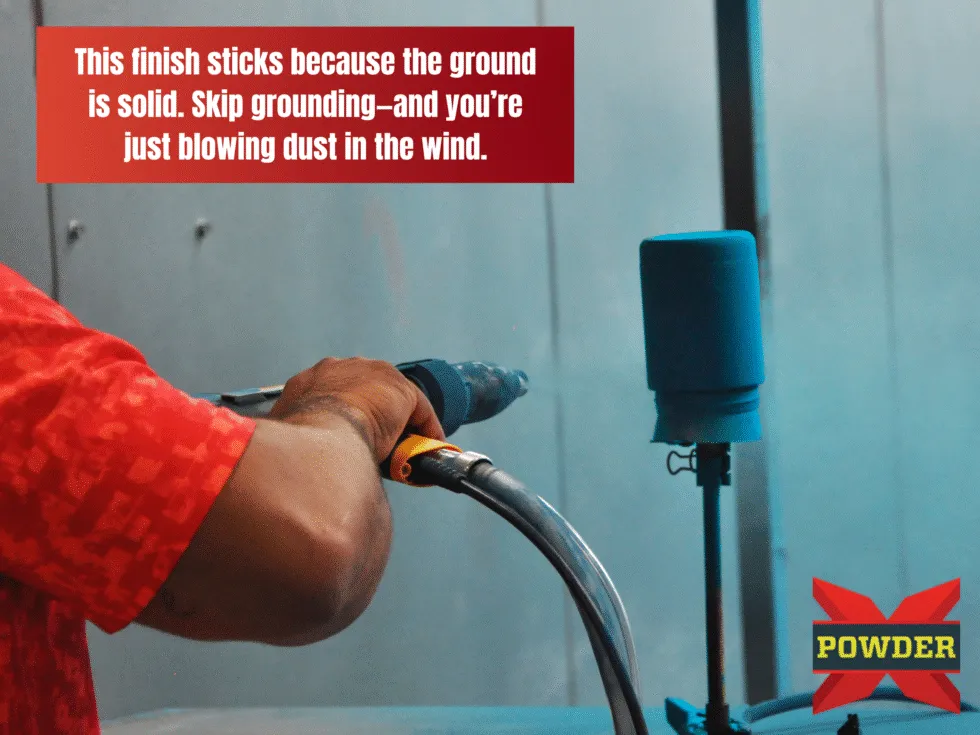
The Shocking Truth About Grounding: Why Your Coating Isn’t Sticking
You can have the best powder, the cleanest part, and the flashiest spray gun on the market—but if your grounding for powder coating is off, your powder is going to fail.
I’ve seen it a thousand times. Grounding for powder coating is crucial, especially to ensure proper bonding.
Shoddy grounding leads to inconsistent coverage, adhesion failures, and costly rework. And yet, most coaters overlook it like it’s no big deal. Let me be crystal clear: grounding is not optional—it’s foundational for effective powder coating.
Let’s break it down.
Why Grounding Matters
Imagine powder coating like a magnet game. Here, effective grounding plays a critical role in powder coating success.
Your powder gun charges the particles with electricity (usually negatively), and your part needs to be the opposite pole—grounded—so the powder sticks like a glove. No ground? No attraction. The powder floats around like it’s confused at a high school dance.
This isn’t just about adhesion—poor grounding messes up film thickness, leads to orange peel texture, and even causes the dreaded Faraday cage effect where powder just won’t reach into corners.
The Real Deal on What a Good Ground Looks Like
A solid ground is low-resistance and direct. Here’s how you make that happen: It ensures successful grounding in powder coating applications.
Dedicated Grounding Rod: Copper, at least 8 feet long. Drive it as close to your booth as possible—even through concrete if you have to.
Heavy-Gauge Ground Wire: Use 14-gauge or thicker wire. Connect it directly from the rod to your rack or hooks.
Monthly Maintenance: Pour water around your ground rod monthly to keep the soil conductive. Dry ground = weak ground.
Joey Tip: I’ve personally seen shops double their transfer efficiency just by fixing their ground. That’s real money, folks, thanks largely to proper grounding for powder coating.
Avoiding the Most Common Mistakes
Let’s clear up a few myths and screw-ups:
Myth #1: “One ground wire is enough.” Not for large or irregular parts. Use multiple grounding points.
Myth #2: “The hook makes contact, so we’re good.” Not if the hook has powder build-up. Clean your hooks daily.
Myth #3: “We grounded through the oven rack.” Nope. That might work for light jobs, but it won’t cut it long-term.
Testing Your Ground (Yes, You Should)
Use a multimeter or grounding tester to check resistance. You’re aiming for under 1 ohm. Anything above that? Your grounding is failing, affecting powder coating efficiency and cash flow.
Final Thoughts: Ground Like a Pro
Grounding isn’t sexy. It doesn’t get headlines or Instagram likes. However, the importance of grounding in powder coating cannot be understated.
But it’s the difference between a finish that flakes off in six months and one that lasts for years.
Remember, we’re not here to just coat parts—we’re here to build businesses that last. If you treat grounding like an afterthought, your bottom line will suffer. If you master it, you’ve just gained a competitive edge 90% of your competitors are ignoring.
“It’s better the powder sticks to the part than to you.” – Joey Golliver
#PowderX #PowderMarket #JoeyGolliver #PowderCoachsPlaybook


