When to Upgrade Hobby Powder Coating Equipment | Powder-X
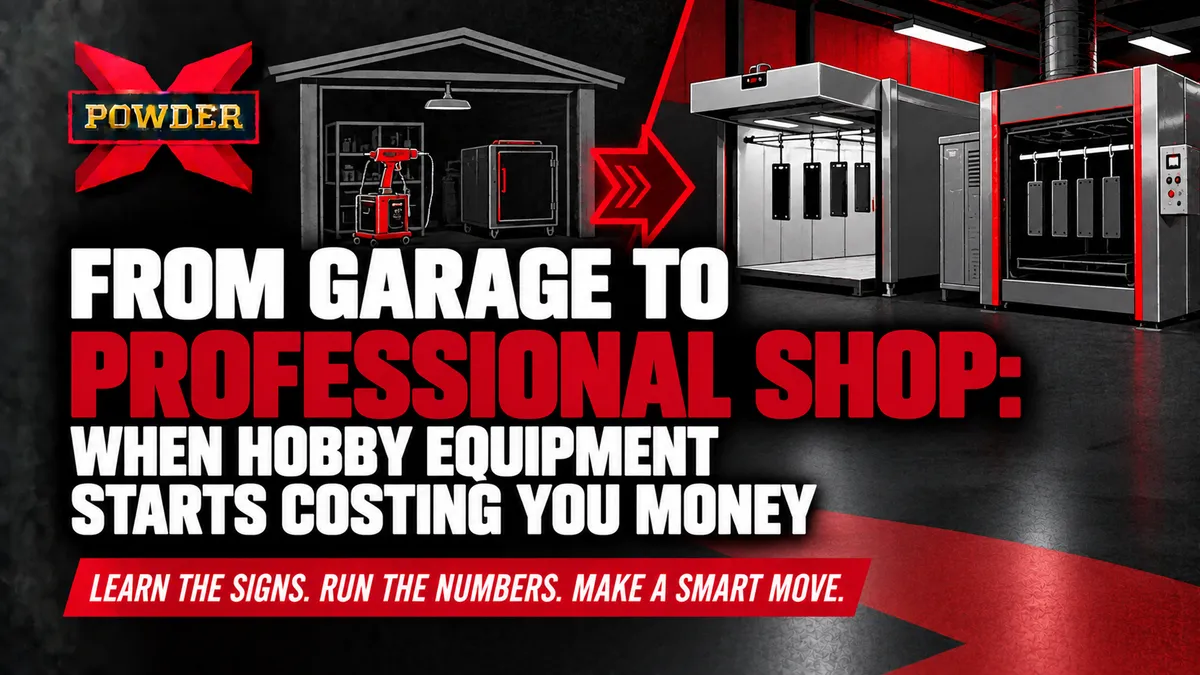
From Garage to Professional Shop: When Hobby Equipment Starts Costing You Money
Every powder coating business has to start somewhere.
For many entrepreneurs, that means a garage, a small powder gun, a basic oven, and a handful of customers willing to give them a chance.
And there's nothing wrong with that.
Hobby equipment can be a great way to learn the process, develop skills, and find out whether there's a real market for powder coating services.
But eventually, a growing business reaches a point where the equipment that helped it get started begins holding it back.
Jobs take longer than they should. Larger parts have to be turned away. Production becomes inconsistent. Customers start asking for faster turnaround times.
At Powder-X, that's when an important question needs to be asked:
Is the equipment still saving the business money—or has it started costing the business opportunities?
Hobby Equipment Isn't the Problem. Outgrowing It Is.
A small powder coating setup can work well for learning, personal projects, and occasional customer jobs.
The challenge begins when that equipment is expected to support professional production demands.
A shop processing a few brackets on the weekend has very different needs from a business coating parts for manufacturers, fabricators, or repeat commercial customers.
Professional customers expect more than an attractive finish.
They expect consistency, dependable lead times, proper curing, and the ability to handle recurring production.
If the equipment can't reliably deliver those things, the business may be approaching its practical limits.
The equipment that gets a business started isn't always the equipment that can take it to the next level.
Sign #1: Every Job Takes Longer Than It Should
Time is one of the biggest differences between hobby coating and professional production.
A small setup may require frequent loading, unloading, repositioning, and waiting between steps.
That might not matter when coating a few personal projects.
But when customers are paying for production, every extra hour affects profitability.
Imagine a shop coating 40 small parts.
With limited equipment, those parts may require several separate oven loads. Each load involves handling, heating, curing, and unloading.
A properly sized professional batch system may be able to process the same work more efficiently, depending on the parts and equipment configuration.
The difference isn't simply convenience.
It's labor, equipment time, and the number of paying jobs the business can complete.
When the process takes too long, the shop has fewer hours available to make money.
Sign #2: The Oven Is Limiting the Jobs You Can Accept
An oven determines more than how much space a shop has for curing.
It also affects which jobs the business can realistically pursue.
A customer might need a large fabricated bracket, railing, equipment component, or series of industrial parts coated.
If those parts won't fit, the shop has to turn down the work or find another solution.
But physical size isn't the only concern.
Professional curing requires the entire part to reach the powder manufacturer's specified part-metal temperature for the required cure time.
Heavy steel components can take considerably longer to heat than thin sheet metal.
A small oven may work for lightweight parts while struggling with larger loads or production demands.
That's why Powder-X emphasizes choosing curing equipment around the parts, their weight, production volume, and required process—not simply the oven's advertised dimensions.
An oven that limits the work a business can accept can also limit the business's earning potential.
Sign #3: Powder Application Is Becoming Inconsistent
A basic powder gun may be adequate for learning the fundamentals.
But as the workload becomes more demanding, application control becomes increasingly important.
Complex parts, recessed areas, frequent color changes, and repeat production can expose the limitations of entry-level equipment.
Professional powder coating requires control over variables such as powder delivery, electrostatic settings, grounding, gun technique and film thickness.
If an operator spends too much time fighting inconsistent powder flow, poor coverage, or difficult application settings, the problem may be more than technique.
The equipment may no longer match the work.
That doesn't mean a professional gun automatically produces professional results.
Operator training and proper process control still matter.
But equipment that provides consistent, adjustable application can make it easier to establish repeatable production settings.
Sign #4: The Shop Is Spending Too Much Time on Rework
This is where inexpensive equipment can become surprisingly expensive.
A coating defect may require a part to be stripped, cleaned, prepared, coated, and cured again.
Now the business has paid for materials, labor, and equipment time twice.
Common problems such as poor adhesion, inconsistent film thickness, contamination, and undercuring can have several causes.
Some come from inadequate preparation or incorrect procedures. Others may be made worse by equipment limitations or poor process control.
Before blaming the equipment, identify the actual cause.
But if the shop repeatedly struggles to maintain the conditions needed for quality work, upgrading the process may be necessary.
The cheapest equipment isn't necessarily the least expensive equipment to operate.
Sign #5: Preparation Has Become an Afterthought
One of the biggest differences between hobby coating and professional finishing is how surface preparation is handled.
A small project might involve basic cleaning and blasting.
Professional work may require more controlled preparation, depending on the substrate, service environment, and customer specifications.
Powder-X emphasizes that preparation supports three important objectives: appearance, adhesion, and corrosion protection.
Blasting alone doesn't provide the same corrosion-protection benefits as an appropriate chemical pretreatment process.
And a professional coating system needs to account for more than the booth and oven.
Cleaning, pretreatment, drying, compressed-air quality, grounding, and material handling all influence the final result.
Professional powder coating isn't just a better gun and a bigger oven. It's a better-controlled process.
Sign #6: You're Turning Away Repeat Customers
A one-time custom job can be profitable.
But repeat commercial customers can create something even more valuable: predictable production.
Fabricators, manufacturers, and other businesses may need the same parts coated every week or every month.
Those relationships can help a powder coating shop grow.
The problem comes when the equipment can't support the volume or turnaround those customers require.
A customer ordering 20 parts today may eventually need 200.
If the shop can't accommodate that growth, the work may go somewhere else.
This is one of the biggest opportunity costs of remaining with equipment that's too small for the business.
The real cost isn't always the job being turned away today. It may be the repeat customer the shop never gets to keep.
Sign #7: The Owner Has Become the Entire Production System
In a small garage operation, one person often handles everything.
Preparation. Coating. Curing. Inspection. Customer calls. Estimates. Packaging.
That works when production volume is low.
But as demand increases, the owner becomes the bottleneck.
The equipment sits idle while parts are being prepared. The oven waits while the next rack is coated. Customers wait for quotes while production is running.
Professional equipment can help improve workflow, but only when the shop is organized to use it.
Better racking, properly sized booths and ovens, planned material handling, and repeatable procedures can allow production stages to work together more efficiently.
That's how a business begins moving beyond the limitations of one person's available hours.
How to Know Whether an Upgrade Will Pay for Itself
Moving from hobby equipment to professional powder coating equipment is an investment.
And like any business investment, it should be evaluated using numbers.
Start with the costs of the current operation.
How many good parts can the shop finish per hour?
How much labor does each job require?
How many oven loads are needed?
How much rework occurs?
How many profitable jobs are being turned away?
Then estimate what a properly sized professional system could realistically improve.
A simple starting formula is:
ANNUAL UPGRADE BENEFIT
Annual Savings + Additional Contribution Profit - Additional Operating Costs
APPROXIMATE PAYBACK PERIOD
Total Upgrade Investment/Annual Net Financial Benefit
The payback calculation only works when the annual net benefit is positive.
For example, suppose a professional equipment upgrade costs $30,000.
The business estimates it could save $6,000 annually in labor and rework while generating another $9,000 in annual contribution profit from additional work, after accounting for increased operating expenses.
That creates an estimated annual financial benefit of $15,000.
$30,000 ÷ $15,000 = approximately two years to recover the investment.
These are illustrative figures, not guaranteed savings.
Actual results depend on equipment cost, production demand, financing, utilities, labor, facility requirements, and how effectively the new system is used.
But this calculation changes the conversation.
Instead of asking, “Can the business afford professional equipment?”
The owner can ask:
“What is the current equipment costing the business by limiting production?”
Professional Equipment Doesn't Have to Mean Full Automation
One common misconception is that moving beyond hobby equipment requires a fully automated powder coating line.
It doesn't.
For many growing operations, a professional batch system is the logical next step.
A properly sized curing oven, suitable spray booth, professional application equipment, clean and dry compressed air, reliable grounding, appropriate preparation, and good material handling can support a wide range of commercial work.
Batch equipment also provides flexibility for changing part sizes, custom projects, and frequent color changes.
Conveyorized production may become attractive later if the business develops enough consistent, repeatable volume to justify it.
The important thing is to match the equipment to the work.
Don't buy automation because it looks like growth. Buy the system that makes growth possible.
Don't Upgrade Before the Business Is Ready
Not every garage operation needs professional equipment immediately.
If the shop is still learning, demand is inconsistent or the current setup safely handles the work being accepted, an expensive upgrade may be premature.
The better approach is to identify the actual limitation.
Is it oven size?
Application quality?
Preparation?
Production speed?
Material handling?
Or simply a lack of consistent customers?
Sometimes the best investment is better training, improved racking or a more organized workflow.
Other times, the numbers clearly support a larger professional system.
The goal isn't to spend more money.
It's to remove the limitation that's preventing the business from making more money.
The Powder-X Takeaway
Hobby equipment has an important place in powder coating.
It gives people an opportunity to learn, develop skills, and discover whether coating can become a business.
But when customers begin expecting consistent quality, dependable production, and faster turnaround, the equipment needs to support those expectations.
Watch for the warning signs: excessive labor, limited oven capacity, inconsistent application, costly rework, inadequate preparation, and profitable jobs being turned away.
Then calculate what those limitations are costing the business.
A professional powder coating system should be viewed as more than an equipment purchase.
It's an investment in production capacity, process control, and the ability to pursue larger opportunities.
The goal isn't to have the biggest powder coating shop. It's to build a business where the equipment helps make money instead of holding it back.
Ready To Build A Powder Coating System The Right Way?
Whether you are starting your first powder coating business, bringing finishing in-house, or upgrading an existing operation, Powder-X can help you choose a batch system built around your goals.
From ovens and booths to complete systems, training, technical support, and long-term guidance, our team is here to help you make a smart investment in equipment that is designed to perform.
Contact Powder-X today to speak with one of our coating specialists and start building a powder coating operation with confidence


