How to Choose Powder Coating Chemistry | Powder-X
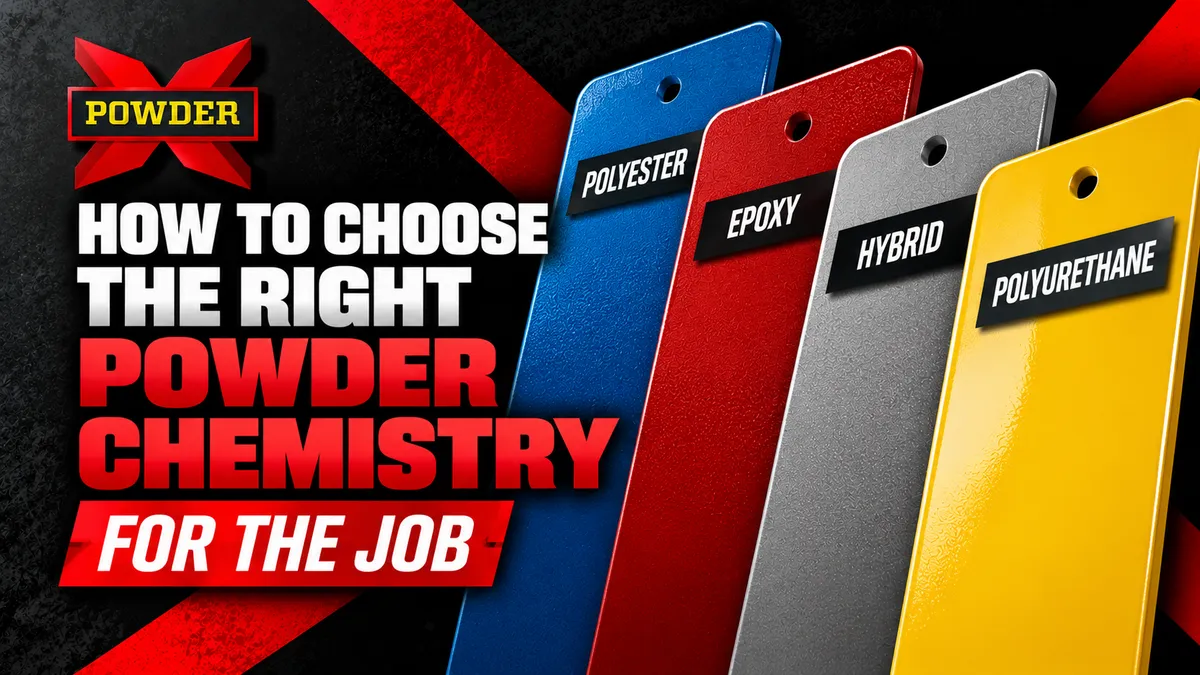
How to Choose the Right Powder Chemistry for the Job
Not all powder coatings are created equal.
Two parts can look almost identical after coating, but perform very differently once they're put to work.
One might spend its life inside a climate-controlled building. The other could face years of sunlight, rain, chemicals and temperature changes.
The difference isn't always how the powder was applied. Sometimes, it's the chemistry of the powder itself.
Choosing the wrong powder chemistry can lead to fading, cracking, corrosion problems and costly rework—even when the application process is done correctly.
At Powder-X, the focus is on helping coating operations understand the entire finishing process, including how material selection affects the final result.
Why Powder Chemistry Matters
Powder coating isn't one universal material.
Different powder formulations are engineered to deliver different properties, including weather resistance, chemical resistance, flexibility, appearance and durability.
Think of powder chemistry like choosing tires for a vehicle.
A tire designed for a racetrack isn't necessarily the best choice for snow-covered roads. Both are tires, but they're built for different conditions.
Powder coatings work the same way.
The best powder isn't necessarily the most expensive one. It's the one designed for the job.
Polyester Powder Coating: A Common Choice for Outdoor Applications
Polyester powder coatings are widely used when exterior durability and appearance are important.
They generally offer good resistance to sunlight and weathering, making appropriately specified formulations suitable for applications such as outdoor furniture, fencing, architectural components and exterior metal products.
However, not all polyester powders provide the same level of outdoor performance.
Some are formulated for general outdoor use, while others are designed to meet more demanding weathering specifications.
Best fit: Outdoor products that need color and gloss retention.
For long-term exterior projects, verify the powder manufacturer's weathering ratings and performance specifications.
Epoxy Powder Coating: Strong Protection for Indoor Applications
Epoxy powder coatings are known for their adhesion, chemical resistance and protective properties.
They're commonly used for indoor industrial components, electrical equipment and applications where resistance to certain chemicals is important.
But epoxy has a limitation.
Traditional epoxy powders generally don't hold up well to prolonged ultraviolet exposure. Sunlight can cause chalking and color changes.
That doesn't necessarily mean the coating has lost every protective property, but it can make epoxy a poor choice for exposed decorative surfaces.
Best fit: Indoor industrial applications requiring chemical resistance and protective performance.
Epoxy-Polyester Hybrid: A Practical Indoor Option
Epoxy-polyester hybrid powders combine characteristics of epoxy and polyester resin systems.
They're commonly used for indoor applications where appearance, mechanical performance and cost all matter.
Office furniture, shelving, cabinets and interior metal products are examples.
Hybrids can provide a useful balance of properties, but they generally aren't intended for prolonged outdoor exposure.
Best fit: Indoor products requiring a durable, attractive finish without demanding exterior weathering requirements.
Polyurethane and Specialty Powder Coatings
Polyurethane powder coatings are another option for applications requiring particular appearance and performance characteristics.
Depending on the formulation, they may offer good weathering performance, smooth finishes and resistance to certain chemicals.
Specialty powder chemistries are also available for more demanding requirements, including high-temperature exposure or specific industrial environments.
But these products aren't interchangeable.
A coating designed for elevated temperatures may have different application and curing requirements than a standard decorative powder.
Best fit: Applications with specialized performance requirements that standard powder formulations may not meet.
Match the Powder to the Environment
Before choosing a powder, consider where the finished part will actually be used.
Will it be exposed to sunlight? Moisture? Road salt? Cleaning chemicals? Elevated temperatures?
An indoor cabinet and an outdoor railing may need completely different coating systems.
The substrate matters, too.
Steel, aluminum and galvanized components can require different pretreatment procedures, and the coating's performance depends heavily on the condition of the surface underneath it.
For aggressive environments, the right solution may involve a specified primer-and-topcoat system rather than a single layer.
Powder chemistry matters, but proper surface preparation is just as important.
Don't Forget Curing Requirements
Different powder chemistries can have different curing schedules.
Some formulations are designed for lower-temperature curing, while others require higher temperatures or longer cure times.
That affects production planning, especially when coating thick metal parts or heat-sensitive substrates.
Always review the powder manufacturer's Technical Data Sheet (TDS).
The required curing conditions are typically based on part-metal temperature, not simply the temperature displayed on the oven controller.
Using the right powder with the wrong cure cycle can still produce a poor finish.
Test Before Committing to Production
When a job has demanding requirements, don't rely on color samples alone.
Review the powder's technical specifications and confirm that the selected formulation meets the customer's performance expectations.
For critical applications, representative test panels can help evaluate appearance, adhesion, film thickness and other required properties.
It's also important to confirm that the coating is compatible with the selected pretreatment process and application equipment.
A small amount of testing before production can prevent a much larger problem afterward.
The Powder-X Takeaway
Choosing the right powder chemistry starts with understanding what the finished part needs to withstand.
Polyester is commonly selected for exterior durability. Epoxy is useful for many indoor protective applications. Epoxy-polyester hybrids serve a wide range of indoor products, while polyurethane and specialty formulations address other performance requirements.
But chemistry alone doesn't guarantee success.
Proper preparation, application equipment, film thickness and curing all contribute to the finished coating's performance.
The right powder coating job starts long before the trigger is pulled. It starts with choosing a coating system built for the environment, the substrate and the customer's expectations.
Ready To Build A Powder Coating System The Right Way?
Whether you are starting your first powder coating business, bringing finishing in-house, or upgrading an existing operation, Powder-X can help you choose a batch system built around your goals.
From ovens and booths to complete systems, training, technical support, and long-term guidance, our team is here to help you make a smart investment in equipment that is designed to perform.
Contact Powder-X today to speak with one of our coating specialists and start building a powder coating operation with confidence.


