
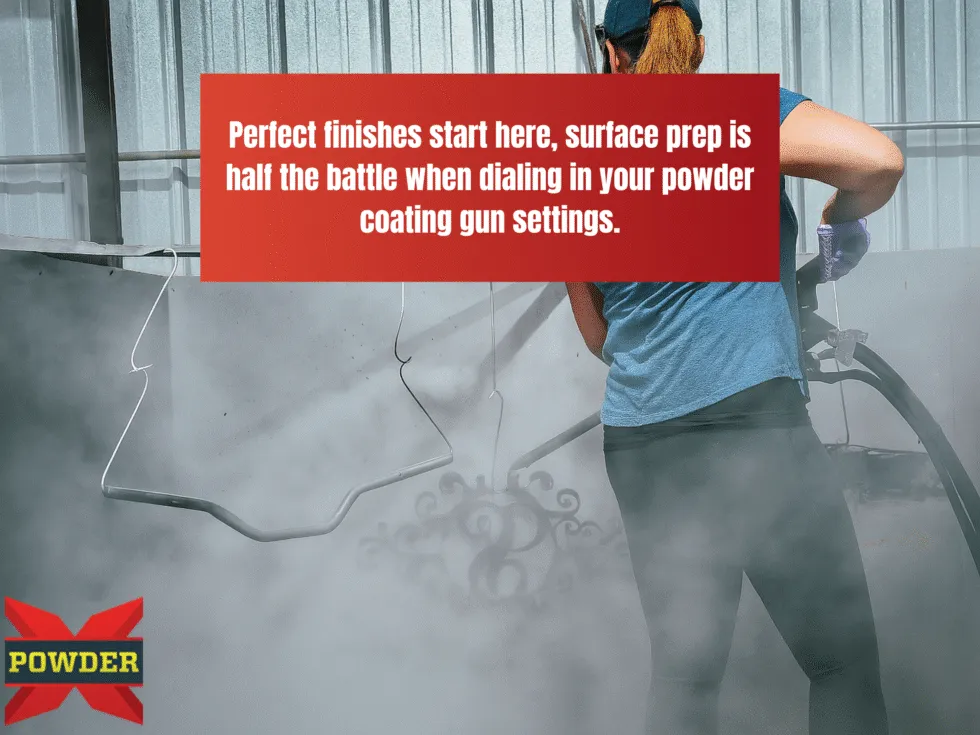
What is the Ideal Gun Setting for Even Powder Coverage?
If your powder coating finish looks uneven, blotchy, or like it had a bad day, chances are your gun settings are working against you, not with you. Ensuring the ideal powder coating gun settings can make all the difference.
You’re not alone, most coaters (especially new ones) assume that spraying more powder or “cranking up the juice” will fix a problem. But if you don’t understand how kilovolts, microamps, airflow, and gun distance play together, you’ll waste powder, ruin parts, and miss out on jobs.
So, what are the ideal gun settings for even coverage?
Let’s break it down.
The Perfect Trio: kV, μA, and Distance
1. Start with the voltage (kV):
Think of kilovolts as the strength of your powder’s “magnetism.” It’s the charge that gets your powder particles to leap off the gun and cling to your grounded part. Achieving the ideal powder coating gun settings involves understanding this balance.
For flat, open surfaces, you want 80–90 kV.
This maximizes transfer efficiency and lets you hold the gun a bit farther back while still getting even coverage.For tight corners or Faraday cage areas, cut it down to 40–50 kV.
Lower voltage keeps the powder from overcharging and bouncing off instead of sticking.
Joey Tip: Most pros start high for the main coat and dial it back by half for second coats or recessed areas.
2. Watch your microamps (μA):
If voltage is the potential, microamps are the punch. They measure how much electrical charge is actually flowing.
You want low μA readings, ideally around 20–25 μA.
This helps minimize back-ionization (those popcorn-like “starbursts” on the part).
Rule of Thumb: High kV + low μA = better coverage and less waste.
Some pro-grade guns even let you limit the μA so you don’t accidentally overcook your part with charge. That’s like having traction control on a Ferrari; it keeps you fast but safe, aligning with ideal powder coating gun settings.
3. Distance matters (a lot):
Keep your gun 8–10 inches away from the part.
Too close? You’ll cause uneven builds, orange peel, or “puffing” of powder.
Too far? You lose transfer efficiency, waste powder, and risk light coverage.
Hold the gun steady, move smoothly, and always trigger away from the part first so you don’t spurt powder like a busted can of whipped cream.
Bonus: Airflow & Flow Rate
Don’t blast it. The air-to-powder ratio should be adjusted for a soft cloud, not a hurricane.
Let the gun do the work. You shouldn’t have to force anything. Flow should be smooth and even before you ever point at the part.
The Problem with Hobby Guns
Here’s the truth: some entry-level powder guns won’t let you adjust μA at all. You might only get a single dial for voltage or air. That’s like trying to land a plane with just a throttle.
If you’re serious about quality and your reputation, invest in a professional-grade system. It’s not about bells and whistles. It’s about control. Professional systems often provide more flexibility for ideal powder coating gun settings.
“If we have sufficient charge and sufficient ground, the powder MUST stick. The rest is just dialing in the settings to make it perfect.” – Joey Golliver
Summary: Ideal Gun Settings at a Glance
Need More Help?
Every powder and every part is different. If you’re struggling to get consistent coverage or need advice on ideal powder coating gun settings, give our team a call at 888-326-4840. We’ve coached thousands of coaters through these exact settings and we’ll help you dial it in fast.
#PowderX #PowderMarket #JoeyGolliver #PowderCoachsPlaybook


