
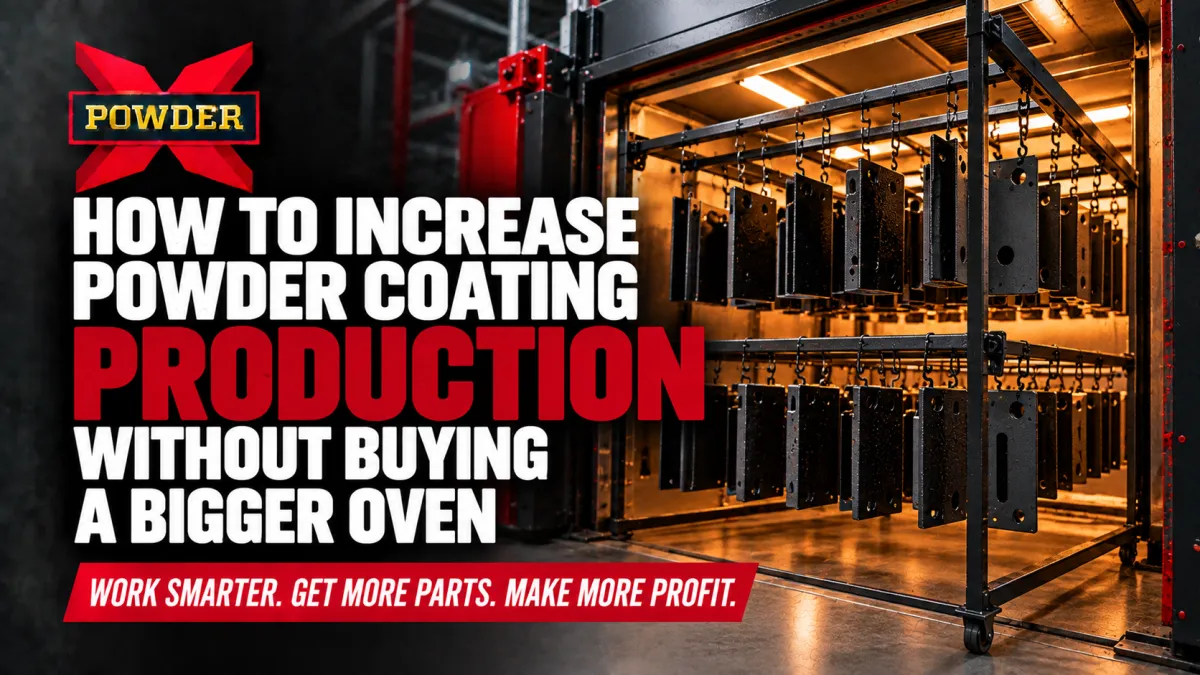
How to Increase Powder Coating Production Without a Bigger Oven | Powder-X
How to Increase Powder Coating Production Without Buying a Bigger Oven
When a powder coating shop starts getting busy, one piece of equipment often gets blamed first:
The oven.
Racks are waiting. Production is backed up. Lead times are getting longer. The obvious conclusion is that the shop needs a bigger oven.
Sometimes it does.
But before spending the money, Powder-X recommends asking a different question:
Is the oven actually too small—or is the operation not getting everything it can out of the oven it already has?
Production capacity isn't determined by oven size alone. Racking, scheduling, part mix, cure time, preparation, material handling and rework can all determine how many finished parts leave the building each day.
Sometimes the fastest way to increase capacity is to make the existing process work better.
First, Make Sure the Oven Is Really the Bottleneck
A bottleneck is simply the part of the process that limits how much the entire operation can produce.
If coated racks are constantly waiting for oven space while the oven runs continuously, curing may truly be the limiting step.
But what if the oven regularly sits empty waiting for parts?
What if operators are still preparing the next rack after the previous load comes out?
What if finished parts are blocking the oven because there's nowhere for them to cool?
Those aren't oven-capacity problems.
They're workflow problems.
Before buying equipment, track a few normal production days. Look at how much time the oven spends curing parts versus sitting empty during loading, unloading or waiting.
A bigger oven won't fix an oven that's waiting for work.
Get More Parts Into Each Load
One of the easiest ways to increase production is to improve rack density.
Suppose an oven currently processes 20 parts per load. Better racking allows 30 parts to fit safely without compromising coating access, airflow or cure.
That's a 50% increase in parts per cycle without changing the oven.
This is why the previous Powder-X discussion on hooks and racking matters so much. Better fixtures can improve part orientation, loading speed and the amount of usable capacity inside existing equipment.
But don't turn the oven into a game of Tetris.
Parts still need enough spacing for proper airflow and uniform heating. The objective is to increase productive density, not simply cram more metal into the chamber.
More parts per load only matters when they're good parts coming out.
Build Better Racks for Repeat Jobs
Generic hooks and adjustable racks make sense for one-off work.
Repeat production deserves another look.
If the same 100 brackets come through every week, a purpose-built fixture may allow them to load faster and fit more efficiently.
Even modest improvements add up.
If a fixture increases a load from 40 parts to 50, that's 25% more production every time that rack enters the oven.
Custom racking can also make loading more predictable. Operators know exactly where each part goes, how it should be oriented and how many parts belong on each rack.
Repeat work becomes more valuable when the process itself becomes repeatable.
Reduce the Time Between Oven Loads
The cure cycle isn't the only time that matters.
Look at what happens between cycles.
The doors open.
A rack comes out.
Employees move it somewhere to cool.
Another rack has to be found.
It gets moved into position.
Then the oven is loaded and restarted.
How long did that take?
Five minutes may not sound important. But if the oven runs eight cycles per shift, five minutes between every load adds up to 40 minutes.
That's time the oven could potentially be producing.
Stage the next load before the current cycle ends. Keep the path to the oven clear. Make sure employees aren't hunting for carts, racks or parts when the doors open.
Don't make the oven wait for the shop to get organized.
Understand the Actual Cure Time
This is an area where improving production requires care.
Powder-X does not recommend shortening cure cycles simply to push more parts through.
Undercure is an excellent way to turn higher production into higher rework.
Instead, determine what the parts actually require.
Powder coating cure schedules are based on the temperature of the part itself, not simply the temperature displayed on the oven controller. Part mass matters; thicker and heavier parts take longer to reach cure temperature. Powder-X training recommends using temperature-measurement equipment and following the powder manufacturer's Technical Data Sheet to understand the real process.
If a shop automatically runs every product for the same extremely conservative cycle, profiling different part families may reveal opportunities to create better production recipes without compromising cure.
The goal isn't to cure faster.
It's to stop guessing.
Group Similar Parts Together
Imagine alternating between lightweight sheet-metal parts and heavy fabricated steel throughout the day.
Those parts don't necessarily heat at the same rate.
Now the production schedule is constantly changing around dramatically different thermal loads.
Where practical, grouping similar parts can make oven cycles more predictable.
A shop may schedule lighter parts together, heavier parts together or recurring product families in dedicated production windows.
This also helps with racking, powder selection and setup.
The more predictable the load, the easier it becomes to understand how long the process actually takes.
Don't Use the Cure Oven for Work Another Process Could Handle Better
Some operations use the same oven for multiple steps.
Parts may enter for drying or outgassing, leave for coating, then return for final cure.
That may be completely appropriate for the production level.
But it also means one part can occupy oven capacity multiple times.
As volume increases, ask whether another step has become responsible for consuming valuable cure capacity.
Would a separate dry-off solution make sense?
Could preparation be scheduled differently?
Would a dedicated outgassing process help with recurring cast or contaminated parts?
That doesn't automatically mean buying another oven. It means identifying what is consuming the capacity of the oven you already own.
Powder-X training notes that parts need to be completely dry before coating and that drying can be accomplished in several ways depending on the process. Powder Coach's Playbook Final E…
Keep the Booth Ahead of the Oven
An efficient oven needs coated parts ready when capacity becomes available.
If application can't keep up, improving oven throughput won't accomplish much.
Look at how long parts spend in the booth.
Are operators fighting poor grounding?
Are color changes taking longer than necessary?
Are difficult parts being hung in orientations that make them harder to coat?
Is powder delivery inconsistent?
Does the next rack arrive on time?
This is where production needs to be viewed as a complete system.
The oven can only cure what the rest of the shop can feed it.
Keep Pretreatment Ahead of Production Too
The same principle applies upstream.
If the booth is waiting for prepared parts, the problem may start long before powder application.
Preparation is fundamental to appearance, adhesion and corrosion protection, so the answer isn't to rush it. Powder Coach's Playbook Final E…
Instead, improve the flow.
Have parts properly cleaned, rinsed, dried, cooled and ready for coating before they're needed. Schedule work so one department isn't constantly waiting for another.
Increasing production isn't about making every employee move faster.
It's about reducing the amount of time parts spend waiting.
Reduce Rework
This may be one of the most overlooked ways to create oven capacity.
Every defective batch that goes back through the process occupies space that could have been used for new production.
If a shop processes eight oven loads today but two are rework, it didn't really produce eight new loads.
It produced six.
Fix the causes of rework and capacity immediately becomes available.
Grounding, preparation, compressed air, application technique, film thickness and proper cure all matter.
As Powder-X has discussed in the rework guide, the fastest part through a powder coating shop is the one that only needs to be coated once.
Look at Your Part Mix
Not every job uses oven capacity equally.
A rack of small brackets may create far more revenue per oven cycle than one oversized custom part occupying most of the chamber.
That doesn't mean the large job is bad.
It means oven capacity has value and should be priced accordingly.
If a one-off job consumes half a shift of oven time, the price should reflect what the business is giving up to process it.
This becomes particularly important as a shop approaches capacity.
When oven time is limited, production scheduling becomes a profitability decision.
Add Racks Before Adding Oven
Sometimes the limiting factor isn't oven space.
It's rack availability.
If a shop has to wait for finished parts to cool and unload before the next batch can even be racked, additional racks may allow preparation, coating and curing to overlap more effectively.
While one rack is curing, another can be coated.
A third can be loaded.
Another can be cooling.
Now the operation begins working as a pipeline instead of a series of isolated steps.
That's often a much smaller investment than replacing the oven.
Measure Parts Per Shift, Not How Busy Everyone Looks
A busy shop can still be inefficient.
People can spend all day moving carts, searching for hooks, waiting on parts and reorganizing racks while production barely improves.
Track something meaningful.
For example:
Good Finished Parts ÷ Production Hours = Good Parts Per Hour
Then monitor what changes that number.
Did better racking improve it?
Did staging reduce oven downtime?
Did a new production schedule help?
Did reducing rework create more capacity?
This turns improvement from an opinion into something measurable.
When a Bigger Oven Really Is the Answer
Eventually, optimization has limits.
If the oven is properly profiled, loads are dense and efficient, racks are staged, downtime is minimal, upstream processes can keep it supplied and demand still exceeds capacity, then the shop may genuinely need more curing capacity.
At that point, the conversation can move toward a larger batch oven, additional oven capacity or potentially conveyorized production.
But that's a much better equipment decision because the existing process has already been studied.
The company knows exactly what is limiting growth.
Buy more capacity when the business needs more capacity—not when inefficiency makes it look like it does.
The Powder-X Takeaway
Before buying a bigger powder coating oven, look at what happens around the one already installed.
Improve rack density. Build better fixtures for repeat parts. Stage the next load. Reduce loading and unloading delays. Profile cure requirements correctly. Group similar work. Keep preparation and application ahead of curing. Reduce rework. Make sure enough racks are available to keep production moving.
None of those strategies make the oven physically larger.
But they can make the operation more productive.
And that's ultimately what matters.
The cheapest additional oven capacity may be the capacity already sitting inside the oven you're using today.
Ready To Build A Powder Coating System The Right Way?
Whether you are starting your first powder coating business, bringing finishing in-house, or upgrading an existing operation, Powder-X can help you choose a batch system built around your goals.
From ovens and booths to complete systems, training, technical support, and long-term guidance, our team is here to help you make a smart investment in equipment that is designed to perform.
Contact Powder-X today to speak with one of our coating specialists and start building a powder coating operation with confidence


