Manual vs. Automatic Powder Coating: When Automation Pays | Powder-X
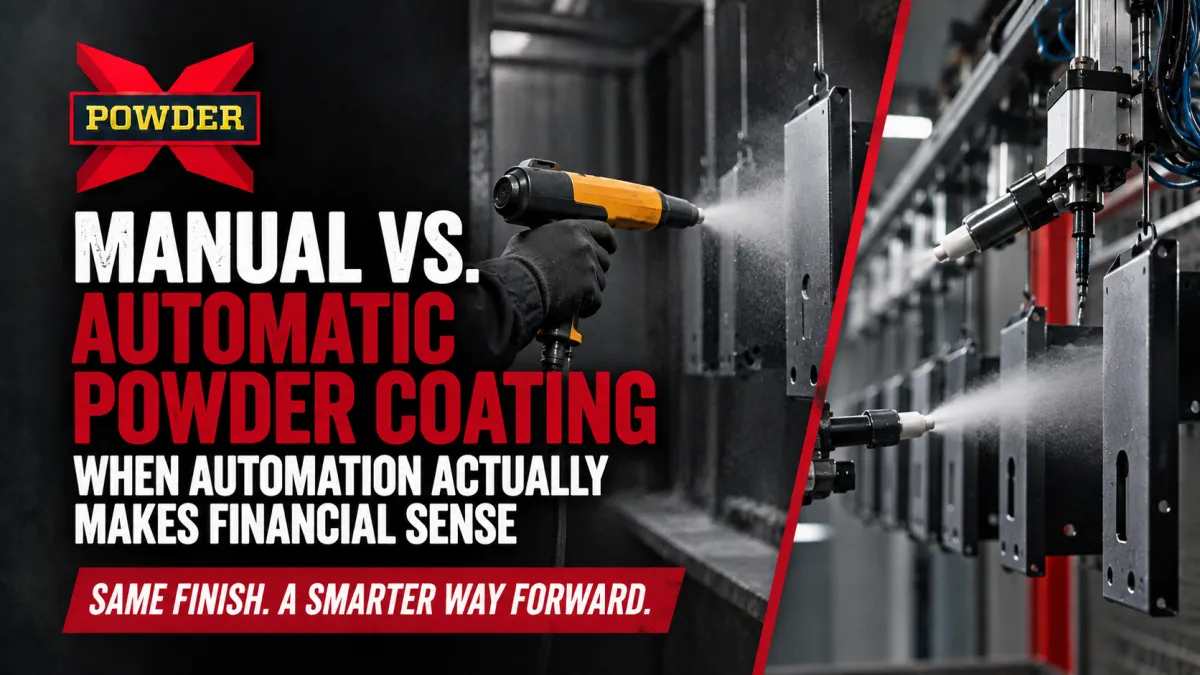
Manual vs. Automatic Powder Coating: When Automation Actually Makes Financial Sense
Automation gets a lot of attention in powder coating.
Automatic guns, reciprocators, conveyors and complete automated finishing lines can produce an impressive amount of work. But that doesn't mean every powder coating operation should automate.
For Powder-X, the question isn't “Can this process be automated?”
It's “Will automation make this operation more profitable?”
Those are two very different questions.
Manual Powder Coating Isn't the “Beginner” Option
Manual powder coating sometimes gets treated as the first step before a company graduates to automation.
That's the wrong way to look at it.
A well-designed manual system can be exactly the right solution for an operation coating lower volumes, changing colors frequently, running different part sizes or handling custom work.
A skilled operator also has something automation doesn't naturally have: flexibility.
Put an unfamiliar part in front of an experienced coater and that operator can change gun position, adjust technique and respond to difficult geometry almost immediately.
That flexibility has real value.
What Changes With Automatic Powder Coating?
Automatic powder coating takes repetitive parts of the application process and makes them more consistent.
Instead of an operator manually moving the gun around every part, automatic guns can be mounted on reciprocators or other positioning equipment. With a conveyorized system, parts can continuously travel through pretreatment, drying, application and curing.
More advanced systems can incorporate part detection, automatic triggering, stored recipes, gun positioning and increasingly sophisticated controls.
But automation isn't simply about replacing a person holding a powder gun.
It's about creating a repeatable production process.
That's why automation works particularly well when the work itself is repeatable.
Production Volume Is the First Question
Imagine a company coating 30 different fabricated parts every day in small batches.
Now compare that with a manufacturer coating 2,000 nearly identical components every shift.
Those companies shouldn't automatically buy the same application system.
Manual application may give the first operation the flexibility it needs. The second operation has enough repetitive work that manual coating could become a production bottleneck.
Powder-X's training material makes this distinction when discussing production systems: manual batch operations are well suited to lower production volumes, while automatic systems become increasingly relevant as consistent production requirements increase.
Automation makes the most sense when there is enough predictable work to keep it working.
A machine sitting idle isn't producing ROI.
Labor Matters—but Don't Use the Wrong Math
One of the first arguments for automation is usually labor savings.
That's reasonable, but the calculation needs to go deeper than:
Automatic guns = fewer employees.
Automation can reduce repetitive manual spraying and allow employees to be used elsewhere. But parts still need to be loaded, unloaded, inspected and managed. Equipment needs maintenance. Color changes still take time. Pretreatment still needs attention. Quality still needs to be monitored.
Automation often changes where labor is used rather than eliminating labor entirely.
The better question is:
How many productive labor hours can automation realistically save per year, and what are those hours worth to the operation?
That's a number that can be measured.
Consistency Can Be Worth More Than Labor Savings
This is where the automation conversation gets more interesting.
Suppose an operation has enough manual spraying capacity, but film thickness varies significantly between operators.
One employee consistently applies too much powder. Another misses areas. Rework is becoming expensive. Powder consumption is higher than it should be.
Now automation may solve a different problem.
Automatic application can make gun movement, triggering and application settings more repeatable. With a stable part presentation and process, that can help improve consistency from part to part.
Consistency can affect:
powder consumption,
film thickness,
quality,
rework,
production scheduling,
and ultimately cost per finished part.
Saving powder and reducing rework on thousands—or millions—of parts can become a much bigger financial opportunity than simply eliminating a few minutes of spraying labor.
Part Mix Can Make or Break the ROI
Automation loves repetition.
If an operation runs the same family of parts for hours at a time, automation can become extremely efficient.
If every rack contains something completely different, the calculation changes.
Automatic equipment has become considerably more flexible, but the business still needs to account for setup, programming, gun positioning, color changes and process adjustments.
A job shop coating railings in the morning, brackets at lunch and a custom fabricated assembly in the afternoon has different requirements than an OEM running the same component five days a week.
Neither business model is wrong.
The equipment has to match the work.
Color Changes Matter More Than People Think
An operation can have high production volume and still lose efficiency through constant color changes.
Every change may require cleaning equipment, changing powder supplies and preventing contamination between colors. Depending on the recovery configuration, frequent changes can affect how much value an automated system actually provides.
That's why Powder-X evaluates not only how many parts a company produces, but also how those parts are produced.
Ten thousand parts in one color is a very different production problem from ten thousand parts spread across 30 colors.
The number on the production report may be identical.
The process isn't.
Don't Automate a Bad Process
This may be the most important point in the entire article.
If parts arrive dirty, automation doesn't fix that.
If grounding is poor, automation doesn't fix that.
If pretreatment isn't controlled, automation doesn't fix that.
If the cure schedule is wrong, automation doesn't fix that either.
It may simply allow the operation to produce bad parts faster.
The fundamentals still matter: preparation, grounding, powder application and proper cure all need to work together as a system. Powder-X's Powder Coach's Playbook repeatedly emphasizes that successful finishing depends on controlling the complete process rather than treating individual pieces of equipment as isolated solutions.
Automate a controlled process—not a broken one.
So When Does Automation Actually Make Financial Sense?
The answer should come from the numbers.
Start by identifying what automation is expected to improve. Is the goal greater throughput? Lower labor cost? Reduced powder consumption? Better consistency? Less rework? More production capacity?
Then put a dollar value on those improvements.
A simplified calculation might look like this:
Annual Labor Savings
Annual Material Savings
Annual Rework/Scrap Savings
Additional Contribution From Increased Capacity
= Estimated Annual Financial Benefit
Then:
Automation Investment ÷ Estimated Annual Financial Benefit = Approximate Payback Period
For example, a system shouldn't be justified because it can coat twice as many parts if the company has no realistic need for the additional capacity.
Capacity only has financial value when it can be used.
That's the difference between production capability and ROI.
Don't Forget the Cost of Doing Nothing
There is another side to the calculation.
Sometimes companies stay manual for too long.
Orders increase. Overtime grows. Quality becomes harder to maintain. Skilled operators become a bottleneck. Lead times stretch. Eventually, the company starts turning away work because the coating department can't keep up.
At that point, the cost isn't just additional labor.
It's opportunity cost.
If an automated system allows a manufacturer to reliably produce significantly more sellable product with the same available production hours, that additional capacity can become part of the financial justification.
Automation doesn't need to be cheaper than manual coating in every category.
It needs to create enough overall value to justify the investment.
Sometimes the Right Answer Is Somewhere in the Middle
Going from completely manual coating to a fully automated line isn't the only option.
An operation might automate application while retaining manual touch-up. It might add reciprocators to an existing process. It might improve part detection and gun triggering. Or it might design a system that allows additional automation to be added as production grows.
That can be especially valuable for a growing manufacturer.
Instead of buying equipment for an imaginary future, the company can build around today's production while creating a realistic path toward tomorrow's.
Automation doesn't have to be all or nothing.
The Powder-X Approach
The decision should start with the parts—not with the equipment catalog.
Part size. Geometry. Production volume. Colors. Changeover frequency. Current labor. Powder consumption. Rework. Available floor space. Utilities. Growth projections.
Then identify the bottleneck.
If manual application isn't limiting production, adding automatic guns simply because they look more advanced may not create much financial return.
But if the operation has consistent volume, repeatable parts and a measurable production problem that automation can solve, the calculation can change quickly.
That's the Powder-X approach:
Don't automate because you can. Automate when the numbers tell you it's time.


