How to Calculate Powder Coating Cost Per Part | Powder-X
How to Calculate the Cost Per Part for Powder Coating
A powder coating shop can stay busy all day, produce great-looking parts and still make less money than it should.
Why?
Because coating a part and making a profit on that part are two different things.
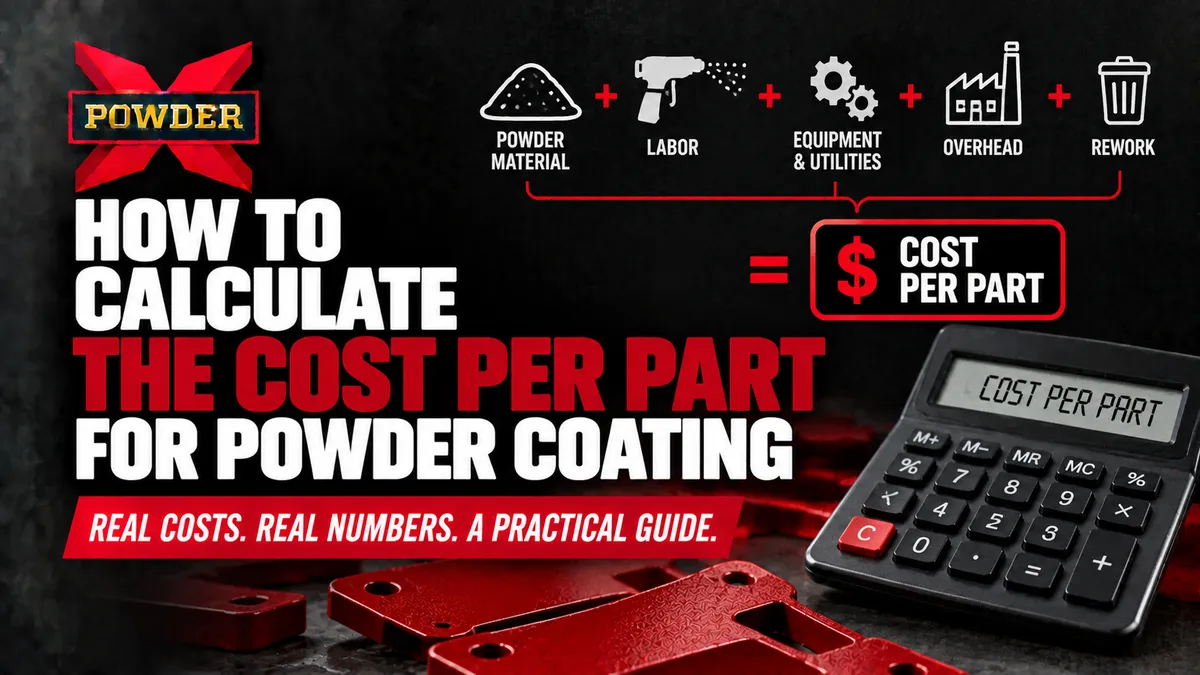
Powder, labor, preparation, equipment, utilities, and overhead all contribute to the cost of a finished product. If even one of those expenses gets overlooked, a job that looks profitable on paper can end up costing the business money.
At Powder-X, understanding production costs is just as important as understanding the equipment.
The goal isn't simply to coat more parts. It's to know what each finished part actually costs—and what the business needs to charge to make a profit.
What Does Cost Per Part Mean in Powder Coating?
Cost per part is the total cost of producing a finished, acceptable powder-coated part.
It includes more than the powder applied to the metal.
A realistic calculation considers materials, preparation, labor, equipment operation, overhead, and the normal cost of producing parts that don't pass inspection the first time.
The basic formula is:
COST PER PART FORMULA
Total Production Cost/Good Finished Parts = Cost Per Part
For example, if a shop spends $600 to process a batch and produces 100 acceptable parts, the cost is $6 per part.
But that $600 needs to include the actual cost of running the job—not just the most obvious expenses.
Start With Powder Consumption
Powder is one of the easiest expenses to identify, but it can also be one of the easiest to calculate incorrectly.
A shop shouldn't assume that every pound of powder purchased ends up on a finished part.
Some powder becomes overspray. Some may be recovered, depending on the system and operating requirements. Color changes, cleanup, and application efficiency can also affect actual consumption.
Suppose a job consumes 12 pounds of powder at $6 per pound.
That's:
12 × $6 = $72 in powder cost
If the batch produces 100 good parts, powder costs $0.72 per part.
For more accurate estimates, track the amount of powder actually consumed over several production runs rather than relying only on theoretical coverage.
The price of powder matters. How efficiently the shop uses it matters just as much.
Don't Forget Surface Preparation
Powder coating quality begins before the first particle of powder reaches the metal.
Parts may need degreasing, blasting, chemical pretreatment, rinsing, drying, or outgassing, depending on the substrate and performance requirements.
Those steps have costs.
Blasting uses media, labor, compressed air, and equipment time. Chemical pretreatment consumes chemicals, water, energy, and maintenance resources. Drying requires time and potentially additional energy.
Powder-X emphasizes preparation because it affects appearance, adhesion, and corrosion protection.
Skipping preparation to save money can create a much more expensive problem later.
When calculating cost per part, preparation should be treated as a normal production expense—not an optional extra.
Calculate Labor Based on the Entire Job
Labor isn't just the time spent spraying powder.
Employees may be involved in receiving, cleaning, masking, racking, coating, loading the oven, unloading, inspection, packaging and material handling.
All of that time contributes to the finished part.
Suppose a batch requires three total labor-hours and the shop's fully burdened labor cost is $30 per hour.
3 hours × $30 = $90 in labor
For 100 good parts, that's $0.90 per part.
A fully burdened labor rate should account for relevant payroll-related expenses, not simply the employee's base hourly wage.
And be careful when calculating labor on jobs involving multiple employees.
Two employees working for one hour represent two labor-hours—not one.
Include Oven and Equipment Operating Costs
The oven is an important part of the calculation.
Gas or electricity consumption depends on the equipment, operating conditions, insulation, controls, load characteristics and cure requirements.
A large oven running a lightly loaded batch may have a very different cost per part from the same oven processing a properly loaded rack.
The booth, compressed-air system, pretreatment equipment, and other machinery also consume resources.
A practical approach is to estimate the relevant equipment operating cost for the time required to process the job.
For example, if the allocated energy and equipment operating expense is $40 for a batch of 100 good parts, that's another $0.40 per part.
The important thing is to use realistic operating information whenever possible rather than guessing from equipment size alone.
Account for Racking and Batch Size
This is where production efficiency begins affecting profitability.
Imagine an oven cycle costs approximately the same amount whether the rack holds 30 parts or 50 comparable parts.
With 30 parts, the fixed cost of that cycle is divided by 30.
With 50, it's divided by 50.
The second load can have a lower cost per part because more acceptable products share the same production expense.
That's why hooks, racking, and fixture design matter financially.
Better part density can improve how much productive work the shop gets from each cycle.
But there is a limit.
Parts still need adequate coating access, grounding, airflow, and proper cure.
The cheapest load isn't the one with the most parts. It's the one producing the most good parts at the right total cost.
Overhead Is Still Part of the Cost
This is one of the biggest mistakes in powder coating pricing.
A shop calculates powder, labor, and oven energy, adds a little profit, and assumes the job is covered.
But the business still has rent, insurance, equipment depreciation, maintenance, administrative expenses, software, facility costs and other operating expenses.
Those costs don't disappear because they aren't directly tied to one particular part.
They need to be recovered through the work the business produces.
One approach is to establish an overhead allocation rate based on productive labor-hours or another consistent production measure.
For example, if the shop has $12,000 in monthly overhead and 600 productive labor-hours, the allocation is:
$12,000 ÷ 600 = $20 per productive labor-hour
A job requiring three productive labor-hours would receive $60 in allocated overhead.
The important detail is consistency. Costs already included in the labor or equipment rate shouldn't be counted again.
Rework Can Change the Cost Per Part Quickly
Suppose a shop coats 100 parts, but only 90 pass inspection.
The business still paid to process all 100.
Now those expenses are spread across fewer acceptable parts.
If the original batch cost $600:
$600 ÷ 90 = $6.67 per good part
That's already higher than the expected $6 per part.
And if the remaining ten parts need to be stripped, prepared and coated again, the total job cost increases further.
This is why Powder-X connects quality control directly to profitability.
Poor grounding, contaminated compressed air, incorrect film thickness, inadequate preparation and improper cure can all contribute to costly rework.
Every part that has to be coated twice makes the good parts more expensive to produce.
A Practical Powder Coating Cost Per Part Example
Consider a shop processing 100 identical fabricated brackets.
The following figures are illustrative, not industry-average prices.
Cost category | Batch cost |
|---|---|
Powder | $72 |
Surface preparation and supplies | $85 |
Direct labor | $90 |
Equipment and utilities | $40 |
Allocated overhead | $60 |
Inspection, handling and packaging | $25 |
Total production cost | $372 |
If all 100 parts pass inspection:
EXAMPLE RESULT
$3.72 per part
$372 total cost ÷ 100 acceptable parts
Now suppose only 95 parts pass inspection, with the five rejected parts excluded from the acceptable output.
The cost becomes approximately $3.92 per good part before additional repair expenses.
That's why tracking good finished parts is so important.
Calculate Your Own Cost Per Part
Use this simple calculator to explore how batch expenses and accepted output affect your cost.
Powder ($)
Preparation ($)
Labor ($)
Equipment & utilities ($)
Overhead ($)
Other costs ($)
Good finished parts
Total batch cost
$372.00
Cost per good part
$3.72
Copy calculation planning tool only. Enter total batch costs, with no double-counting. This does not include selling price or profit.
Cost Per Part and Selling Price Are Not the Same Thing
Knowing the cost is only the first step.
The business still needs to earn a profit.
Suppose the true production cost is $4 per part.
Selling it for $4 means the business has covered the costs included in that estimate but earned no profit from the job.
To establish a selling price using a target gross margin, the formula is:
Selling Price = Cost Per Part ÷ (1 − Target Margin)
For a $4 cost and a 30% target margin:
$4 ÷ 0.70 = $5.71 selling price
That's different from adding a 30% markup to cost, which would produce a selling price of $5.20.
Understanding the difference helps prevent underpricing.
The right target margin depends on the business, the job, its risks and the costs included in the calculation.
Don't Treat Every Job the Same
A shop coating 1,000 identical brackets shouldn't automatically use the same pricing assumptions as a customer bringing in one complicated fabricated assembly.
Repeat production may offer more efficient racking, predictable labor, consistent cure cycles and fewer setup changes.
Custom work may require additional masking, preparation, color changes, handling or specialized fixtures.
Small orders may also need a minimum charge because setup costs don't disappear when the customer only brings in a few parts.
Cost per part should reflect the work required—not simply the size of the finished product.
Use Cost Per Part to Find Production Improvements
Once a shop understands its costs, the information becomes useful beyond pricing.
It can reveal whether better racking would reduce labor, whether frequent color changes are becoming expensive, whether a lightly loaded oven is increasing unit costs or whether rework is consuming too much production capacity.
It can also help determine whether additional equipment or automation makes financial sense.
For example, if a process improvement reduces cost per part by $0.40 and the operation produces 50,000 parts annually, the potential annual savings are:
50,000 × $0.40 = $20,000
That's the kind of information that turns equipment decisions into business decisions.
The Powder-X Takeaway
Calculating powder coating cost per part doesn't require complicated accounting software.
It requires understanding the complete process.
Track powder consumption. Include preparation and labor. Account for equipment operation and overhead. Measure the number of acceptable finished parts. Include the real cost of rework when it occurs.
Then use those numbers to make better pricing and production decisions.
Because a powder coating shop shouldn't have to guess whether a job is making money.
Know the cost. Understand the process. Price for profit.
That's how better powder coating production becomes a better powder coating business.
Ready To Build A Powder Coating System The Right Way?
Whether you are starting your first powder coating business, bringing finishing in-house, or upgrading an existing operation, Powder-X can help you choose a batch system built around your goals.
From ovens and booths to complete systems, training, technical support, and long-term guidance, our team is here to help you make a smart investment in equipment that is designed to perform.
Contact Powder-X today to speak with one of our coating specialists and start building a powder coating operation with confidence


