How Powder Coating Guns Work | Electrostatic Powder Coating Explained
It’s Not Magic. It’s Physics. Here’s How a Powder Coating Gun Really Works.
Understanding the Science Behind Better Coverage, Less Waste, and Stronger Finishes
If you have ever watched powder coating for the first time, you probably asked the same question most people do.
How does that powder stick to the part before it ever goes into the oven?
At first glance, it almost looks like magic.
It is not. It is electrostatics.
When you understand how electrostatics works, you become a better coater. You troubleshoot faster. You waste less powder. You improve finish quality. You stop guessing and start making adjustments with a purpose.
That matters whether you are coating car parts in a small shop, bringing powder coating in-house for manufacturing, or building a full production finishing line.
Powder coating is not just spraying dry powder at metal and hoping for the best. It is a controlled process built on science, equipment, technique, and training.
Let’s break it down.
The Secret Is in the Charge
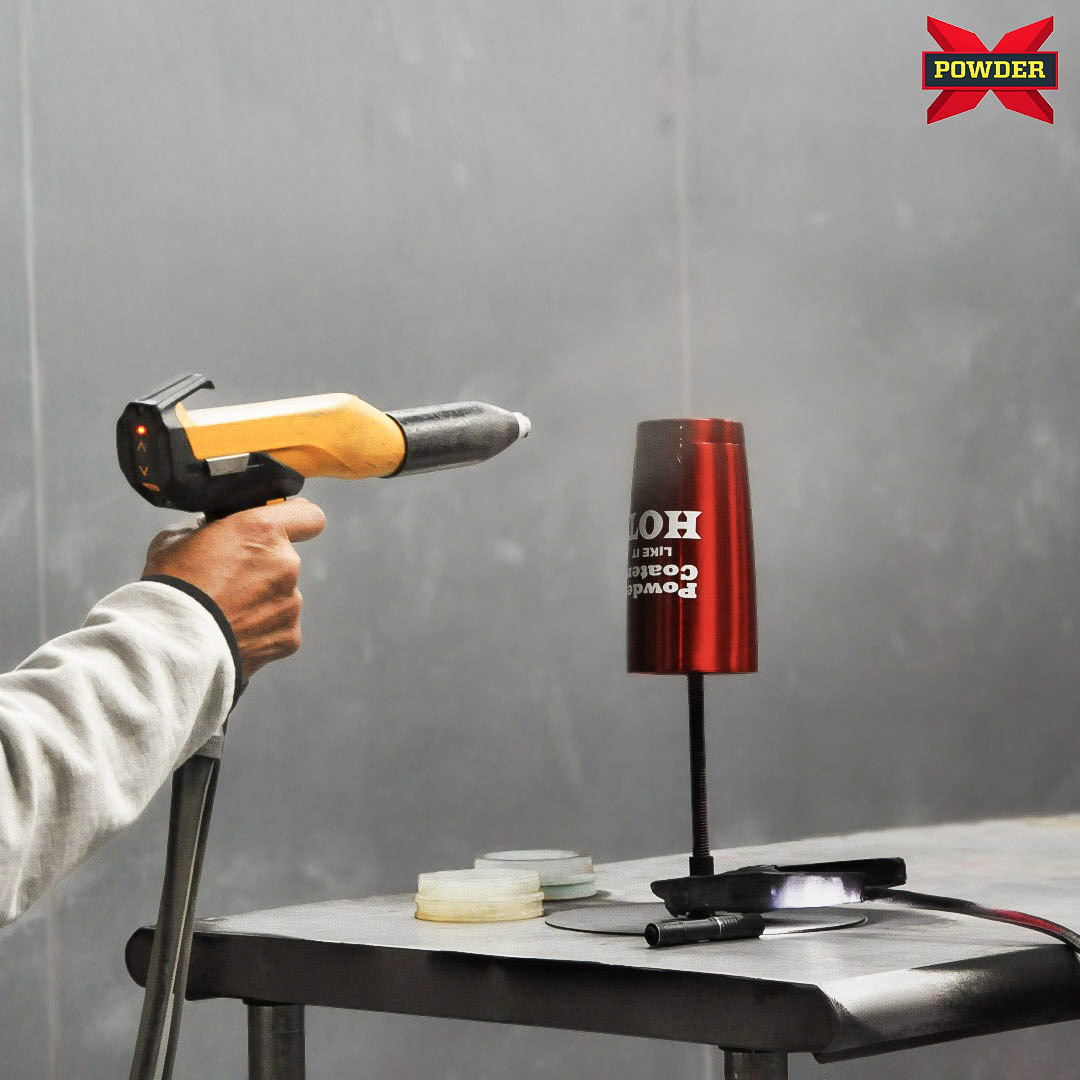
A powder coating gun is not just a sprayer.
Its real job is to electrically charge the powder particles before they leave the nozzle.
At the same time, the metal part being coated must be connected to a proper ground. Once the powder particles are charged and the part is grounded, electrostatic attraction takes over.
The charged powder is drawn toward the grounded metal.
Instead of floating through the air like traditional paint overspray, the powder is pulled toward the part. That attraction is what makes powder coating so efficient when the system is set up correctly.
You are not just spraying coating.
You are directing it.
That is one of the major advantages of electrostatic powder coating. The process allows more material to reach the part, which can reduce waste, improve coverage, and support more consistent production.
Why Powder Wraps Around the Part
One of the most useful advantages of electrostatic powder coating is the way powder can wrap around edges and corners.
Because the powder particles are attracted to the grounded workpiece, they do not only travel in a straight line like liquid paint. In many applications, they can move toward the part from different angles and provide better edge coverage than traditional liquid coating methods.
That can mean:
Better coverage.
Less overspray.
Higher transfer efficiency.
More consistent finishes.
Improved durability.
Cleaner production.
This is one reason powder coating has become a preferred finishing method for manufacturers, fabricators, automotive shops, industrial coaters, and businesses that care about both appearance and performance.
When the equipment, grounding, powder flow, and operator technique are working together, powder coating becomes a highly efficient finishing process.
The Oven Does Not Make Powder Stick
Many beginners assume the oven is what makes powder adhere to the part.
That is not exactly how the process works.
The electrostatic charge is what holds the powder on the grounded part long enough for the part to be moved into the curing oven.
Once the part is inside the oven, heat causes the powder to melt, flow, crosslink, and cure into the hard, durable finish powder coating is known for.
The gun gets the powder onto the part.
The oven turns that powder into a finished coating.
Both steps matter. If the gun is not applying powder correctly, the oven cannot magically fix the problem. If the oven is not curing properly, even a perfect application can fail.
Powder coating works best when every part of the system does its job.
Not Every Powder Coating Gun Works the Same Way
There are two primary ways powder coating guns create an electrical charge: corona charging and tribo charging.
Both methods have a place in the industry, but they work differently.
Corona Powder Coating Guns
Corona guns are the most common style used in professional powder coating shops.
A corona gun uses a high-voltage electrode at the tip of the gun to charge the powder as it exits the nozzle. The charged powder is then attracted to the grounded part.
Modern industrial corona guns give operators control over important settings such as voltage, powder flow, and air adjustments. Those controls allow a trained operator to coat a wide variety of parts, from flat panels to more complex fabricated components.
For most commercial powder coating operations, a quality corona gun provides the flexibility, control, and consistency needed for daily production.
Tribo Powder Coating Guns
Tribo guns create charge through friction.
Instead of using a high-voltage electrode, the powder moves through specially designed materials inside the gun. As the powder particles rub against those surfaces, they gain a charge.
Tribo technology can perform well in certain applications, especially when the powder type and operating conditions are tightly controlled. However, tribo guns are less common in many general powder coating shops because they require more specific powder compatibility and process control.
The right gun depends on the work you are doing, the type of powder being used, and the level of control your operation needs.
Why Grounding Is So Important
Grounding is one of the most important parts of powder coating, and it is also one of the most commonly overlooked.
If the part is not properly grounded, the powder has nowhere to go.
Poor grounding can cause:
Thin coverage.
Uneven film build.
Poor transfer efficiency.
Excess overspray.
Back ionization.
Finish inconsistencies.
Trouble coating corners and edges.
Wasted powder.
Many shops spend too much time adjusting gun settings when the real issue is a weak ground.
Before blaming the powder, the gun, or the operator, check the ground.
A strong ground gives the charged powder a clear path to the part. Without it, the entire process becomes harder than it needs to be.
Good grounding is not glamorous, but it is foundational. In powder coating, small details often make the biggest difference.
Complex Parts Require Better Technique
If you have ever struggled to coat inside corners, recessed areas, tight angles, or deep pockets, you have probably experienced the Faraday Cage Effect.
The Faraday Cage Effect happens when the electrostatic field pulls powder toward exposed edges and outer surfaces first, making it harder for powder particles to reach enclosed or recessed areas.
A common mistake is assuming the solution is to turn the voltage up.
In many cases, that makes the problem worse.
Difficult parts often require more control, not more power.
Better results may come from:
Lowering voltage.
Reducing powder flow.
Adjusting gun distance.
Changing the spray angle.
Moving slower.
Using the correct nozzle.
Improving grounding.
Coating difficult areas first.
Using modern gun controls designed for complex parts.
This is where training and experience matter. Powder coating is not just about having equipment. It is about knowing how to use that equipment in real-world conditions.
Sometimes the best adjustment is not more force.
It is more control.
Great Equipment Still Needs Great Operators
A great powder coating gun can make a major difference in production.
But even the best gun cannot fix poor technique.
The best finishes happen when quality equipment is paired with proper training and disciplined process control.
Operators need to understand:
Correct gun distance.
Proper spray angle.
Powder flow settings.
Voltage adjustments.
Grounding.
Air quality.
Surface preparation.
Film build.
Curing requirements.
How to adjust for part geometry.
The operator still makes the difference. The equipment gives that operator the tools to succeed.
This is why training matters. A shop can invest in good equipment, but if the team does not understand the process, that equipment will never deliver its full value.
Invest in Equipment That Helps You Win
Your powder coating gun is one of the hardest-working tools in your shop.
A quality powder coating system can help deliver:
Better transfer efficiency.
More consistent coverage.
Less wasted powder.
Faster production.
Fewer rejects.
Cleaner finishes.
Better control on complex parts.
More confidence from job to job.
Cheap equipment may look attractive on the front end, but poor transfer efficiency, inconsistent spray patterns, limited controls, and constant troubleshooting can cost far more over time.
There is a difference between buying equipment and investing in production.
A serious powder coating operation needs equipment built for real work, real parts, real deadlines, and real business demands.
That is where the right system makes a difference.
The Bottom Line
Understanding how a powder coating gun works is not just for engineers.
It is for every shop owner, operator, manufacturer, and entrepreneur who wants better finishes, lower waste, fewer rejects, and more profit.
When you understand the science behind the process, you stop guessing.
When you stop guessing, your quality improves.
When your quality improves, your business becomes stronger.
Powder coating may look simple from the outside, but the shops that win long-term understand what is happening inside the process. They respect the physics. They maintain their equipment. They train their people. They make adjustments with purpose.
That is how better finishes are created.
That is how better businesses are built.
Ready to Upgrade Your Powder Coating Operation?
At Powder-X, we help manufacturers, entrepreneurs, and growing shops build powder coating operations designed for performance, reliability, and profitability.
Whether you are buying your first powder coating gun, upgrading your application equipment, bringing powder coating in-house, or building a complete turnkey finishing system, our team can help you choose the right solution for your business.
From powder coating guns and booths to ovens, complete systems, training, and technical support, Powder-X is here to help you build an operation that does more than spray powder.
We help you build a system that works.
Contact Powder-X today to speak with one of our coating specialists and discover why shops across the country trust us for equipment, training, and support that keeps production moving.


