
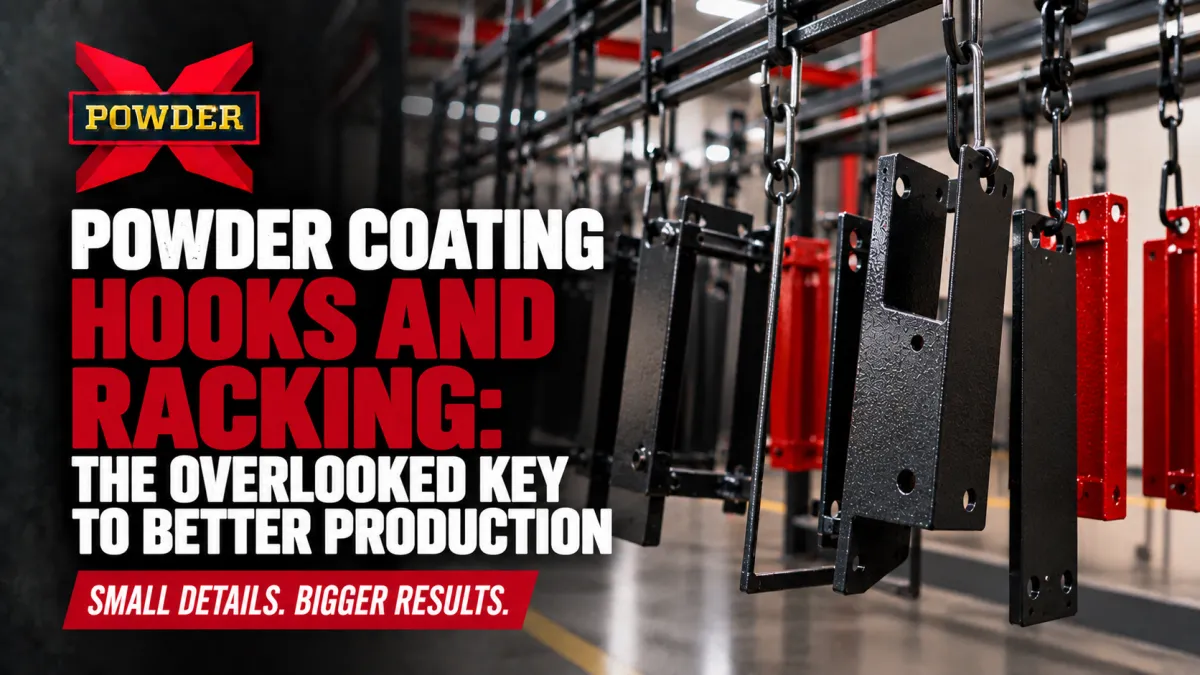
Powder Coating Hooks & Racking: The Key to Better Production | Powder-X
Powder Coating Hooks and Racking: The Overlooked Key to Better Production
When people think about improving a powder coating operation, they usually think about the big equipment.
A better gun. A larger oven. A new booth. Maybe automation.
Hooks and racks rarely get the same attention.
But those simple pieces of metal affect how many parts can be processed, how easily they're coated, how well they're grounded, and how much labor goes into every load.
At Powder-X, that's why racking shouldn't be treated as an afterthought.
The way a part hangs can affect the entire way a part gets coated.
Why Powder Coating Racking Matters
A rack has a pretty simple job: hold the part securely while it moves through the powder coating process.
But good racking needs to accomplish much more than that.
The part needs to be positioned so it can be properly prepared and coated. Operators need access to important surfaces. The rack has to support the part safely. The contact point needs to help provide a reliable electrical path to ground. And the arrangement needs to make good use of the booth and oven capacity.
Get those things right, and production gets easier.
Get them wrong, and a $2 hook can start creating problems for equipment worth thousands of dollars.
Your Hook Is Part of the Grounding System
This is the first thing to understand.
Electrostatic powder coating depends on charged powder being attracted to a properly grounded part.
That means there needs to be a reliable electrical path from the part through the hook and rack to ground.
Powder-X training specifically calls for quality grounding wires and hooks with good conductivity and recommends regularly inspecting them for wear. It also emphasizes that the grounding point on the part should be clean and free of contaminants that interfere with electrical contact.
So that little contact point between the hook and the part?
It matters.
The powder gun may get all the attention, but the gun can only work with the ground it's given.
Powder Buildup Can Turn a Good Hook Into a Bad Hook
Hooks don't stay clean forever.
Every trip through the booth and oven can add coating to areas of the hook or rack. Over time, that buildup can begin insulating the electrical connection.
The hook still looks like a hook.
The part is still hanging.
But electrically, the process may not be working the way it did when the hook was clean.
That can contribute to poor transfer efficiency, inconsistent coverage, and difficulty coating complex areas.
This is why hook and rack cleaning needs to be part of preventive maintenance rather than something that happens only when buildup becomes obvious.
The objective is simple:
Maintain metal-to-metal contact where electrical contact is required.
Good Racking Helps You Fit More Production Into the Same Equipment
Now consider the business side.
Suppose one rack holds 20 parts.
With a better fixture, the same usable space can safely hold 30 parts without compromising coating access, cure, or quality.
That's 50% more parts moving through that load.
No larger oven.
No second booth.
No faster gun.
Just better use of the equipment already installed.
This is one reason racking becomes increasingly important as production grows. A company shouldn't automatically buy more equipment every time capacity gets tight.
Sometimes the first question should be:
Are we using the capacity we already have efficiently?
More Parts Per Rack Isn't Always Better
There is a limit.
Packing parts together simply to increase rack density can create an entirely new set of problems.
Parts can shield one another from the powder cloud. Operators may struggle to reach certain surfaces. Tight spacing can make Faraday areas more difficult. Parts may swing into each other. Air circulation and heating around the load also need to remain appropriate for the process.
A rack that holds 40 poorly coated parts isn't necessarily better than one that holds 30 good ones.
The goal is productive density, not maximum density.
Fit as many parts as the process can handle while still maintaining coating quality, safe handling and proper cure.
Part Orientation Can Make Coating Easier—or Harder
How a part hangs changes how the operator sees and sprays it.
Take a part with several recessed areas and internal corners.
Hang it one way, and those areas may be difficult to reach.
Rotate the same part, and suddenly the gun has a much cleaner path.
This is particularly important when dealing with the Faraday Cage effect. Powder-X training describes Faraday areas as tight corners and recesses where charged powder has difficulty penetrating, and good grounding is especially important when trying to improve coverage in those areas.
Before trying to solve every difficult part by changing gun settings, look at the rack.
Sometimes the easiest way to improve application is to present the part to the gun differently.
Think About Where the Hook Mark Will Be
The hook has to touch the part somewhere.
That contact point may leave an uncoated or visibly different area.
So choose it intentionally.
Whenever possible, locate hook points where they won't affect the appearance or performance of the finished product. That might be a mounting hole, hidden edge or another area acceptable to the customer's requirements.
For repeat production, Powder-X training recommends establishing consistent grounding locations so they're accessible and provide reliable grounding from run to run.
That consistency helps operators know exactly how the part should be hung every time it enters the shop.
Stable Parts Are Easier to Coat
A part swinging around on a hook isn't doing the operator any favors.
Neither is a part that rotates every time powder air hits it.
Racking should hold parts securely enough for consistent application while still allowing practical loading and unloading.
Heavy or irregular parts may require more substantial support or multiple contact points. Powder-X's grounding guidance also notes that larger or irregular parts may benefit from multiple grounding points to help maintain an effective electrical connection.
Safety matters here too.
A rack should be designed around the actual weight and geometry of the parts—not around whatever hook happens to be lying on the table.
Better Racking Can Reduce Labor
Imagine an operator loading 500 identical brackets.
If every bracket requires fiddling with a generic hook for 20 seconds, that's a lot of labor.
Now imagine a purpose-built fixture where each part drops quickly into the correct position.
A few seconds saved doesn't sound impressive.
Multiply those seconds by hundreds of parts, multiple batches, and 250 working days.
Suddenly, fixture design isn't a tiny production detail.
It's a labor decision.
Repeat jobs are especially good candidates for dedicated racks because the investment can be used again and again.
Good Racking Creates Repeatability
The first time a new part comes through the shop, somebody has to figure out how to hang it.
Where does the hook go?
Which direction should the part face?
How many fit on a rack?
How far apart should they be?
If the job comes back every month, that knowledge shouldn't have to be reinvented.
Document the racking pattern.
For recurring production, a simple photo of a properly loaded rack can become a useful work instruction. Record the hook type, orientation, spacing and number of parts per load.
Now the next operator doesn't have to guess.
Repeat work becomes more profitable when the process becomes repeatable too.
Don't Let Racks Create a Bottleneck
Racks also affect material flow.
If a shop only has three usable racks but production requires six to keep the booth and oven moving, the racks themselves can become a bottleneck.
Operators end up waiting for parts to cool and unload before another batch can be prepared.
Likewise, oversized or awkward racks can create problems moving between preparation, booth, and oven.
This connects directly with shop layout.
The rack needs to work with the entire system: doors, aisles, booth openings, oven capacity, preparation area, staging space and material-handling method.
Design the rack around the process—not just the part.
When Do Custom Racks Make Sense?
Not every job needs an engineered fixture.
One-off and highly variable work often makes adjustable racks and general-purpose hooks the practical choice.
Repeat production is different.
If hundreds or thousands of the same parts will be processed, a custom rack may improve loading speed, part density, orientation, and consistency enough to pay for itself.
The calculation is similar to any other production improvement:
Fixture Cost ÷ Labor and Throughput Savings = Approximate Payback
And don't overlook increased capacity.
If improved racking allows more good parts through each cycle, the benefit may extend far beyond labor savings.
Hooks and Racks Need Preventive Maintenance Too
Booths get maintained.
Guns get maintained.
Ovens get maintained.
Racks and hooks should be treated the same way.
Build a routine for inspecting contact points, cleaning coating buildup, checking for bent or damaged hooks and replacing components that no longer provide reliable support or electrical contact.
Powder-X's grounding guidance specifically recommends regularly inspecting grounding wires and hooks and replacing them when needed.
If grounding suddenly gets worse on a process that used to run well, the hooks and racks should be among the first things inspected.
The Powder-X Takeaway
Hooks and racks may be some of the least expensive components in a powder coating system.
That doesn't make them unimportant.
Good racking can improve grounding, make difficult surfaces easier to coat, increase usable production capacity, reduce handling time, and create more consistent results from one batch to the next.
So before assuming the shop needs a bigger oven, another gun, or more automation, take a good look at how the parts are hanging.
Sometimes, better production doesn't start with bigger equipment. It starts with a better hook.


