
Powder Coating Line Bottlenecks: Find What's Slowing Production | Powder-X
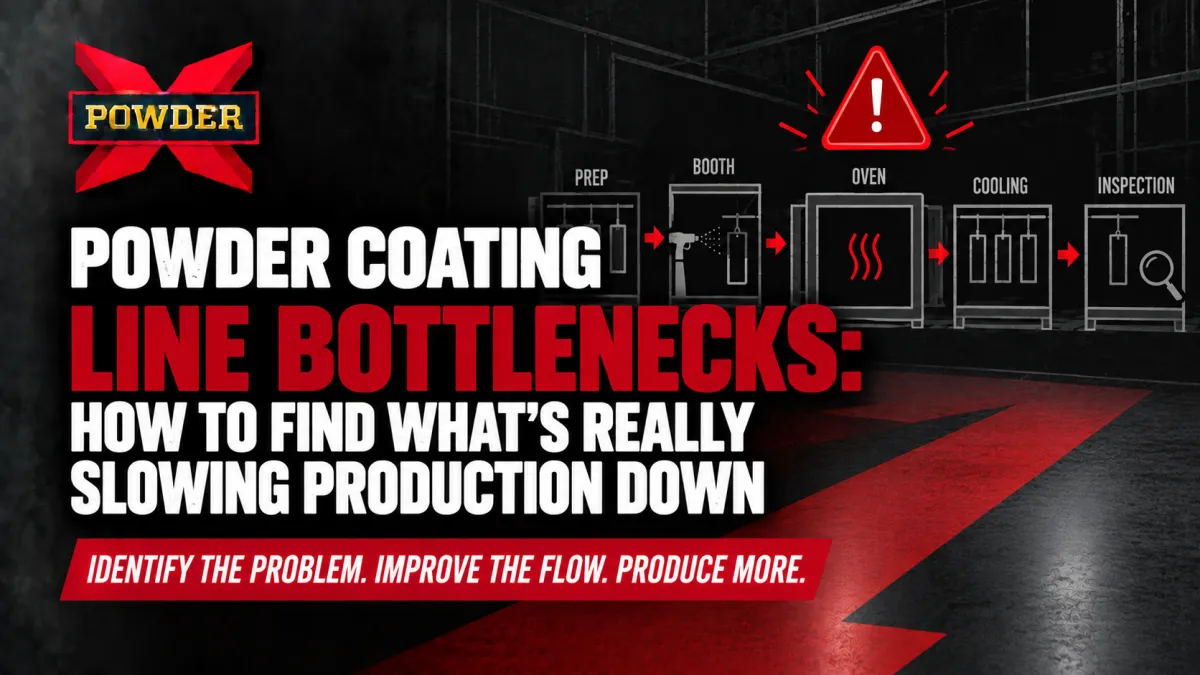
Powder Coating Line Bottlenecks: How to Find What's Really Slowing Production Down
A powder coating shop can have a great oven, a professional booth and experienced operators—and still struggle to get enough finished parts out the door.
Racks are waiting. Employees are moving parts around. The oven is running. The booth is busy. Everybody seems to be working hard.
But production isn't keeping up.
At Powder-X, that's a sign that the problem may not be how hard the equipment or employees are working.
The real problem may be a bottleneck somewhere in the process.
Before investing in bigger equipment, additional employees or automation, a powder coating operation needs to identify what's actually slowing production down.
Because speeding up the wrong part of the process won't necessarily make the shop more productive.
What Is a Bottleneck in Powder Coating?
A bottleneck is the step in a production process that limits how much work the entire operation can complete.
Think about traffic on a highway.
Four lanes of traffic move smoothly until the road narrows to one lane. It doesn't matter how fast the cars were traveling before that point. Everybody eventually slows down.
A powder coating operation works the same way.
If preparation can handle 100 parts per hour, the booth can coat 80, but the oven can only cure 40, the oven may be the bottleneck.
The entire operation can't consistently produce more than its limiting step allows.
And here's the important part:
A bottleneck isn't always a piece of equipment.
It might be a shortage of racks, poor scheduling, excessive color changes, inefficient material handling or a preparation process that can't keep up.
Start by Following the Parts
One of the simplest ways to identify production bottlenecks is to follow a batch of parts through the shop.
Where do they arrive?
How long do they wait before preparation?
How long does preparation take?
Are they waiting for a rack?
How long does coating take?
Do they sit outside the oven?
How long does curing take?
Where do they go afterward?
Look for the places where parts consistently stop moving.
A rack waiting five minutes might not seem like much. But if that delay happens ten times per shift, the shop has lost 50 minutes of potential production time.
The goal is to understand where time is being spent and where time is being wasted.
Bottleneck #1: Surface Preparation
Preparation is one of the most important stages of powder coating, but it can also become a major production limitation.
Blasting, washing, chemical pretreatment, rinsing and drying all take time.
Powder-X emphasizes proper surface preparation because it directly affects appearance, adhesion and corrosion protection.
That means preparation can't simply be rushed to increase production.
But the process can be organized more efficiently.
If operators are waiting for parts to be cleaned, or the booth regularly sits empty because preparation hasn't finished, the problem may start before powder application.
A booth capable of coating 100 parts per hour doesn't help much if preparation only supplies 30.
Bottleneck #2: Poor Racking and Grounding
Hooks and racks may look like small details, but they can affect the entire production schedule.
If parts take too long to hang, racks aren't available or operators constantly rearrange parts to improve access, valuable time disappears.
Poor grounding can also create application problems that require additional spraying or rework.
A better rack may allow more parts to move through each cycle while improving coating access and consistency.
For repeat jobs, dedicated fixtures can make a significant difference.
Instead of spending money on more equipment, a shop may be able to improve throughput simply by changing how parts are presented to the equipment already installed.
Sometimes production doesn't need a bigger machine. It needs a better rack.
Bottleneck #3: The Powder Coating Booth
It's easy to assume that a busy booth is a productive booth.
Not necessarily.
An operator may spend significant time adjusting gun settings, changing colors, correcting coverage problems or waiting for parts to arrive.
The booth might be operating all day without producing as many acceptable parts as it should.
Look at what happens between jobs.
Are color changes taking longer than necessary?
Is powder equipment being cleaned efficiently?
Are operators struggling with difficult part orientations?
Are gun settings being established from scratch every time a repeat job returns?
A repeatable application process can reduce unnecessary adjustments and help parts move through the booth more consistently.
Bottleneck #4: The Curing Oven
The oven often gets blamed first when production starts backing up.
Sometimes that's justified.
If coated racks are constantly waiting outside an oven that's already running efficiently, curing capacity may be limiting production.
But don't assume that means the shop needs a larger oven.
Look at the entire oven cycle.
How long does loading take?
How long does the part need to reach the required temperature?
How long is the actual cure?
How long does unloading take?
How much time passes before the next load enters?
Remember that powder coating cure requirements depend on part-metal temperature, not simply the oven controller setting.
The correct cure schedule must be maintained.
But better staging, improved rack density and reduced loading delays may increase production without compromising quality.
The goal isn't to shorten the cure. It's to eliminate unnecessary time around the cure.
Bottleneck #5: Material Handling
This is one of the easiest production problems to overlook.
Parts move from receiving to preparation, then to racking, coating, curing, cooling and inspection.
Every unnecessary movement consumes labor.
If employees constantly move one rack to reach another, push carts across the building or wait for a forklift, the layout may be slowing production.
That's why Powder-X approaches shop layout as part of the complete coating system.
Equipment placement should support the way parts naturally move through the operation.
A well-designed workflow reduces backtracking, congestion and unnecessary handling.
Parts should spend more time being processed and less time being moved around.
Bottleneck #6: Cooling and Finished-Part Staging
Parts coming out of the oven need somewhere to cool safely.
If the cooling area is full, the next rack may have nowhere to go.
Now the oven can't unload.
If the oven can't unload, the next load can't enter.
And suddenly, a lack of floor space is affecting production capacity.
The same problem can happen when finished parts wait too long for inspection or packaging.
A shop needs enough planned staging space to keep work moving without filling every aisle with racks.
Sometimes a small layout improvement can create a noticeable production improvement.
Bottleneck #7: Rework
Rework is a production bottleneck that can be especially expensive.
Every part that needs to be stripped, prepared, coated or cured again consumes resources that could have been used for new work.
Imagine an operation processing ten oven loads per day.
If two loads are rework, only eight loads represent new production.
The equipment is busy, but productive output has dropped.
That's why Powder-X treats quality control as part of production efficiency.
Better preparation, grounding, application, cure verification and inspection can reduce the amount of work that has to pass through the system twice.
The fastest part through a powder coating shop is the one that only needs to be coated once.
How to Find the Real Bottleneck
Before making changes, measure what the shop is actually doing.
Start with a normal production shift and record how many good parts each major process can complete.
Then look at waiting time.
For example:
Process | Capacity per hour |
|---|---|
Preparation | 80 parts |
Racking | 70 parts |
Powder application | 60 parts |
Curing | 40 parts |
Inspection and packaging | 65 parts |
Illustrative example only. Actual capacity depends on part mix, equipment and process requirements.
In this example, curing is the apparent bottleneck because it has the lowest hourly capacity.
But that doesn't automatically mean the shop needs another oven.
First investigate whether the oven is fully loaded, whether racks are staged correctly, whether loading and unloading are efficient and whether the cure process has been properly profiled.
If those factors are already optimized, additional curing capacity may be justified.
If not, the shop may have opportunities to improve output before buying equipment.
Don't Improve a Process That Isn't Limiting Production
Here's where companies can waste money.
Suppose the booth can coat 100 parts per hour, but the oven can only cure 50.
Buying equipment that increases booth capacity to 150 parts per hour won't necessarily increase the number of finished parts leaving the building.
It may simply create a larger pile of coated parts waiting for the oven.
That's why bottleneck analysis matters.
Improving the fastest process doesn't help much when the slowest process still controls production.
Start with the constraint that's limiting output. Improve it. Then measure the process again.
As production increases, the bottleneck may move somewhere else.
That's normal.
Production improvement is an ongoing process, not a one-time equipment purchase.
Measure Good Parts Per Hour
A busy shop isn't necessarily an efficient shop.
A useful starting metric is:
Good Finished Parts ÷ Production Hours = Good Parts Per Hour
For example, if a shop produces 320 acceptable parts during an eight-hour shift:
320 ÷ 8 = 40 good parts per hour
Now suppose better racking, improved staging and fewer delays increase production to 400 acceptable parts in the same shift.
That's 50 good parts per hour—a 25% increase in output.
The oven didn't get bigger.
The building didn't get bigger.
The operation simply became more efficient.
For shops producing different types of parts, measuring completed racks, standard production hours or output by part family may provide a more useful comparison than raw part counts alone.
When Is It Time to Buy More Equipment?
Eventually, every production system has limits.
If preparation, racking, application, curing and material handling are operating efficiently, but demand consistently exceeds capacity, additional equipment may make financial sense.
That could mean a larger oven, another booth, improved pretreatment equipment, additional application capacity or a transition toward conveyorized production.
But the decision should follow the production data.
Powder-X's approach is to match equipment to the work, the facility and the business's realistic production goals.
Don't buy more equipment because the shop feels busy. Buy more equipment when the numbers show exactly where additional capacity is needed.
The Powder-X Takeaway
Powder coating production bottlenecks aren't always obvious.
Sometimes the oven is the problem.
Sometimes it's preparation.
Sometimes it's poor racking, slow color changes, insufficient staging, inefficient material handling or too much rework.
The important thing is to stop guessing.
Follow the parts. Measure production. Identify where work consistently waits. Improve the limiting step and measure again.
Because a powder coating shop doesn't become more profitable simply by keeping everyone busy.
It becomes more profitable by getting more good parts through the process efficiently.
The goal isn't to make every piece of equipment run faster. It's to make the entire operation work better together.
Ready To Build A Powder Coating System The Right Way?
Whether you are starting your first powder coating business, bringing finishing in-house, or upgrading an existing operation, Powder-X can help you choose a batch system built around your goals.
From ovens and booths to complete systems, training, technical support, and long-term guidance, our team is here to help you make a smart investment in equipment that is designed to perform.
Contact Powder-X today to speak with one of our coating specialists and start building a powder coating operation with confidence


