
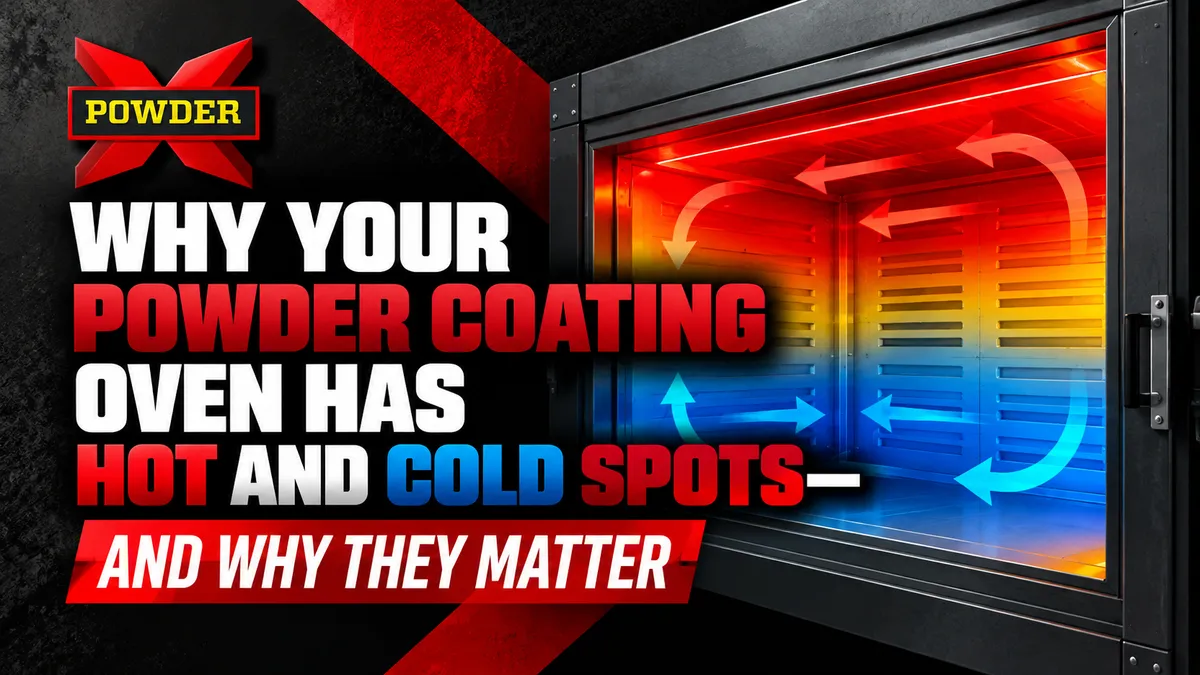
Powder Coating Oven Hot and Cold Spots: Causes & Fixes | Powder-X
Why Your Powder Coating Oven Has Hot and Cold Spots—and Why They Matter
Your powder coating oven says 400°F. The timer goes off, the parts come out, and everything looks good.
But later, some parts fail an adhesion test. Others have inconsistent gloss, and a few don't seem to have cured properly.
So what happened?
The problem might not be the powder, the gun or even the operator. It could be the temperature distribution inside the oven.
Just because your oven displays 400°F doesn't mean every part inside is experiencing the same temperature.
At Powder-X, understanding how heat moves through an oven is an important part of producing consistent, professional finishes.
What Are Hot and Cold Spots in a Powder Coating Oven?
Hot and cold spots are areas inside an oven where temperatures run higher or lower than other areas.
Think about a kitchen oven. Cookies near the back might brown faster than those near the door because heat isn't distributed perfectly evenly.
The same basic principle applies to powder coating ovens.
In an industrial curing oven, uneven temperatures can result from airflow problems, equipment design, loading patterns or maintenance issues.
And when different parts experience different temperatures, they may not cure the same way.
1. Poor Airflow and Heat Circulation
One of the most common reasons for uneven oven temperatures is poor airflow.
In a convection powder coating oven, heated air circulates around the parts to transfer heat into the metal.
If that airflow is restricted or poorly distributed, some areas may receive more heat than others.
Parts positioned directly in strong airflow may heat faster, while parts in poorly circulated areas take longer.
How to fix it: Inspect the circulation system, fan operation, air-distribution components and any blocked airflow paths. Follow the oven manufacturer's maintenance and adjustment procedures.
A properly designed convection oven should distribute heated air consistently throughout its usable work area.
2. Overloading the Oven
Trying to fit more parts into each oven cycle might seem like an easy way to increase production.
But overcrowding can interfere with heat circulation.
When parts are packed too closely together, they can block airflow and create areas that heat more slowly.
This is especially important with large fabricated assemblies or tightly loaded racks.
How to fix it: Allow appropriate spacing between parts and racks. Establish loading patterns that provide consistent airflow without sacrificing unnecessary production capacity.
The goal isn't simply to fit the most parts inside the oven. It's to cure the most acceptable parts efficiently.
3. Different Part Sizes and Thicknesses
Not every apparent cold spot is actually an oven problem.
A thin metal bracket and a thick steel plate will heat at different rates, even when they're exposed to the same oven temperature.
The heavier part generally needs more time to reach the required curing temperature.
That can make it seem like one section of the oven isn't heating correctly when the real difference is the amount of metal being heated.
How to fix it: Account for part thickness, mass and material when establishing cure cycles. Whenever practical, group parts with similar heating requirements.
Remember, oven temperature and part-metal temperature are not the same thing.
4. Worn Door Seals and Heat Loss
Oven doors are another area worth checking.
Damaged seals, poorly fitting doors or excessive door openings can allow heat to escape.
That may cause temperature fluctuations, particularly near the door or during repeated loading and unloading.
The oven may eventually recover, but the parts inside can experience different heating conditions during that time.
How to fix it: Inspect door seals, hinges and closing mechanisms. Repair damaged components and follow consistent loading procedures to minimize unnecessary heat loss.
5. Temperature Sensors and Controls
Sometimes the oven is heating, but the temperature reading doesn't tell the full story.
A temperature sensor measures conditions at its installed location. It doesn't automatically represent every point inside the oven.
If the sensor is poorly positioned, damaged or out of calibration, the displayed temperature may not accurately reflect the conditions experienced by the load.
How to fix it: Verify sensor placement, calibration and control performance according to the oven manufacturer's recommendations.
For a more complete picture, use an oven temperature survey or profiling system.
Why Hot and Cold Spots Matter
Uneven temperatures can create more than appearance problems.
If a part doesn't receive the required curing conditions, the coating may be under-cured.
That can affect properties such as adhesion, hardness, chemical resistance and durability.
Excessive heat exposure can create different problems, including color or gloss changes with certain powder formulations.
The result is an inconsistent process: parts from the same batch may look similar but perform differently.
And when those problems lead to rework, the shop pays for additional labor, powder, energy and production time.
An oven that heats unevenly can quietly turn a profitable job into an expensive one.
How to Check for Hot and Cold Spots
The most reliable approach is to measure what's actually happening inside the oven.
An oven temperature survey uses multiple calibrated sensors positioned throughout the usable work area to identify temperature differences.
A separate cure profile uses thermocouples attached to representative parts to track how quickly the metal heats and how long it remains within the required cure conditions.
These measurements answer two different questions:
Oven temperature survey: Is the oven distributing heat consistently?
Part-metal temperature profile: Is the coating receiving the cure specified by the powder manufacturer?
Both are valuable.
If a problem appears only with certain parts, examine the loading pattern and part mass. If it repeatedly appears in the same oven location, investigate airflow, heat distribution and equipment condition.
Avoid changing multiple settings at once. Document the results so the cause can be identified and corrected.
Can You Fix Hot and Cold Spots by Increasing the Oven Temperature?
Turning up the temperature might seem like the easiest solution.
But it can create another problem.
If one section of the oven is too cold, increasing the overall setpoint may cause parts in hotter areas to receive unnecessary heat exposure.
The better approach is to identify why the temperature difference exists.
That could mean correcting airflow, adjusting loading patterns, repairing door seals or servicing the control system.
The goal isn't to make the hottest area hotter. It's to make the entire curing process more consistent.
The Powder-X Takeaway
A powder coating oven does more than heat parts. It plays a major role in determining whether the finished coating performs as intended.
Poor airflow, overcrowded racks, heat loss, control problems and differences in part mass can all contribute to inconsistent curing.
That's why professional powder coating operations need to understand both oven temperature distribution and actual part-metal temperature.
Inspect the equipment. Maintain proper airflow. Load parts consistently. Verify curing conditions instead of relying only on the oven display.
A consistent powder coating finish starts with consistent heat—and knowing what the metal is actually experiencing inside the oven.
Ready To Build A Powder Coating System The Right Way?
Whether you are starting your first powder coating business, bringing finishing in-house, or upgrading an existing operation, Powder-X can help you choose a batch system built around your goals.
From ovens and booths to complete systems, training, technical support, and long-term guidance, our team is here to help you make a smart investment in equipment that is designed to perform.
Contact Powder-X today to speak with one of our coating specialists and start building a powder coating operation with confidence


