Powder Coating Quality Control: Tests Every Shop Should Run | Powder-X
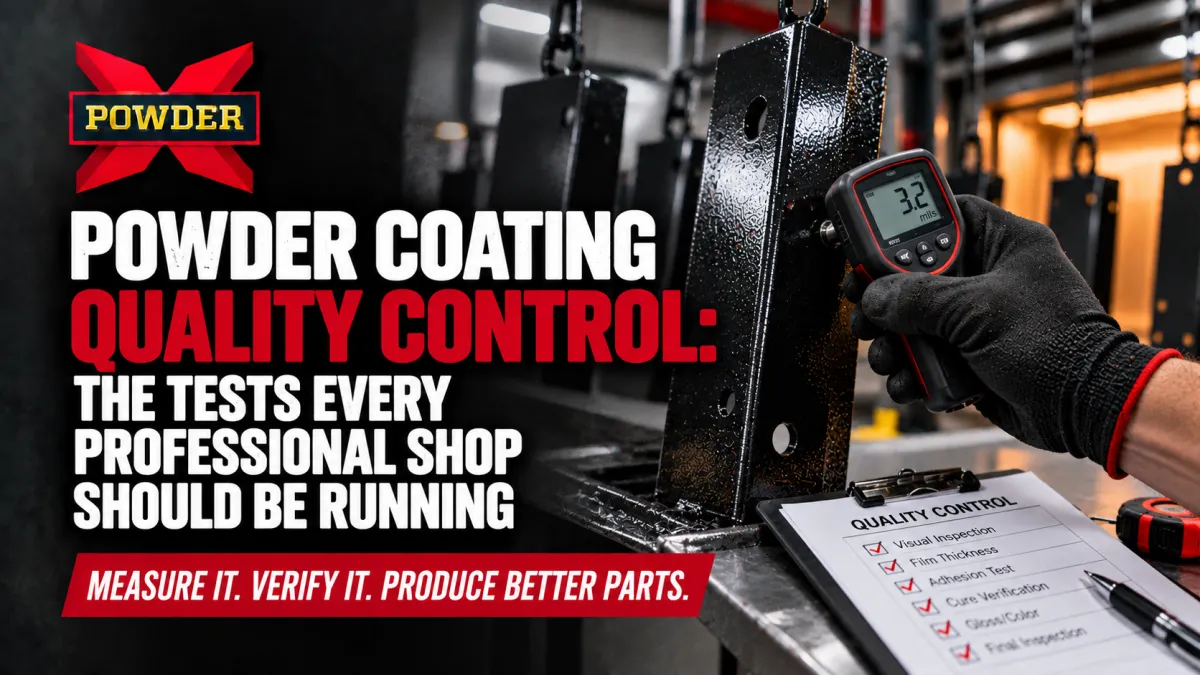
Powder Coating Quality Control: The Tests Every Professional Shop Should Be Running
A powder-coated part can look great and still be wrong.
The color matches. The gloss looks good. Coverage appears even. The customer picks it up happy.
Then the coating chips, peels or fails in service.
That's why professional powder coating quality control can't stop with “It looks good.”
At Powder-X, quality starts long before final inspection. Preparation, application and cure all affect the finished coating. The purpose of testing is to verify that those processes produced the result they were supposed to produce.
You don't test because you expect the coating to fail. You test so you know the process is working.
What Does Powder Coating Quality Control Actually Mean?
Quality control is simply a repeatable way of checking that finished parts meet the requirements established for the job.
Those requirements won't be identical for every customer.
A decorative indoor product doesn't necessarily need the same testing as an exterior component exposed to weather, chemicals or heavy use. An OEM may also provide its own coating specification with specific tests and acceptance criteria.
The important point is to stop treating quality as an opinion.
"That looks about right" isn't a measurement.
A professional operation should know what it's trying to achieve, how it will measure it and what happens when a part falls outside the acceptable range.
1. Start With Visual Inspection
Yes, appearance still matters.
Visual inspection is one of the simplest quality checks and should be part of every coating operation.
Look for obvious defects such as:
thin or missed areas,
excessive orange peel,
pinholes or outgassing,
craters or fisheyes,
contamination,
inconsistent color or gloss,
runs or excessive buildup,
poor coverage in corners and Faraday areas.
Lighting matters here. Inspecting dark parts in a poorly lit corner of the shop isn't much of an inspection.
Visual inspection won't tell you everything, but it can tell an experienced operator that something in the process deserves a closer look.
2. Measure Film Thickness
A coating can look perfect while being too thin—or far thicker than necessary.
That's why a dry film thickness gauge is such an important quality-control tool.
Powder manufacturers typically provide a recommended film-thickness range for their coatings. That target matters because insufficient film build can affect coverage and performance, while excessive film build can waste powder and contribute to appearance problems.
Powder-X training emphasizes applying the coating within the manufacturer's recommended thickness rather than assuming more powder creates a better finish. Powder Coach's Playbook Final E…
Take measurements at multiple locations when appropriate, especially on larger or more complicated parts.
If film thickness matters, measure it. Don't eyeball it.
3. Verify Cure—Don't Assume It
This is one of the biggest quality-control mistakes in powder coating.
The oven is set to 400°F, so the part must be cured.
Not necessarily.
Powder coating cure requirements are based on the part-metal temperature, not simply the temperature displayed on the oven controller.
A heavy steel fabrication may take considerably longer to reach the required temperature than a thin sheet-metal panel. Powder-X's training material stresses following the powder manufacturer's Technical Data Sheet and ensuring the entire part reaches the required cure temperature for the required amount of time. Powder Coach's Playbook Final E…
A temperature data logger with probes attached to the part can help verify what is actually happening during the cure cycle.
Remember:
The oven tells you the environment. The metal tells you the process.
4. Perform an Adhesion Test When the Job Requires It
A beautiful coating doesn't mean much if it doesn't stay attached to the substrate.
One common method of evaluating adhesion is the cross-cut or cross-hatch adhesion test. A controlled pattern is cut through the coating, tape is applied and removed according to the applicable test procedure, and the coating is evaluated for loss of adhesion.
ASTM D3359 is a widely used standard for assessing coating adhesion by tape testing, although the correct method and acceptance criteria depend on the coating system and customer specification.
The important part isn't simply owning an adhesion-test kit.
It's understanding why you're testing and what constitutes a passing result for that job.
If adhesion is poor, don't immediately blame the powder. Start looking at the complete process—cleaning, pretreatment, substrate condition and cure.
5. Check Cure With the Appropriate Test
A properly profiled oven is one of the strongest ways to verify the cure process, but shops may also use additional tests as part of their quality program.
Depending on the powder and specification, this might include a solvent-rub test or another cure-related test prescribed by the coating manufacturer or customer.
This is where following the powder supplier's documentation matters.
Different powder chemistries and specifications can require different evaluation methods. A test that is appropriate for one coating shouldn't automatically be applied to everything that comes through the shop.
The Technical Data Sheet should be part of the process—not something that stays unopened in a filing cabinet.
6. Test Impact Resistance When Performance Demands It
Some coated products are going to get bumped, handled, assembled or abused.
An impact test helps evaluate how the coating behaves when the substrate is suddenly deformed.
A controlled weight is dropped using an impact tester, and the coating is examined for cracking or loss of adhesion according to the applicable test method and specification.
For production parts exposed to real mechanical demands, this can provide information that a simple visual inspection never will.
Again, the goal isn't to perform every laboratory test on every bracket leaving the building.
It's to match testing to how the product is actually expected to perform.
7. Consider Bend or Flexibility Testing
If the finished component will bend, flex or undergo forming, coating flexibility may matter.
Mandrel bend and similar tests can evaluate whether a coating remains attached as the substrate is bent around a defined radius.
A coating might have excellent appearance and adhesion on a flat panel but crack when the metal underneath it is deformed.
That's why quality specifications should be connected to the product's real-world use.
8. Measure Gloss and Color When Consistency Matters
"Looks close enough" may work for some jobs.
It doesn't work for all of them.
Manufacturers producing repeat products may need consistent gloss and color from batch to batch.
A gloss meter provides an objective measurement rather than relying solely on an operator's perception. Color-measurement instruments can be used when tighter color control is required.
This becomes especially valuable when the same product is manufactured repeatedly over months or years.
Instead of comparing today's part to somebody's memory of what last month's part looked like, the shop has measurable data.
9. Test Pretreatment, Not Just the Finished Coating
Quality control shouldn't begin after the part leaves the oven.
By then, many important decisions have already been made.
Powder-X teaches that preparation supports three critical objectives: appearance, adhesion and corrosion protection.Powder Coach's Playbook Final E…
For chemical pretreatment systems, important process variables can include time, temperature, chemical concentration and impingement. Those variables need to stay within the requirements of the chemical supplier and the process being used. Powder Coach's Playbook Final E…
Depending on the system, that may mean monitoring chemical concentration, pH, temperature or other bath conditions specified by the chemical manufacturer.
A perfect film-thickness reading can't undo poor pretreatment underneath the coating.
10. Keep an Eye on Grounding and Compressed Air
These may not look like traditional finished-part tests, but they're important process-control checks.
Powder-X puts considerable emphasis on proper grounding because electrostatic application depends on a reliable path to ground. Dirty hooks and poor contact can affect transfer efficiency, coverage and Faraday-area penetration. Powder Coach's Playbook Final E…
Compressed air deserves the same attention.
Powder is hygroscopic, and moisture or oil contamination in compressed air can create application and finish problems. Clean, dry air helps keep powder delivery consistent. Powder Coach's Playbook Final E…
Good quality control doesn't only inspect failures.
It monitors the conditions that create good parts in the first place.
Do You Need to Run Every Test on Every Part?
No.
That can become expensive and unnecessary.
A better quality-control plan is based on the customer's requirements, coating manufacturer's recommendations, applicable specifications and the intended service environment.
A basic commercial job might require visual inspection, film-thickness measurements and documented cure verification.
A demanding OEM application might require considerably more testing and documentation.
Some tests can also be destructive, which means they're commonly performed on representative test panels or samples rather than every production part.
The important thing is consistency.
Define what gets tested, how often it gets tested, the acceptable range and what happens when something fails.
Build a Simple Powder Coating Quality-Control Record
Testing becomes much more valuable when the results are recorded.
A shop doesn't need to create paperwork simply for the sake of paperwork. But recording a few important process measurements can make troubleshooting dramatically easier.
For a production job, that might include the powder and lot, pretreatment checks, film-thickness readings, oven profile or cure verification, visual inspection results and any customer-required performance tests.
Then, when something changes, there is something to compare.
If coating failures suddenly appear after six months of good production, the question becomes:
“What changed?”
Data can help answer it.
Quality Control Is Also Profit Control
Quality testing isn't simply about satisfying specifications.
It protects the business.
Every defective part potentially means additional powder, labor, stripping, preparation, oven time and lost production capacity. As discussed in Powder-X's guide to the hidden cost of rework, a quality problem quickly becomes a profitability problem.
Catching a process drifting out of control after five parts is very different from discovering it after 500.
That's the financial value of quality control.
Testing costs money. Reworking an entire production run costs considerably more.
The Powder-X Takeaway
Professional powder coating isn't just about creating a finish that looks good when it comes out of the oven.
It's about creating a controlled process capable of producing the expected result again and again.
Inspect the appearance. Measure film thickness. Verify cure. Test adhesion and mechanical performance when the specification requires it. Monitor pretreatment. Check grounding and compressed air. Document the measurements that matter.
Most importantly, follow the requirements established by the powder manufacturer, pretreatment supplier, customer and applicable specifications rather than inventing one universal test program for every job.
Because professional quality control answers a much more important question than:
"Does it look good?"
It answers:
“Can the process prove that it's good?”
Ready To Build A Powder Coating System The Right Way?
Whether you are starting your first powder coating business, bringing finishing in-house, or upgrading an existing operation, Powder-X can help you choose a batch system built around your goals.
From ovens and booths to complete systems, training, technical support, and long-term guidance, our team is here to help you make a smart investment in equipment that is designed to perform.
Contact Powder-X today to speak with one of our coating specialists and start building a powder coating operation with confidence.


