Powder Coating Shop Layout: How to Avoid Bottlenecks | Powder-X
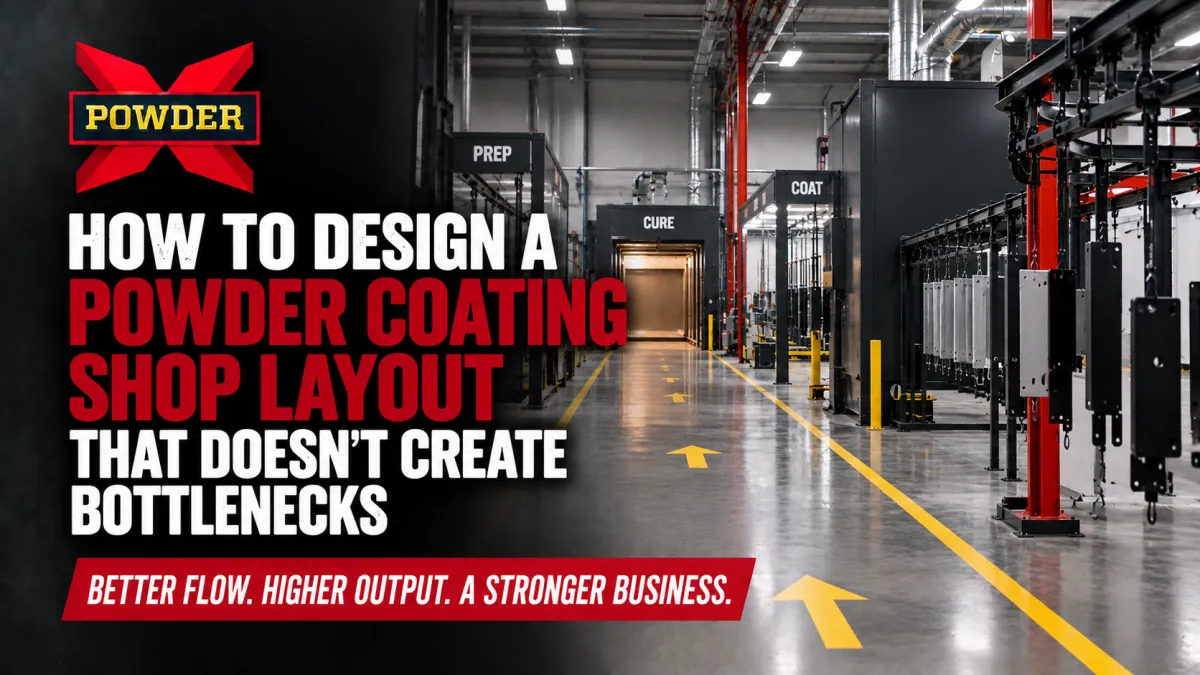
How to Design a Powder Coating Shop Layout That Doesn't Create Bottlenecks
A powder coating shop can have a great oven, a properly sized booth, and experienced operators—and still struggle to get enough work out the door.
Sometimes the problem isn't the equipment.
It's the layout.
At Powder-X, equipment should be designed around the process the business needs to run. Where equipment is placed, how parts move, and where work waits can have a major effect on production and efficiency.
A good powder coating shop should help parts move naturally from one step to the next.
The goal isn't to fit equipment into a building. It's to build a workflow inside the building.
First, What Is a Bottleneck?
If you're newer to manufacturing, "bottleneck" is simply a term for the part of a process that limits everything behind it.
Think about pouring water from a bottle. The bottle may hold plenty of water, but everything has to pass through the narrow neck before it can get out.
A powder coating line works the same way.
If the booth can coat 30 parts per hour but the oven can only cure 10, the oven becomes the bottleneck. If the oven has plenty of capacity but employees can only prepare eight parts per hour, preparation becomes the bottleneck.
Additionally, bottlenecks aren't always pieces of equipment.
A narrow aisle, poorly located rack storage, long travel distance, insufficient cooling space, or parts constantly crossing each other's path can slow the entire operation.
Your shop can only move as efficiently as its slowest critical step.
Start With the Process, Not the Floor Plan
It's tempting to begin designing a powder coating shop by asking:
"Where can the oven fit?"
That's usually the wrong first question.
Start by mapping the process.
A typical operation might move through receiving, preparation, pretreatment, drying, masking, racking, powder application, curing, cooling, inspection, and packaging.
Not every shop will use exactly that sequence or every one of those steps. The process depends on the parts and production requirements.
But the principle remains the same:
Parts should move forward whenever possible.
If parts are constantly traveling backward across the building, crossing forklift traffic or being moved out of the way so another batch can pass, the layout is creating work that adds no value to the finished product.
Follow the Part Through the Building
One of the simplest ways to evaluate a layout is to pretend you're the part.
Where do you enter?
Where are you unloaded?
How far do you travel to preparation?
Where do you wait?
How do you reach the booth?
Where do you go after coating?
Can the loaded rack easily reach the oven?
Where do you cool?
Where are finished parts inspected and packaged?
Now count how many times the part has to be picked up, put down, turned around, or moved simply because it's in somebody else's way.
Those movements take time.
One unnecessary movement may not seem important. Multiply it by hundreds of parts every day, and it becomes labor you're paying for without producing another finished part.
Size the Oven and Booth as a System
Powder coating equipment should not be sized independently.
Suppose a booth and operator can prepare and coat a rack every 15 minutes, but the oven process only allows one rack every hour.
Pretty soon, coated racks are waiting for oven space.
Now the booth may stop because there is nowhere to put finished racks. Employees begin rearranging carts. Aisles fill up. The schedule starts slipping.
That's a bottleneck.
The opposite can happen too. A large oven isn't particularly productive if preparation and application can't keep it supplied with parts.
Powder-X's training emphasizes looking at powder coating as a complete process rather than a collection of individual machines. Preparation, application, and cure all have to work together.
The best equipment isn't necessarily the equipment with the greatest individual capacity. It's equipment with capacities that work together.
Give Pretreatment Enough Attention
Preparation is one of the most important stages in powder coating, but it can become an afterthought when designing the floor plan.
That's a mistake.
Powder-X teaches three primary reasons for proper preparation: appearance, adhesion, and corrosion protection.
If blasting, washing, chemical pretreatment or drying can't keep pace with production, everything downstream eventually waits.
There also needs to be enough room to perform these processes correctly.
A shop that can spray 20 parts while only preparing five isn't a 20-part operation.
It's a five-part operation with an expensive booth waiting for work.
Plan Around Material Handling
A 10-foot part fitting inside a 12-foot oven doesn't automatically mean the process works.
How does that 10-foot part get there?
Can it turn the corner between the booth and oven? Is the aisle wide enough? Does the rack fit through every doorway? Can an employee safely move it? Does a forklift need access?
This becomes even more important with large fabricated products and heavy assemblies.
Part dimensions, rack dimensions, and material-handling requirements should influence the layout from the beginning.
Otherwise, a company can end up with equipment capable of processing the part but a building that makes moving the part unnecessarily difficult.
Leave Room for Work-in-Process
Parts don't always move continuously.
They may wait for preparation. Pretreated parts may need staging before coating. Coated racks may wait for oven capacity. Finished parts need somewhere to cool before inspection and packaging.
That material is often called work-in-process, or WIP.
A good layout gives that work a defined place.
A poor layout lets it accumulate wherever there happens to be room.
That's when aisles disappear.
Carts get trapped. Employees start moving one rack just to reach another. Finished parts get mixed with unfinished parts.
A little planned staging space can prevent a lot of wasted movement.
The goal isn't to create enormous storage areas between every process. Too much WIP can hide production problems.
The goal is to give normal production flow enough breathing room.
Don't Forget Cooling
Parts coming out of the curing oven are hot.
They need somewhere to go.
This sounds obvious, but cooling space can easily be underestimated during layout planning because it isn't a major piece of equipment.
If the cooling area is too small, hot racks can begin backing up at the oven exit.
Now the oven can't unload.
If the oven can't unload, another load can't go in.
Suddenly, a few feet of missing floor space is affecting the capacity of one of the most important pieces of equipment in the shop.
Empty floor space can be production equipment when it's in the right place.
Keep Clean and Dirty Work From Fighting Each Other
Powder coating needs cleanliness.
Blasting, grinding, and other preparation processes can create dust and contamination. Powder application needs a controlled environment.
Putting those processes too close together—or designing traffic so dirty parts constantly move through clean coating areas—can create unnecessary contamination problems.
The layout should consider more than travel distance.
It should consider what each area is doing to the environment around it.
The shortest path isn't always the best path if it carries contamination directly toward the booth.
Think About Color Changes and Powder Storage
If an operation changes colors frequently, the layout should support it.
Where is powder stored?
How far does an operator travel to retrieve it?
Where are supplies staged?
Where does cleaning occur?
Where are commonly used colors located?
A few extra minutes per color change can become significant when repeated throughout the week.
The same thinking applies to masking supplies, plugs, hooks, and maintenance items.
Operators shouldn't have to walk across the entire building every time they need something used repeatedly throughout the process.
Watch for People and Forklifts Crossing Paths
Efficient flow also needs to be safe flow.
If employees moving racks repeatedly cross forklift traffic, shipping traffic, or incoming raw parts, the layout deserves another look.
Where possible, separate predictable production movement from unrelated traffic.
The goal is to reduce congestion and unnecessary interaction between processes.
This isn't just about speed.
A shop layout has to work when production is busy—not only when the building is empty.
Design for Today's Production With a Path for Tomorrow
There's another mistake Powder-X sees in equipment planning: designing entirely around today's production without considering realistic growth.
If production increases, where does another rack go?
Could additional application equipment be added?
Is there room for a larger pretreatment process?
Could material handling eventually become automated?
Could a conveyor be incorporated?
Those are good questions.
But there is a difference between planning for growth and paying for imaginary growth.
The shop shouldn't waste half the building on capacity that may never be needed. It should avoid creating a layout where the only way to expand three years from now is to tear everything apart.
Find the Bottleneck Before Buying More Equipment
When production can't keep up, the natural reaction is often:
"We need more equipment."
Maybe.
But first identify what's actually limiting production.
If the oven sits empty because preparation can't supply enough parts, buying a larger oven won't fix the problem.
If racks spend 30 minutes waiting because employees can't move them through a congested aisle, another powder gun probably won't help either.
Watch the process.
Where do parts consistently pile up?
Where are employees waiting?
Which machine is always full?
Which machine is regularly sitting idle?
Where are racks being moved multiple times?
Where the work consistently waits, there's usually something worth investigating.
The Powder-X Approach to Shop Layout
A good powder coating layout starts with the work.
Part size. Part weight. Production volume. Pretreatment. Racking. Application. Cure requirements. Material handling. Utilities. Color changes. Cooling. Inspection. Shipping. Future growth.
Then the equipment gets designed around that process.
Because a powder coating shop isn't simply an oven sitting beside a booth.
It's a production system.
And when that system is laid out correctly, parts should move through it with as little unnecessary handling, waiting and backtracking as possible.
Don't design the shop around where the equipment fits. Design the equipment around how the work needs to flow.
Ready To Build A Powder Coating System The Right Way?
Whether you are starting your first powder coating business, bringing finishing in-house, or upgrading an existing operation, Powder-X can help you choose a batch system built around your goals.
From ovens and booths to complete systems, training, technical support, and long-term guidance, our team is here to help you make a smart investment in equipment that is designed to perform.
Contact Powder-X today to speak with one of our coating specialists and start building a powder coating operation with confidence.


