
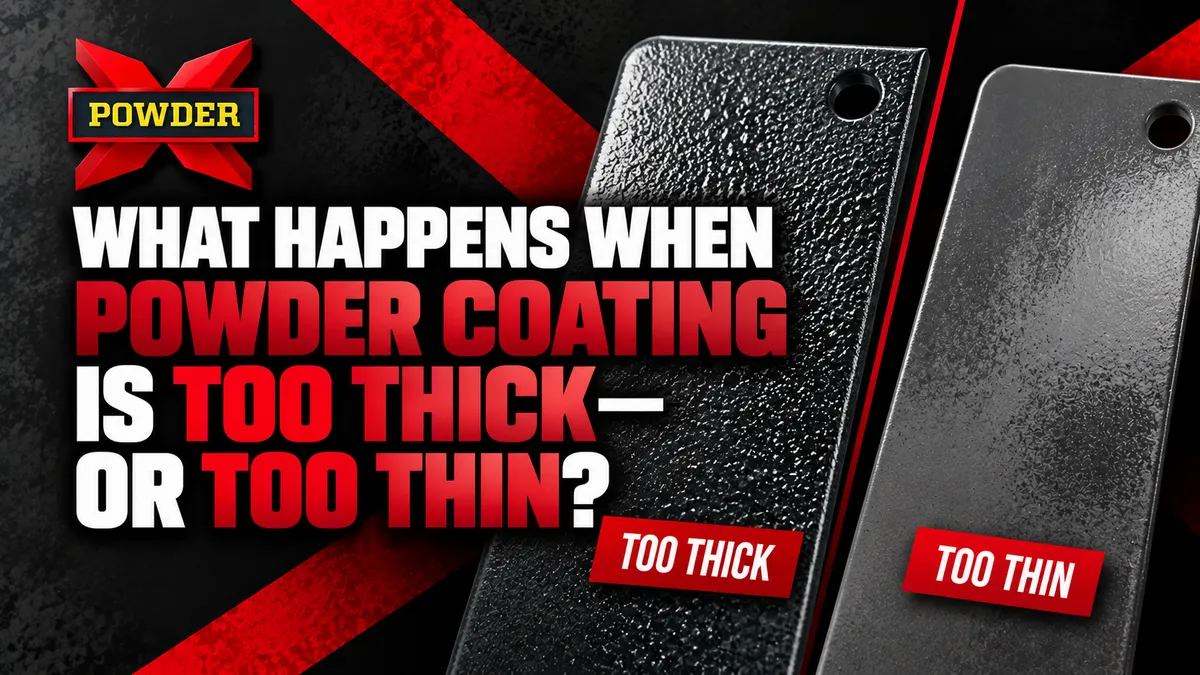
Powder Coating Too Thick or Too Thin? Causes & Fixes | Powder-X
What Happens When Powder Coating Is Too Thick—or Too Thin?
When it comes to powder coating, more isn't always better.
A coating that looks thick and durable might actually have too much powder applied. On the other hand, a thin coating may look perfectly fine until it starts showing signs of wear or corrosion.
So how much powder is enough?
At Powder-X, proper film thickness is an important part of producing a consistent, professional finish. Too much or too little powder can affect appearance, performance, and profitability.
The goal isn't to apply the most powder possible. It's to apply the right amount for the job.
What Is Powder Coating Film Thickness?
Film thickness is the measurement of how thick the cured powder coating is on a part.
It's commonly measured in mils, with one mil equal to one-thousandth of an inch.
For reference, 2 mils equals approximately 51 microns.
Many conventional powder coatings have recommended film thicknesses somewhere around 2–4 mils, but that isn't a universal requirement. Some powders and applications call for thinner or considerably thicker films.
The correct range comes from the powder manufacturer's Technical Data Sheet (TDS) and the customer's performance specifications.
A coating isn't better simply because it's thicker. It needs to be within the specified range.
What Happens When Powder Coating Is Too Thick?
Applying excessive powder may seem like an easy way to improve coverage or durability.
Unfortunately, it can create several problems.
1. Orange Peel and Uneven Texture
One of the most noticeable signs of excessive film thickness is orange peel.
Instead of flowing into a smooth finish, the coating develops a textured appearance resembling the skin of an orange.
Orange peel can have several causes, including powder formulation and curing conditions, but excessive film build is one factor worth checking.
How to fix it: Measure the cured film thickness and compare it with the manufacturer's recommendations. Adjust application settings and technique if the coating is too heavy.
2. Poor Appearance Around Corners and Edges
Too much powder can create uneven buildup, especially when an operator makes repeated passes trying to cover difficult areas.
The result may be an inconsistent finish, with heavy coating in accessible areas and poor coverage in recessed sections.
Increasing powder output isn't necessarily the solution.
How to fix it: Check grounding, gun distance, electrostatic settings, and part orientation. Difficult corners may require a different application approach rather than more powder.
3. Reduced Flexibility or Coating Performance
Some powder formulations can become more susceptible to cracking, chipping or other performance issues when applied beyond their recommended film thickness.
That doesn't mean every thick coating will fail. Certain products are specifically designed for high-build applications.
But applying a conventional powder far beyond its specified range can change how the coating behaves under impact, bending or other service conditions.
How to fix it: Follow the powder manufacturer's film-thickness requirements and verify the coating's performance where necessary.
4. More Powder Waste and Higher Costs
This one is straightforward.
If a job requires 3 mils of coating and the shop consistently applies 5 mils, more material is being used than the specified process requires.
Across hundreds or thousands of parts, that excess consumption can become a significant expense.
Heavy application may also increase spraying time and contribute to additional rework.
More powder on the part doesn't automatically mean more value for the customer.
What Happens When Powder Coating Is Too Thin?
Applying too little powder creates a different set of problems.
A thin coating may look acceptable immediately after curing, but it may not provide the intended appearance or protection.
1. Poor Coverage and Visible Substrate
One of the most obvious signs of insufficient film thickness is poor hiding.
The underlying metal may show through, or the finish may appear uneven in color and gloss.
This is especially noticeable with certain colors, textures, and part geometries.
How to fix it: Check powder flow, application technique, grounding, and film thickness. Verify that the coating reaches the powder manufacturer's recommended range.
2. Reduced Corrosion Protection
Powder coating is often selected because it provides a durable protective finish.
But when the coating is thinner than specified, it may not deliver the intended barrier protection.
Thin spots, especially around edges and difficult-to-reach areas, can leave the substrate more vulnerable to corrosion.
Surface preparation and pretreatment still matter. A thick coating won't compensate for poor preparation, and a thin coating shouldn't be expected to perform beyond its design.
How to fix it: Measure film thickness in representative locations, including areas prone to low coverage, and confirm that the complete coating system meets the required specification.
3. Lower Resistance to Wear and Damage
Depending on the powder chemistry and application, insufficient film thickness can reduce the coating's ability to withstand abrasion, handling or service conditions.
A part may look good when it leaves the shop but fail to meet its intended performance requirements.
How to fix it: Apply the specified film build and use appropriate quality-control testing when required by the customer or coating standard.
4. Inconsistent Color and Finish
Film thickness can also affect appearance.
Some colors and special-effect powders are particularly sensitive to variations in film build.
One part may appear slightly different from another even though both were coated with the same powder.
How to fix it: Establish a target thickness within the approved range and monitor it consistently throughout production.
How Can You Tell if Powder Coating Is Too Thick or Too Thin?
Appearance can offer clues, but it isn't a reliable measurement.
A coating that looks smooth may still be too thick. A coating that appears fully covered may still be below specification.
That's why professional powder coating operations use film-thickness gauges.
For many coated metal parts, a suitable nondestructive gauge can measure cured coating thickness without damaging the finish.
The correct instrument and measurement method depend on the substrate and coating system.
For example, magnetic-induction gauges are commonly used on coated ferrous metals, while eddy-current gauges can be used on suitable nonferrous metals.
Measurements should be taken at representative locations according to the applicable specification.
Don't guess at film thickness based on appearance. Measure it.
Why Is Film Thickness Inconsistent Across the Same Part?
Sometimes the average thickness is acceptable, but certain areas are too heavy or too thin.
That often points toward an application issue.
Poor grounding, incorrect gun settings, inconsistent spraying distance, and part geometry can all affect powder deposition.
The Faraday Cage effect can make it difficult for charged powder to reach recessed corners, while exposed surfaces may receive more coating.
Part orientation and racking also influence how easily the operator can reach different areas.
If the same problem keeps appearing in the same location, investigate the process before simply increasing powder output.
The goal is even, controlled coverage—not just an acceptable reading in the easiest place to measure.
How to Keep Powder Coating Thickness Consistent
Consistent film thickness starts with a repeatable application process.
Use the powder manufacturer's recommended settings as a starting point. Maintain clean grounding connections, verify powder delivery and keep gun distance and spraying technique consistent.
For recurring jobs, establish a documented application recipe.
Measure representative parts during production rather than waiting until the entire batch is finished.
And when a thickness problem appears, change one variable at a time.
That makes it easier to identify whether the issue comes from equipment settings, operator technique, part geometry or the powder itself.
Can You Fix Powder Coating That's Too Thick or Too Thin?
That depends on the coating, the defect, and the customer's requirements.
A part that's slightly outside the preferred range may still be acceptable if the applicable specification permits it and required performance is verified.
But a coating that fails its requirements shouldn't be accepted simply because it looks good.
For parts that are too thin, adding another coat may be possible with certain powder systems, but recoating requires an approved procedure and doesn't automatically correct the original problem.
For excessively thick coatings, stripping and recoating may be necessary if the finish or performance is unacceptable.
The best solution is to identify why the thickness was incorrect so the next batch doesn't have the same problem.
The Powder-X Takeaway
Powder coating film thickness is one of those details that can make a major difference in finished quality.
Too much powder can create appearance problems, unnecessary material costs, and, in some cases, reduced coating performance.
Too little powder can lead to poor coverage, inconsistent appearance, and inadequate protection.
Neither extreme is the goal.
Professional powder coating depends on applying the correct material at the correct thickness, using a controlled and repeatable process.
The best finish isn't the thickest or the thinnest. It's the one that meets the specification—and performs the way the customer expects.
Ready To Build A Powder Coating System The Right Way?
Whether you are starting your first powder coating business, bringing finishing in-house, or upgrading an existing operation, Powder-X can help you choose a batch system built around your goals.
From ovens and booths to complete systems, training, technical support, and long-term guidance, our team is here to help you make a smart investment in equipment that is designed to perform.
Contact Powder-X today to speak with one of our coating specialists and start building a powder coating operation with confidence


