Powder Coating Transfer Efficiency: Calculate Waste | Powder-X
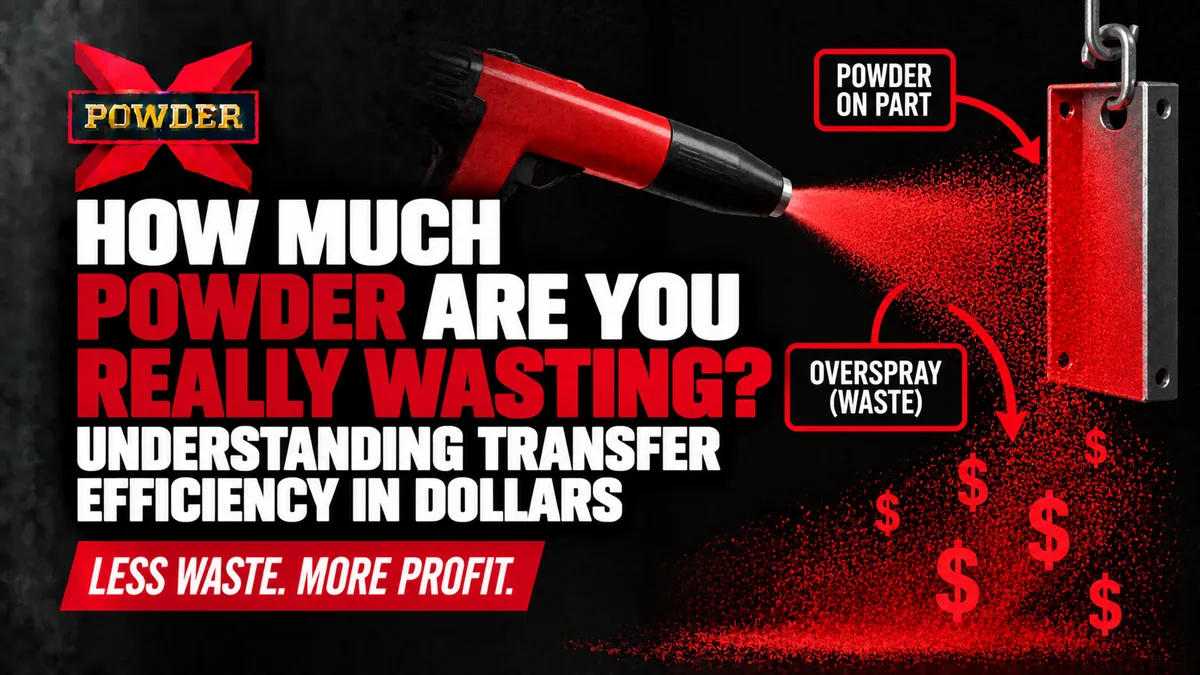
How Much Powder Are You Really Wasting? Understanding Transfer Efficiency in Dollars
Every pound of powder coating costs money.
But not every pound that comes out of the gun ends up on the part.
Some powder reaches the metal. Some becomes overspray. Some may be recovered and reused, depending on the equipment, powder, and process.
And some becomes waste.
For a shop coating a few parts each week, those losses might not seem significant. But as production grows, small differences in powder usage can turn into thousands of dollars over the course of a year.
At Powder-X, improving production efficiency isn't simply about coating more parts. It's about understanding how much material the operation consumes to produce those finished parts.
The important question isn't just how much powder you're buying. It's how much of that powder is actually making you money.
What Is Powder Coating Transfer Efficiency?
Transfer efficiency measures how much of the powder sprayed actually deposits on the intended parts.
It's usually expressed as a percentage.
For example, if a powder coating gun sprays 10 pounds of powder and 6 pounds deposit on the parts, the first-pass transfer efficiency is 60%.
The remaining 4 pounds become overspray.
That doesn't necessarily mean all 4 pounds are permanently wasted. A properly designed recovery system may be able to collect and reuse suitable overspray.
But the powder didn't reach the part on its first pass.
The basic formula is:
First-Pass Transfer Efficiency = Powder Deposited on Parts ÷ Powder Sprayed × 100
The higher the first-pass transfer efficiency, the less overspray the process produces for a given amount of powder deposited.
Better transfer efficiency means more of the powder being sprayed is doing the job it was purchased to do.
Why Transfer Efficiency Matters Financially
Consider two powder coating operations producing the same parts.
Both need to deposit 60 pounds of powder onto finished products.
One operates at 50% first-pass transfer efficiency.
The other operates at 75%.
The first shop must spray:
60 ÷ 0.50 = 120 pounds
The second shop must spray:
60 ÷ 0.75 = 80 pounds
That's a difference of 40 pounds of powder sprayed to achieve the same deposited coating mass.
At $6 per pound, the difference represents $240 worth of powder passing through the application process.
However, that $240 isn't automatically a $240 purchasing-cost saving. If recoverable overspray is reused, the actual material savings will be smaller.
The important point is that higher transfer efficiency reduces the amount of powder that must be handled as overspray.
Depending on the operation, that can mean less cleanup, less filter loading, less reclaim handling, and lower overall material consumption.
First-Pass Transfer Efficiency Isn't the Same as Powder Utilization
This distinction matters when calculating actual dollars.
First-pass transfer efficiency tells the shop how much sprayed powder reaches the parts immediately.
Overall powder utilization considers how much purchased powder ultimately becomes acceptable finished coating after accounting for recovery, reuse, and waste.
A shop with a reclaim system may achieve good overall powder utilization even when first-pass transfer efficiency is relatively modest.
A spray-to-waste operation is different.
Powder that misses the part may be collected for disposal rather than returned to production.
That means the financial impact of overspray depends heavily on how the system handles it.
To understand real powder waste, measure purchased powder against the amount that ends up on acceptable finished parts.
Calculate How Much Powder Is Actually Being Lost
Suppose a shop purchases and consumes 500 pounds of powder during a production period.
Of that amount, an estimated 325 pounds become coating on acceptable finished parts.
The overall powder utilization is:
325 ÷ 500 × 100 = 65%
That leaves 175 pounds that didn't become acceptable finished coating.
At $6 per pound:
175 × $6 = $1,050
That's $1,050 in powder material cost not represented in the acceptable finished coating.
Some of that difference may come from overspray. Some may come from color changes, cleaning, rejected parts, testing or other material losses.
The calculation doesn't identify the cause by itself.
But it tells the business there's a cost worth investigating.
What Does Powder Waste Cost Over a Year?
The annual impact becomes clearer when the numbers are expanded.
Imagine a shop consumes 500 pounds of powder every month at $6 per pound.
That's $3,000 in monthly powder purchases.
If 35% of purchased powder doesn't become acceptable finished coating, the implied material loss is $1,050 per month.
ILLUSTRATIVE ANNUAL POWDER COST
Annual powder purchases
$36,000
Annual powder not on good parts
$12,600
Example assumes 500 lb purchased and consumed monthly, $6/lb and 65% overall utilization. These are illustrative figures, not industry averages.
Now imagine the operation improves overall utilization from 65% to 75% while maintaining the same amount of acceptable finished coating.
Instead of purchasing approximately 500 pounds per month, the shop would need about 433 pounds.
That's roughly 67 pounds less each month.
At $6 per pound, the potential savings are approximately $400 per month, or $4,800 annually.
No additional customers.
No higher selling prices.
Just better material utilization.
And that's before considering potential reductions in cleanup, handling, and waste-management costs.
Poor Grounding Can Cost More Than You Think
One of the first places to investigate poor transfer efficiency is grounding.
Electrostatic powder coating relies on charged powder being attracted to a properly grounded part.
When that electrical connection is compromised, application can become less efficient and less consistent.
Dirty hooks, excessive coating buildup on racks, and poor metal-to-metal contact can all create problems.
The operator may respond by spraying more powder, making additional passes, or spending longer trying to achieve proper coverage.
That can increase powder consumption and labor.
Powder-X emphasizes keeping grounding points clean and maintaining hooks and racks because good grounding supports consistent application.
Before blaming the powder gun, make sure the part has a reliable path to ground.
More kV Doesn't Always Mean Better Transfer
It's tempting to assume that increasing electrostatic voltage will attract more powder to the part.
Sometimes an adjustment helps.
But higher voltage isn't automatically better.
Part geometry, gun-to-part distance, grounding, and the amount of powder already deposited all affect how charged powder behaves.
Excessive electrostatic settings can contribute to back-ionization or make coverage more difficult in recessed areas.
The Faraday Cage effect is another example. Tight corners and recesses can be difficult to coat because the electrostatic field tends to favor more exposed surfaces.
Trying to force powder into those areas by increasing voltage may make the problem worse.
Proper application settings should be selected for the part, powder, and equipment.
The goal isn't maximum voltage. It's controlled, efficient deposition.
Powder Flow Matters Too
More powder coming out of the gun doesn't necessarily mean more powder sticking to the part.
Excessive powder delivery can create a dense cloud that the part can't efficiently collect.
That can increase overspray without improving the finished coating.
Gun distance, air settings, powder flow, and application technique all need to work together.
Clean, dry compressed air is also important because moisture or oil contamination can affect powder delivery and finish quality.
If powder flow is inconsistent, operators may spend more time correcting coverage or applying unnecessary material.
A stable process helps control both quality and consumption.
Part Shape Can Affect Transfer Efficiency
Not every part coats the same way.
A flat metal panel presents a relatively accessible surface.
A complex fabricated assembly with recessed corners, deep channels and difficult angles creates a different application challenge.
Part orientation can make those areas easier or harder to reach.
That's why racking matters.
Positioning the part correctly can improve gun access, reduce unnecessary spraying and make application more consistent.
For repeat jobs, a purpose-built rack may improve both loading efficiency and powder utilization.
Sometimes the solution isn't a different gun setting.
It's hanging the part differently.
Color Changes Can Create Hidden Powder Losses
Powder consumption doesn't stop when spraying stops.
Frequent color changes can create additional waste through equipment cleaning, leftover powder in feed systems, and material that can't be economically recovered or reused.
A shop running one color for an extended production period may have a very different material-cost profile from a custom coater changing colors several times each day.
That doesn't mean custom work is unprofitable.
It means the pricing needs to reflect the process.
Color-change time and associated powder loss should be included when estimating job costs.
Otherwise, the business may be giving away materials and labor without realizing it.
Rework Makes Powder Utilization Worse
A part that has to be coated twice consumes more material than a part finished the first time correctly.
If the original coating must be stripped, the powder deposited during the first attempt becomes part of the loss.
Then the part needs to be prepared and coated again.
Poor preparation, contamination, inconsistent application, and incorrect cure can all contribute to rework.
That's why quality control and powder efficiency are connected.
A shop can improve powder utilization by reducing overspray, but it can also improve utilization by reducing the number of parts that need to be coated again.
The most efficient powder is the powder that produces an acceptable finish the first time.
How to Measure Powder Utilization in Your Shop
A shop doesn't need a complicated system to begin tracking powder consumption.
Start with a repeat job or a consistent production period.
Record the pounds of powder issued to production, any unused powder returned to inventory, the amount of acceptable finished work, and the powder consumed during the job.
For a more accurate utilization calculation, estimate the coating mass deposited on acceptable parts using part surface area, average dry film thickness, and the cured coating's density. Where practical, representative test pieces can help validate those estimates.
Keep reclaimed powder separate in the records so it isn't counted as a new purchase every time it circulates through the system.
Then compare similar jobs over time.
If one run consumes significantly more powder than another, investigate what changed.
Grounding? Gun settings? Part orientation? Film thickness? Color changes? Rework?
The objective is to turn powder consumption into a measurable production metric rather than a number discovered when the next powder order is placed.
A Simple Powder Waste Calculator
This calculator estimates material savings from improving overall powder utilization while producing the same amount of acceptable finished coating.
Powder consumed per period (lb)
500
Powder price ($/lb)
6
Current utilization (%)
65
Target utilization (%)
75
Production periods per year
12
Powder saved per period
66.7 lb
Estimated annual material savings
$4,800
Target powder requirement: 433.3 lb per period, compared with 500 lb currently.
When Better Equipment Makes Financial Sense
Sometimes better technique, grounding, racking, and process control are enough to improve powder efficiency.
Other times, equipment limitations may be part of the problem.
Professional application equipment, suitable spray booths, and properly designed powder-recovery systems can provide better control over the coating process.
But equipment should be evaluated based on the work being performed.
A custom shop with frequent color changes may benefit from a different application and recovery strategy than a high-volume operation coating identical parts.
The right question isn't simply whether a more expensive system can improve transfer efficiency.
It's whether the expected reduction in material consumption, labor, and operating costs can justify the investment.
The Powder-X Takeaway
Powder waste is easy to overlook because it doesn't always show up as a defective part.
Sometimes it disappears into booth filters.
Sometimes it's lost during color changes.
Sometimes it comes from poor grounding, inefficient application settings, or excessive film thickness.
And sometimes it's the result of coating the same part twice.
Understanding first-pass transfer efficiency helps explain how effectively powder reaches the part. Tracking overall powder utilization helps reveal what the business is actually spending.
Measure both where practical. Identify the biggest losses. Improve the process and compare the results.
Because reducing powder waste isn't just about saving material.
It's about keeping more of every powder coating job's revenue where it belongs—in the business.
Ready To Build A Powder Coating System The Right Way?
Whether you are starting your first powder coating business, bringing finishing in-house, or upgrading an existing operation, Powder-X can help you choose a batch system built around your goals.
From ovens and booths to complete systems, training, technical support, and long-term guidance, our team is here to help you make a smart investment in equipment that is designed to perform.
Contact Powder-X today to speak with one of our coating specialists and start building a powder coating operation with confidence


