Powder Coating vs. Liquid Paint: What’s the Difference?
Powder Coating vs. Liquid Paint: What’s the Difference—and Which Is Better?
For decades, liquid paint was simply how things were finished.
Cars, machinery, furniture, fabricated metal—you sprayed on a liquid coating, waited for it to dry, and moved on.
Then powder coating changed the equation.
Today, powder coating is used on everything from automotive components and patio furniture to heavy equipment, appliances, fencing, architectural products, and industrial machinery. It has become a preferred finishing process for manufacturers and professional coating operations because it can deliver something businesses are always looking for: a better finish with a more efficient process.
But what actually makes powder coating different from liquid paint?
And is powder coating always the better choice?
The answer starts with understanding how the two processes work.
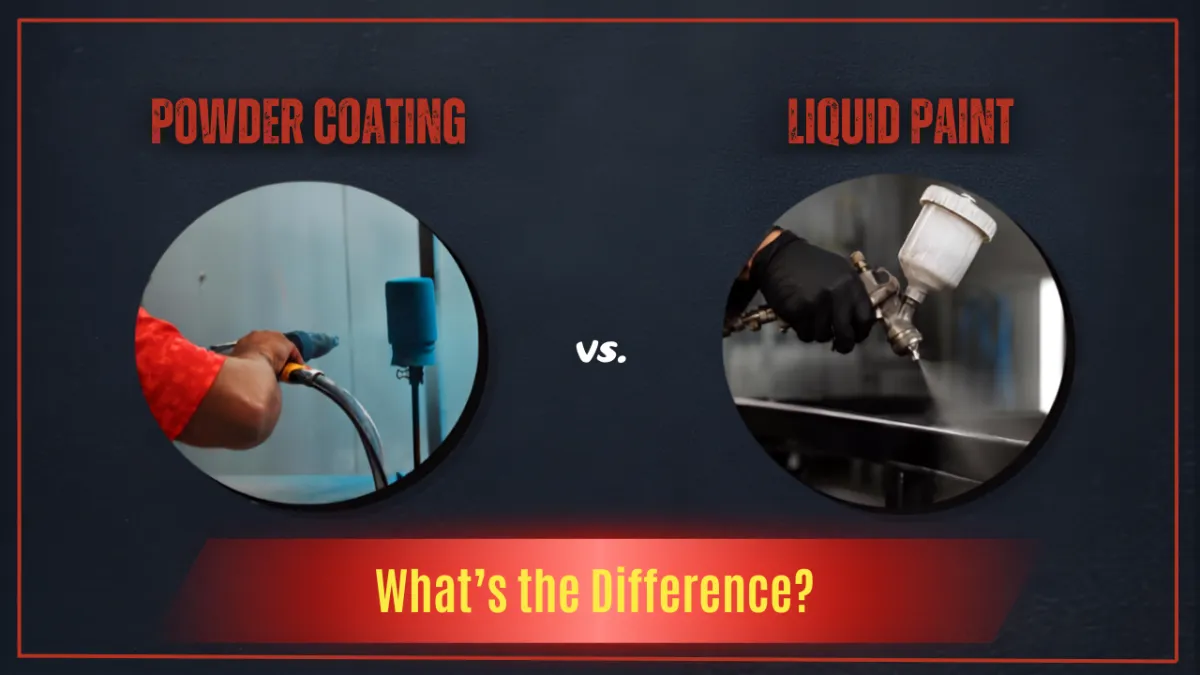
Liquid Paint and Powder Coating Start Very Differently
Traditional liquid coatings use pigments and resins suspended in a liquid carrier, which commonly includes water or solvents depending on the coating system. After the paint is applied, that liquid portion has to evaporate or otherwise leave the film as the coating dries or cures.
Powder coating takes a different approach.
Powder coatings are dry materials made from carefully formulated resins, pigments, curing agents, flow modifiers, and other additives. The powder is applied to a properly prepared part—most commonly using an electrostatic powder coating gun—and the coated part is then placed into a curing oven.
Inside the oven, the powder melts, flows, and cures into a continuous finish.
That difference may sound simple, but it changes almost everything about the finishing process.
Powder Coating Is Built for Durability
One of the biggest reasons manufacturers move toward powder coating is performance.
When the correct powder chemistry is matched to the application—and the part is properly pretreated, coated, and cured—the result can be an extremely durable finish with excellent resistance to chipping, scratching, corrosion, chemicals, and weathering.
Of course, not every powder performs the same way.
An epoxy designed for chemical resistance shouldn't be treated like an exterior-grade polyester designed for UV exposure. Pretreatment matters. Film thickness matters. Cure matters.
Powder coating isn't automatically indestructible simply because it's powder.
But when the entire process is done correctly, the durability is one of the technology's greatest strengths. Powder-X's training materials emphasize that the final performance depends on the complete process, from preparation through powder selection and cure.
Powder Doesn't Run, Drip, or Sag Like Liquid Paint
Anyone who has spent time spraying liquid coatings knows the balancing act.
Apply too much material and the paint can run or sag. Apply too little and coverage suffers. Multiple coats may be required to achieve the desired finish.
Powder behaves differently because there is no liquid carrier.
The electrostatically charged powder is attracted to the grounded part before curing. Once the process is properly dialed in, that makes it possible to produce consistent coverage without many of the familiar problems associated with spraying wet paint.
Electrostatic application can also improve transfer efficiency and help powder reach edges and other areas of the workpiece rather than simply becoming wasted overspray.
That doesn't mean powder coating requires less skill. Faraday cage areas, complex geometries, grounding, gun settings, and film build all require an operator who understands the process.
It's simply a different—and incredibly capable—way to apply a finish.
The Efficiency Advantage Is Hard to Ignore
This is where powder coating becomes especially interesting for manufacturers.
Every bit of coating that doesn't end up on a finished part represents cost.
Material costs money. Labor costs money. Rework costs money. Disposal costs money. And every unnecessary minute a part spends in the finishing department affects production.
A properly designed powder coating operation can significantly reduce some of that waste.
Depending on the booth and recovery system, powder that doesn't initially deposit on the part may be collected and reclaimed. Powder coatings can also achieve substantial film build in a single application rather than relying on several wet coats.
Once the part completes its specified cure and cools, the coating process is essentially complete.
For a company finishing hundreds or thousands of parts, those seemingly small efficiencies can become very large numbers.
That's why comparing powder coating and liquid paint shouldn't be limited to asking, "Which coating costs less?"
The better question is:
"Which process costs less per acceptable finished part?"
That's the number that matters.
Powder Coating Changes the Environmental Equation, Too
Traditional solvent-borne liquid coatings can introduce volatile organic compounds (VOCs) and create additional requirements around emissions, handling, cleanup, and waste.
Powder coatings do not rely on solvents in the same way.
That can make powder coating attractive to manufacturers looking to reduce VOC emissions and material waste while creating a cleaner finishing process.
There are still environmental, housekeeping, ventilation, fire-safety, and regulatory considerations with powder coating. A professional powder coating system needs to be designed and operated correctly.
But eliminating the solvent carrier changes a major part of the environmental equation.
What About Appearance?
This is where the old assumptions about powder coating really need to disappear.
Powder is no longer just black, white, and a few industrial colors.
Modern powder coatings are available in an enormous range of colors, gloss levels, textures, metallics, wrinkles, hammertones, clears, and specialty finishes.
There are formulations designed for UV resistance, chemical resistance, high temperatures, architectural applications, and much more.
In other words, choosing powder doesn't mean sacrificing appearance to gain durability.
In many applications, it means getting both.
So, Is Powder Coating Always Better Than Paint?
No finishing technology is perfect for every application.
Liquid coatings still have advantages in situations where a part cannot tolerate the heat required for powder curing, where field application is necessary, or where a particular coating specification or finish requires a liquid system.
That's an important distinction.
The goal isn't to choose powder coating because powder is popular.
The goal is to choose the finishing process that makes the most sense for the product.
But when the parts can tolerate the curing process and the application calls for durability, production efficiency, repeatability, and long-term performance, powder coating becomes very difficult to ignore.
Why Powder Coating Changed Modern Finishing
The real innovation of powder coating isn't any single advantage.
It's how many advantages come together in one process.
A durable finish.
Excellent appearance.
High material utilization.
Fast production.
Reduced reliance on solvents.
A huge selection of colors and chemistries.
And a process that can scale from a small batch operation to a highly automated manufacturing line.
That's why powder coating has become much more than an alternative to liquid paint. For many products and manufacturers, it represents a fundamentally better way to finish metal.
The important part is doing it correctly.
Pretreatment, powder selection, application equipment, grounding, compressed air, film build, curing, and operator training all play a role. The coating is only as good as the process behind it.
Powder-X has spent more than 25 years helping powder coaters and manufacturers build that complete process through equipment, system design, installation, training, and technical support.
Because the real advantage isn't simply switching from liquid to powder.
It's building a finishing operation that produces a better part, more consistently, at a cost that makes sense.
Ready To Build A Powder Coating System The Right Way?
Whether you are starting your first powder coating business, bringing finishing in-house, or upgrading an existing operation, Powder-X can help you choose a batch system built around your goals.
From ovens and booths to complete systems, training, technical support, and long-term guidance, our team is here to help you make a smart investment in equipment that is designed to perform.
Contact Powder-X today to speak with one of our coating specialists and start building a powder coating operation with confidence.


