Pretreatment That Passes the Test: How to Spec Your System for ASTM B117 and Industry Standards
If you are planning to offer professional powder coating, or trying to land high-value OEM or government contracts, understanding the pretreatment system specifications powder coating requires is essential to get one thing right from the start:
Pretreatment.
It’s the part most shops underestimate. But it’s also the part that makes or breaks your ability to meet:
OEM finish specs
Government durability contracts
ASTM B117 salt spray testing
ISO or MIL-DTL coating requirements
In this blog, we’ll break down:
– What the industry actually requires
– What your system needs to deliver
– How to spec your equipment to pass the test, not just spray pretty parts
Why Pretreatment Matters
The best powder in the world won’t fix bad prep.
Adhesion, corrosion resistance, and long-term durability all start with pretreatment.
Here’s what failure looks like:
Blisters or peeling after salt spray testing
Powder pulling off at the tape test stage
Uneven film build or fish eyes due to surface contamination
Failed audits or part rejection from prime contractors
“The finish is only as strong as the metal it’s bonded to—and the bond starts in pretreatment.” – Joey Golliver
What is ASTM B117 and Why Does It Matter?
ASTM B117 is the industry’s benchmark test for salt spray (fog) corrosion resistance.
What it does:
Simulates long-term environmental corrosion (salt, humidity, temperature)
Measures how many hours your coating system can resist breakdown
Evaluates coating + substrate + pretreatment as a complete system
Typical requirements:
250–500 hrs: basic industrial durability
750–1,000+ hrs: aerospace, military, or high-exposure environments
If your coating starts failing at 96 hours, no customer’s going to trust you with mission-critical parts.
Core Specs for a Compliant Pretreatment System
To hit industry specs (and pass salt spray tests), your pretreatment system needs to handle three critical stages with precision:
1. Metal Cleaning (Stage 1)
Removes oils, mill scale, fabrication debris
Spec:
Alkaline cleaner (5–10% solution)
Heated to 120–140°F
Contact time: 2–5 minutes
Spray pressure: 15–25 PSI
Stainless steel tank preferred
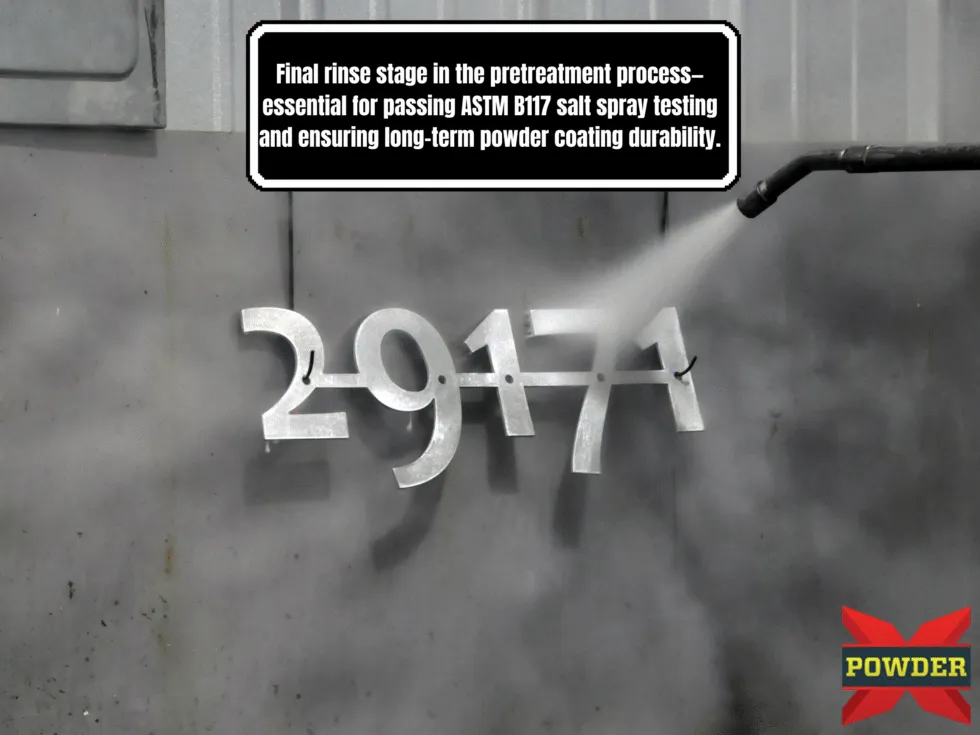
2. Surface Conditioning / Rinsing (Stage 2–3)
Removes cleaner residue, neutralizes pH
Spec:
Counterflow rinse with DI or RO water
Overflow rinse tank to prevent cross-contamination
Conductivity ≤ 300 µS for final rinse
3. Conversion Coating (Stage 4)
Creates a chemical bond between the metal and the powder
Options:
Iron phosphate (basic, good for general steel)
Zinc phosphate (for heavy-duty or automotive specs)
Zirconium (eco-friendly, multi-metal option)
Spec:
Iron phosphate: pH 4–5.5, 3–5 minutes
Zinc phosphate: pH 2.8–3.2, with grain refiners
Temp: 110–140°F
Titration-controlled concentration monitoring
To meet ASTM B117 500+ hours, you’ll likely need:
Zinc phosphate OR zirconium
DI water final rinse
Heated, agitated tanks
Real-time pH and titration management
Bonus Spec: Dry-Off Oven
Moisture on the metal = contamination under the coat.
Dry-Off Requirements:
200°F minimum
8–10 minutes dwell time
Parts must reach metal temp, not just air temp
Infrared assist optional but effective
Equipment Design Tips That Matter
Stainless steel tanks – Especially in heated and phosphate stages
Separate plumbing for each stage – No shared pumps or crossover
Auto-dosing and pH monitoring – Removes guesswork and keeps your system in spec
Exhaust hoods and containment – Meet EPA/OSHA standards and keep your shop safe
Flow meters + conductivity sensors – For rinse water management and salt spray consistency
Joey Note: “Don’t go cheap on tanks and chemistry. Spend it up front or bleed it later on failures.”
How to Know If You’re Ready for ASTM B117
Passes 500 hours of salt spray without rust or blister
Consistent adhesion with tape test
Stable rinse conductivity and pH logged daily
Pretreatment records traceable for audits
If you can't prove it, you can't pass it. That’s why your pretreatment line needs more than tanks, it needs tracking, controls, and repeatability.
Final Word: Spec for the Finish You Want to Deliver
There’s no shortcut to compliance.
But there is a proven process and it starts with a pretreatment system that matches your ambition.
Whether you’re chasing OEM certification or building trust with high-expectation customers, your specs must be dialed in to deliver repeatable results.
Want to hit the mark every time? It starts before the booth. It starts in pretreatment.
#PowderX #PowderMarket #JoeyGolliver #PowderCoachsPlaybook


