
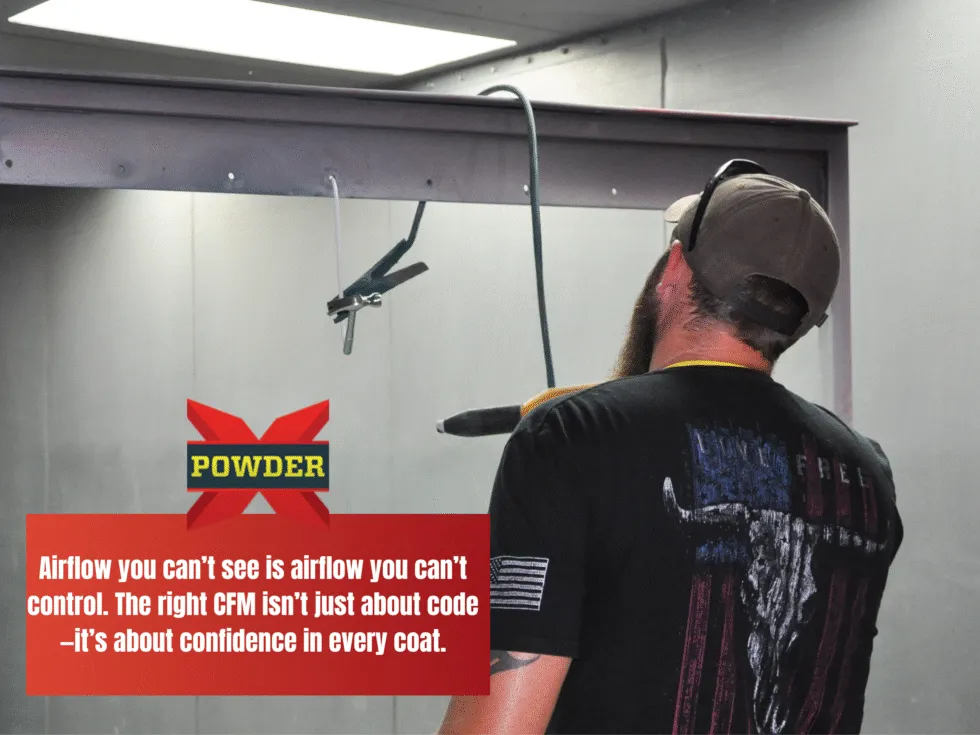
Don't Guess Your Airflow: How to Calculate the Right CFM for Your Powder Coating Booth
You’ve got the gun, the powder, the parts, but if your airflow isn’t dialed in, you’re working blind. And guess what? Without proper CFM airflow for your powder coating booth, achieving high-quality finishes becomes almost impossible.
Undersized airflow means contamination. Oversized airflow wastes energy. Either way, you’re burning profit.
Whether you’re coating a few parts a week or running full production, calculating the correct CFM (cubic feet per minute) for your spray booth is non-negotiable.
This post breaks down what you need to know to match your airflow to your operation and keep your finish flawless.
What Is CFM and Why Does It Matter?
CFM stands for Cubic Feet per Minute, the volume of air your spray booth moves every 60 seconds. It’s the heartbeat of your operation. The right CFM ensures:
Overspray is captured and filtered, not floating back onto your parts
Air quality meets OSHA and EPA standards
The operator’s visibility and safety are preserved
Consistent air movement keeps finish quality top-tier
In powder coating, airflow = finish control. Period.
Step 1: Know Your Booth's Dimensions
Start with the inside dimensions of your booth, because CFM is directly tied to booth volume and air changes per minute.
Let’s say your booth is:
10 ft wide x 8 ft tall x 20 ft deep
That’s 1,600 cubic feet of space
Now the question becomes:
How fast do you want to exchange that air?
Step 2: Choose Your Air Change Rate
The air change rate determines how many times per minute the booth exchanges its total air volume. It depends on your coating frequency and contamination risk.
Here’s a cheat sheet:
Example: For a 1,600 cu ft booth at 1.5 changes per minute:
1,600 × 1.5 = 2,400 CFM
If you’re in a high-volume or high-risk environment, don’t be afraid to spec higher.
Step 3: Consider the Part Size and Load
Large parts or part racks block airflow and can create dead zones where overspray settles.
To compensate:
Increase your CFM by 10–20% for oversized parts
Add directional airflow baffles or intake balance
Ensure even face velocity across the booth filter face (typically 100–150 FPM)
Joey Tip: "If your parts are the size of a mailbox, your booth can breathe easy. If they are the size of a truck door, you need to give it lungs."
Step 4: Match to OSHA and EPA Air Quality Standards
Both OSHA and EPA have guidelines for:
Respirable particulate matter
Airflow across operator breathing zones
Filter efficiency and air capture
While powder coating doesn’t produce VOCs, overspray is still a particulate hazard, especially in enclosed shops.
General compliance airflow:
100 feet per minute across the booth opening
For open-face booths:
Width × Height × 100 FPM = required CFM
Example:
8 ft wide × 8 ft tall booth face × 100 FPM = 6,400 CFM
Yes, that’s higher than your air-change number. Why?
Because open-face booths must protect operator airspace in addition to coating quality.
Step 5: Don’t Forget Filter Loading and Makeup Air
As your filters load up with powder, CFM drops sometimes by 10–30%.
Always spec your fan system with additional static pressure capacity to account for this.
Also consider makeup air. If you’re exhausting 6,000 CFM but only bringing in 2,000 CFM, your booth won’t pull cleanly and your powder won’t stick evenly.
The Joey Rule: Size Your System for Where You’re Going, Not Where You Are
If you are planning to grow (and you should be), spec your booth with 15–25% extra airflow capacity. This gives you:
Room to coat bigger parts
Ability to run longer shifts
Airflow stability as your filters age
The headroom to pass inspections, without duct tape and wishful thinking
Final Word: Airflow Isn’t Guesswork. It’s a Competitive Advantage.
When your booth breathes right, your finish gets better, your shop stays cleaner, and your team breathes easier, literally.
Want help designing a system that meets code, crushes production, and leaves your competitors gasping for air?
That's what we do.
#PowderX #PowderMarket #JoeyGolliver #PowderCoachsPlaybook


