
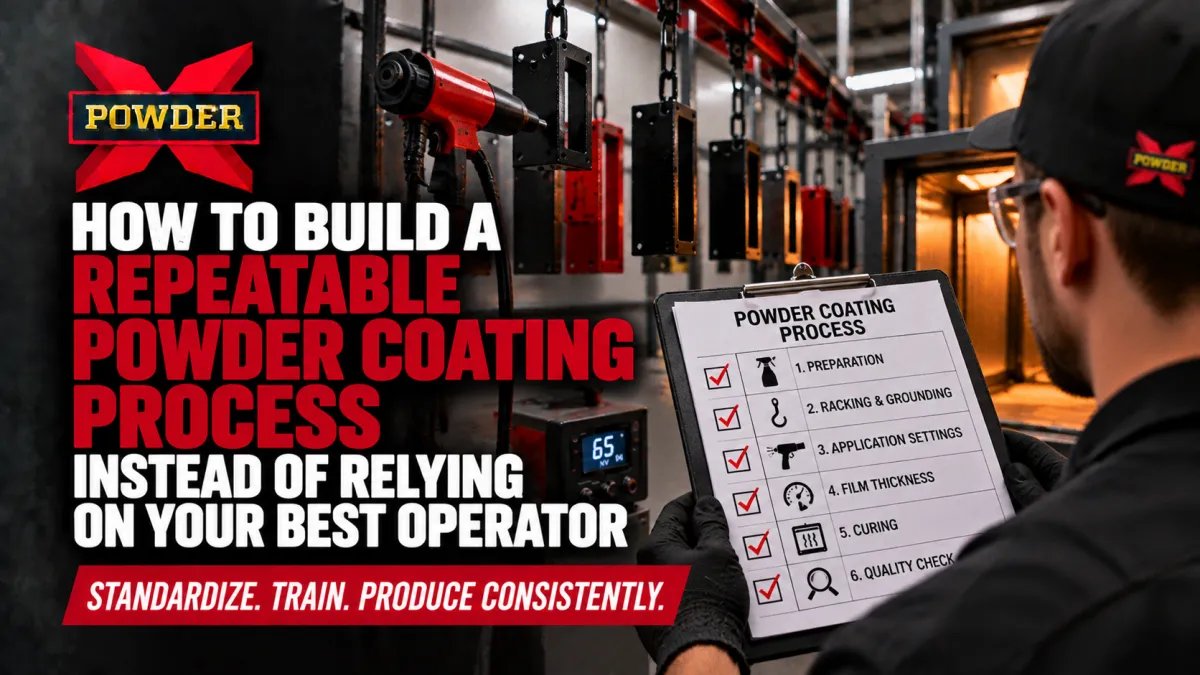
How to Build a Repeatable Powder Coating Process | Powder-X
How to Build a Repeatable Powder Coating Process Instead of Relying on Your Best Operator
Every powder coating shop eventually has that person.
The operator who knows exactly how to spray the difficult parts. They know which rack works best, when to adjust the gun, how long the heavy parts really need in the oven and what to check when something doesn't look right.
That's valuable experience.
It's also a dangerous place for all of that knowledge to live.
If the quality of the finished product depends entirely on one person's memory and experience, the business doesn't really have a repeatable powder coating process. It has a talented operator.
At Powder-X, the goal isn't to eliminate operator skill. It's to take what the best operators know and turn it into a process the entire operation can repeat.
Your best operator should help build the system—not become the system.
What Does a Repeatable Powder Coating Process Mean?
Repeatability means the same job can come through on Monday, again three months later, and again next year with essentially the same controlled process and expected result.
The parts are prepared the same way.
They're racked the same way.
Grounding is checked the same way.
The correct powder and application settings are used.
Film thickness is controlled.
The parts reach the required cure.
Quality is inspected against the same expectations.
That doesn't mean every powder coating job gets processed identically. Different substrates, powders, geometries and performance requirements may need different processes.
The point is that once the correct process has been established, it shouldn't have to be reinvented every time the job comes back.
Start by Writing Down What the Best Operator Already Knows
One of the easiest places to begin is with repeat jobs.
Take a part the shop coats regularly and follow it from beginning to end.
How is it cleaned?
Does it require blasting or chemical pretreatment?
Which rack and hook configuration works best?
Where is the grounding point?
What powder is being used?
What gun settings work well?
What film thickness is required?
How is cure verified?
What does the finished part need to pass before it's approved?
Chances are the experienced operator already knows most of those answers.
Get them out of that person's head and into a usable work instruction.
A photo of the properly loaded rack can be more useful than a paragraph explaining how to hang the parts. A picture showing the grounding point can eliminate confusion. A simple setup sheet can record the application settings.
Documentation doesn't need to be complicated to be valuable.
Standardize Surface Preparation
A beautiful application can't rescue a poorly prepared substrate.
Powder-X training repeatedly emphasizes the importance of surface preparation because it affects appearance, adhesion and corrosion protection. Powder Coach's Playbook Final E…
So "clean the parts" isn't a very good process instruction.
What does clean mean?
If chemical pretreatment is being used, establish the process variables that matter according to the chemical supplier's requirements. If blasting is required, define what needs to be accomplished before the part moves forward. If parts require outgassing, establish when and how that step occurs.
The operator shouldn't have to look at a pile of parts and invent a preparation process every morning.
Good coating starts with a repeatable foundation.
Standardize Hooks, Racking and Grounding
The way a part hangs affects more than convenience.
It can affect application access, Faraday areas, part density and grounding.
Powder-X's training recommends establishing consistent grounding locations on repeat parts and regularly inspecting grounding connections, wires and hooks. It also stresses that the grounding point needs to be clean and free from contaminants that interfere with electrical contact.
For repeat production, document the hook, rack position, part orientation, spacing and grounding point.
Now Operator A and Operator B aren't hanging the same part two completely different ways.
This is exactly where the recent Powder-X discussion on hooks and racking connects to process control.
If the part enters the booth differently every time, don't be surprised when it coats differently every time.
Create Application Recipes
Experienced coaters naturally make adjustments based on the part in front of them.
That skill still matters.
But repeat parts should have a known starting point.
Record the powder manufacturer and product, gun setup, voltage/current settings where applicable, powder delivery settings, nozzle configuration, gun-to-part approach and target film thickness.
Complex parts may also benefit from instructions about which areas should be coated first.
The goal isn't to handcuff a skilled operator.
It's to prevent every operator from starting at zero.
Powder-X training shows how variables such as kV, microamps, gun distance, grounding and application technique can affect results, particularly with more demanding finishes. Powder Coach's Playbook Final E…
A proven recipe gives the operator a baseline. Experience can then be used to troubleshoot exceptions instead of inventing the normal process.
Control the Things the Operator Can't See
Some of the most important powder coating variables aren't obvious from across the shop.
Compressed air is a good example.
Air can look perfectly normal while containing moisture or oil capable of contaminating the powder and affecting the finish. Powder-X training explains that contaminated compressed air can contribute to inconsistent powder flow, uneven application, adhesion problems and finish defects. Powder Coach's Playbook Final E…
Grounding is another.
A part can be hanging securely while the electrical path to ground has deteriorated because of coating buildup or poor contact.
These are reasons to build routine checks into the process.
Don't wait for the best operator to notice something feels different.
Stop Using Oven Setpoint as the Cure Recipe
Repeatability falls apart quickly when the cure instruction says:
"Put it in the oven at 400°F for 20 minutes."
What does that mean?
Twenty minutes from the moment the doors close?
Twenty minutes after the oven recovers?
Twenty minutes after the metal reaches temperature?
Those aren't the same thing.
Powder coating cure needs to follow the powder manufacturer's Technical Data Sheet and account for actual part-metal temperature. A heavy fabrication can take considerably longer to reach the required temperature than a lightweight sheet-metal part.
For recurring production, profile the process and establish a verified cure recipe for that part or part family.
Then document it.
The operator shouldn't have to guess when the chemistry is finished.
Define What “Good” Looks Like
A repeatable process also needs a repeatable definition of acceptable quality.
Don't make the final inspection:
"Looks good to me."
Establish the requirements that matter for the job.
That may include appearance, color, coverage and dry film thickness, along with cure verification and any adhesion or performance testing required by the customer, powder manufacturer or applicable specification.
A visual reference can also help for recurring products.
If everybody knows what passes and what fails, quality becomes much less dependent on who happens to be inspecting the parts that day.
Create a Simple Job Traveler
This doesn't need to become a paperwork nightmare.
For recurring jobs, a simple traveler or digital record can follow the order through production.
It might contain the part number, preparation process, rack configuration, powder product, application recipe, target film thickness, cure profile and inspection requirements.
Operators initial or record the important stages as the work moves through production.
Now if something fails, troubleshooting becomes much easier.
Instead of asking:
"What do you think happened?"
The shop can ask:
"What changed from the established process?"
That's a much better question.
Change One Variable at a Time
This is especially important when troubleshooting.
Suppose coverage suddenly looks wrong.
One operator changes kV.
Another changes powder flow.
Someone else swaps the nozzle.
Then the rack gets changed.
The part comes out better.
Great.
What fixed it?
Nobody knows.
When possible, change one variable at a time and record the result.
That's how troubleshooting turns into process knowledge.
Once the solution is proven, update the work instruction so the entire team benefits from what was learned.
Every solved problem should make the process smarter.
Train the “Why,” Not Just the Steps
A procedure that says "set the gun here" is useful.
An operator who understands why that setting matters is more useful.
Powder-X has always placed a strong emphasis on training because powder coating is a process, not simply a piece of equipment.
Operators should understand why grounding matters. Why contaminated air creates problems. Why preparation affects adhesion. Why Faraday areas behave differently. Why film thickness matters. Why oven temperature and part-metal temperature aren't the same.
That knowledge allows employees to recognize when the normal recipe needs attention.
Standardization shouldn't create button pushers.
It should give knowledgeable operators a reliable process to work from.
Your Best Operator Becomes More Valuable, Not Less
Some experienced employees worry that documenting what they know makes them easier to replace.
In a well-run operation, the opposite should happen.
The best operator becomes the person helping establish recipes, train employees, solve unusual problems and improve the process.
Instead of spending every day rescuing jobs nobody else can run, that person's knowledge begins improving the entire business.
That's leverage.
If one great operator can teach a system that helps five people produce better parts, their experience just became considerably more valuable.
Repeatability Makes Growth Easier
A shop can operate informally when two people know every job.
That becomes much harder at ten employees.
It becomes harder again when a second shift starts.
And it becomes extremely difficult when production grows but all the critical knowledge still lives in one person's memory.
Repeatable processes make training easier. They make estimating more accurate. They make quality control easier. They help identify rework causes. They make automation more realistic because the process being automated is already understood.
This connects directly with Powder-X's approach to production growth:
Control the process before trying to scale the process.
Start With Your Five Most Important Jobs
Don't try to document the entire shop tomorrow.
Start with the five repeat jobs that matter most.
For each one, document:
Preparation → Racking/Grounding → Powder/Application → Film Thickness → Cure → Inspection
Run the process.
Measure the results.
Adjust what needs improvement.
Then repeat it until the shop has a proven recipe.
Once those five are under control, move to the next five.
That's how a collection of operator habits gradually becomes a production system.
The Powder-X Takeaway
Great operators will always matter in powder coating.
Their experience, judgment and ability to troubleshoot difficult parts can't simply be replaced by a checklist.
But a growing business shouldn't require its best operator to personally touch every important job.
Capture the knowledge.
Standardize the repeatable parts of the process.
Document preparation, racking, grounding, application, cure and quality requirements. Train employees to understand why those steps matter. Measure the results and improve the recipe when something better is discovered.
Then the business stops asking:
"Is our best operator here today?"
And starts knowing:
"We have a process for that."
That's a much stronger foundation for growth.
Ready To Build A Powder Coating System The Right Way?
Whether you are starting your first powder coating business, bringing finishing in-house, or upgrading an existing operation, Powder-X can help you choose a batch system built around your goals.
From ovens and booths to complete systems, training, technical support, and long-term guidance, our team is here to help you make a smart investment in equipment that is designed to perform.
Contact Powder-X today to speak with one of our coating specialists and start building a powder coating operation with confidence


