What Is the Water Break Test, and How Do I Perform It?
You've degreased, rinsed, maybe even blasted, but is your part actually ready for powder? That’s where the water break test for powder coating comes in. Think of it as the gatekeeper between your prep process and a perfect finish.
Because the real problem isn’t always visible, it’s what’s left behind.
What Is the Water Break Test?
The water break test is a simple, powerful, and industry-approved method to check whether a metal surface is free of contaminants like oils, residues, or soap films. These invisible contaminants can wreck powder adhesion, causing costly reworks and customer returns.
The principle is straightforward:
If water beads up on the part, it’s not clean. If it sheets smoothly, it’s ready.
In other words, how the water behaves tells you everything about your surface condition.
Why It Matters in Powder Coating
Powder coating doesn’t stick to dirt. Or oil. Or invisible films. And that’s not just a cosmetic issue, it’s a business risk.
Failed adhesion? You’ll see flaking, chipping, or peeling.
Uneven finish? That’s because your powder doesn’t bond uniformly.
Failed inspection or salt spray test? That could cost you a government contract.
The water break test acts as a non-destructive quality control step, helping you catch prep errors before they become financial mistakes.
How to Perform the Water Break Test
This test doesn’t require special equipment. All you need is a clean part, clean water, and proper lighting.
Step-by-Step Guide:
Prep the Part as Usual
Degrease, rinse, and perform your normal pretreatment steps (alkaline cleaner, iron phosphate, etc.).Rinse with Clean Water
Use a gentle stream or spray of deionized or clean tap water.Observe the Water Behavior
Look closely at how the water interacts with the surface:
– Clean Surface: Water forms a smooth, even sheet.
– Contaminated Surface: Water beads, breaks, or forms rivulets.Test Multiple Areas
Test corners, welds, and recessed zones, where grime likes to hide.Dry or Re-clean as Needed
If the water breaks or beads, that part needs to go back to cleaning. No exceptions.
When Should You Use the Water Break Test?
After alkaline cleaning
After rinsing
Before coating
During training or inspections
On every batch, every shift (yes, seriously)
Make this a habit, not a guess.
Joey’s Real Talk: The “Cheap” Shortcut That Costs You Most
Let me say this plainly: If you skip the water break test, you’re skipping quality control. And the cost of failure? Wasted powder, failed batches, angry clients, or even lost certifications.
We train every Powder-X student to make this test second nature. Because the guys winning high-volume, tight-tolerance jobs? They’re not guessing. They’re testing, every time.
Pro Tip: Want to Pass the Test Every Time?
It starts with a complete pretreatment system designed to remove contaminants thoroughly. That means:
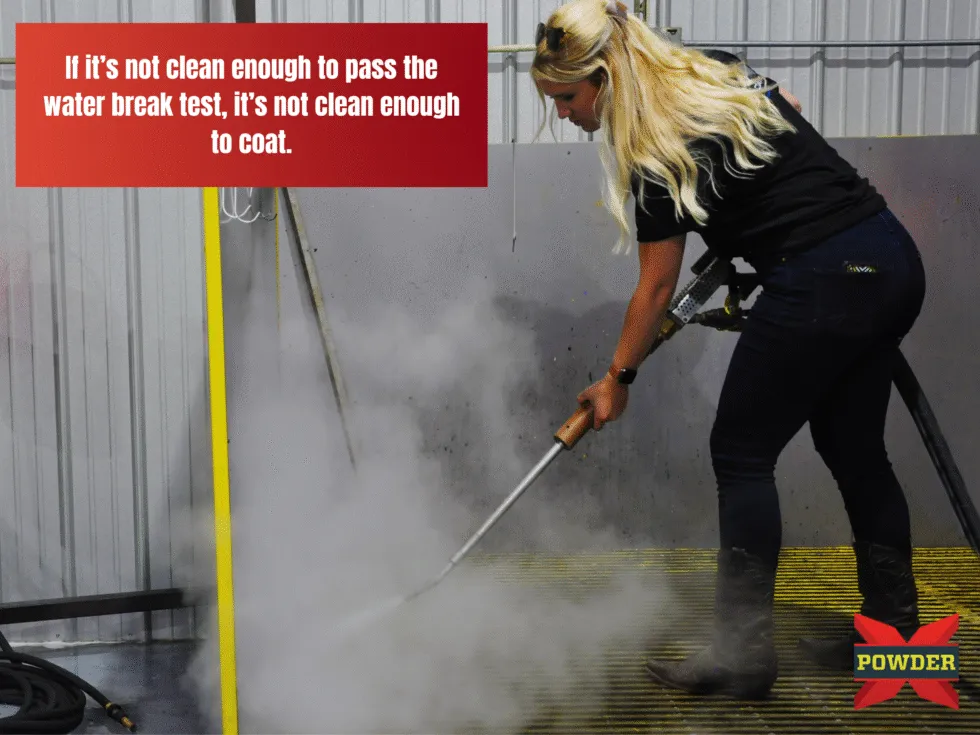
Heated alkaline tank or high-pressure washer
Multiple rinse stages (DI rinse is best)
Correct chemical concentrations
Proper dwell time
Trained operators
And yes, we teach all of this in our Powder-X training. Because success isn’t just about spraying powder. It’s about building a system that delivers repeatable results.
Final Word
The water break test is one of the simplest ways to guarantee powder coating success. It’s not a fancy tool. It’s a commitment to doing things right, every time.
Want to coat like the pros? Then test like the pros.
#PowderX #PowderMarket #JoeyGolliver #PowderCoachsPlaybook


