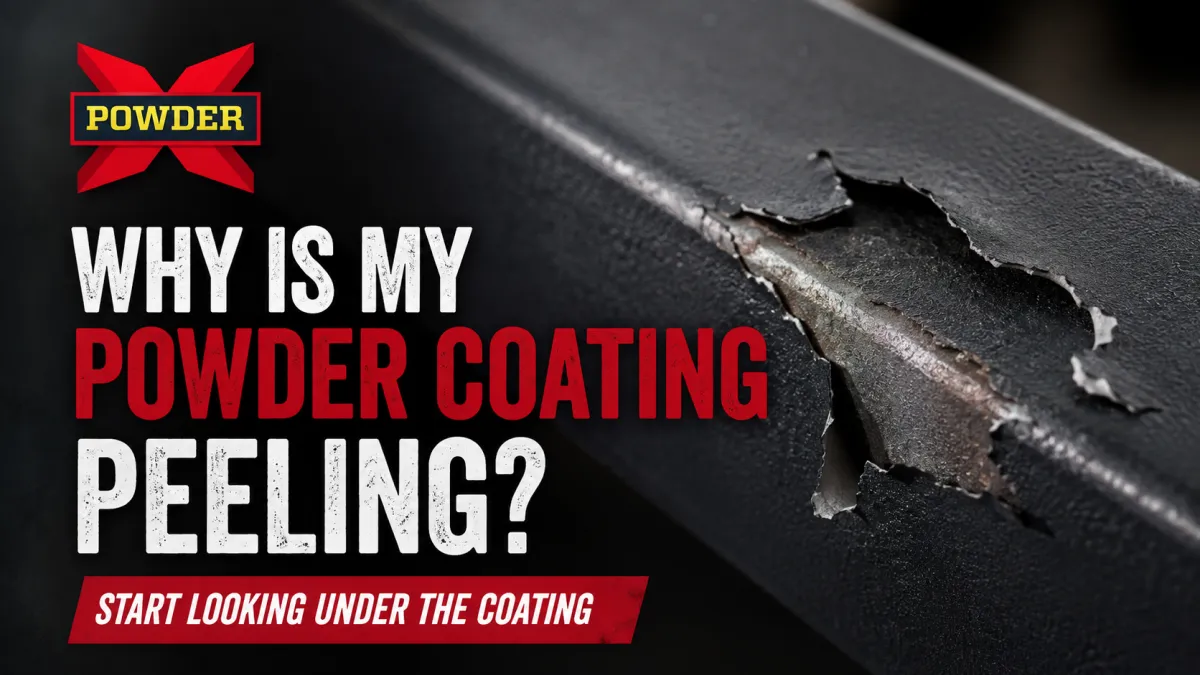
Why Is My Powder Coating Peeling? Start Looking Under the Coating
Why Is My Powder Coating Peeling? Start Looking Under the Coating
Powder coating is supposed to stick.
When a properly prepared, coated, and cured part leaves your shop, you expect that finish to stay where you put it. So when powder begins peeling away from the metal—especially in sheets or large sections—the natural reaction is to look at the coating itself.
But that's often the wrong place to start.
At Powder-X, one of the most important lessons we teach about coating failures is simple:
Most powder coating failures don't start on top of the coating. They start underneath it.
That's why peeling powder is usually telling you to investigate the relationship between the coating and the substrate beneath it.
The powder may simply be where you're seeing the problem. The actual cause could have happened several steps earlier.
Why Does Powder Coating Peel?
Powder coating can peel when it doesn't properly adhere to the substrate or when something beneath the coating causes that bond to fail.
That "something" could be oil, rust, mill scale, an old coating, poor chemical pretreatment, contamination, or corrosion developing underneath the powder.
Think of it like installing expensive flooring over a bad subfloor.
The flooring might be beautiful. The installer might do everything correctly. But if the material underneath it begins separating, the finished floor is going with it.
Powder coating works much the same way.
You're only as good as the foundation you're coating.
That's why Powder-X training focuses heavily on three requirements for an acceptable finished part: appearance, adhesion, and corrosion protection. If preparation is wrong, you can lose all three.
1. Start With Surface Preparation
If powder is peeling, this should be one of your first questions:
What exactly did we coat over?
Metal can look clean and still contain contaminants capable of interfering with adhesion.
Oils, grease, dirt, manufacturing residues, and other contaminants need to be addressed before powder is applied. Heavy contamination may need to be physically removed before the normal chemical cleaning process can do its job.
And this is where shortcuts become expensive.
You might save a few minutes during preparation and lose hours stripping and recoating the finished part later.
Proper prep isn't extra work.
It's part of the coating process.
2. Look for Rust and Mill Scale
Rust and mill scale are particularly important when diagnosing peeling.
Powder can adhere to mill scale—but that doesn't mean the mill scale has a permanent bond to the steel underneath it.
If the mill scale releases, the powder attached to it comes off too.
The Powder Coach's Playbook specifically identifies rust and mill scale as materials that must be removed before coating.
This gives you an important troubleshooting clue.
Look at the backside of the powder that peeled away.
What came off with it?
If you're seeing rust, scale, or other material attached to the powder, you may not be looking at a failure between the powder and the surface contamination.
You may be looking at the surface itself failing underneath the powder.
3. Don't Assume Blasting Solves Everything
Here's another common misunderstanding:
"We blasted it, so the prep couldn't be the problem."
Not so fast.
Blasting has an important place in powder coating. It can remove rust, mill scale, old coatings, and other physical imperfections.
But mechanical preparation and chemical pretreatment serve different purposes.
One of the biggest issues with relying only on blasting is corrosion protection. Powder-X training emphasizes that mechanical preparation by itself doesn't create the conversion coating that chemical pretreatment can provide between the substrate and the powder.
There's also contamination to consider.
If light oil is still on a part when you blast it, you don't necessarily make that oil disappear. You can drive contamination into the metal's surface.
Then you heat the part.
And guess where that contamination wants to go?
Back out.
So when diagnosing peeling, don't simply ask whether the part was blasted.
Ask whether it was properly prepared for the coating system and service environment.
4. Check Your Chemical Pretreatment
Chemical pretreatment isn't just about making a part look clean.
A properly selected process can remove light contamination and establish a conversion coating that helps protect the substrate from corrosion.
That layer underneath the powder matters because corrosion doesn't always attack a coating from the outside.
Powder-X training specifically warns that many powder failures occur from underneath out, sometimes referred to as under-film or filiform corrosion.
That's exactly why the title of this article matters:
Start looking under the coating.
If corrosion is spreading beneath the powder, what you see peeling today may only be the visible symptom of a larger problem developing below the surface.
Your pretreatment process should be appropriate for the metal, finished-product requirements, and environment in which that product will operate.
5. Make Sure the Pretreatment Process Is Controlled
Using the right chemical isn't enough.
You also have to use it correctly.
Chemical pretreatment depends on variables including time, temperature, concentration, and impingement. If one of those moves outside the required range, your process can change even though you're still using exactly the same chemical.
That's why a production process needs to be repeatable.
If you're seeing intermittent peeling—some parts are good while seemingly identical parts fail—start looking for variables.
Did chemical concentration change?
Was contact time different?
Was the temperature correct?
Were spray nozzles working properly?
Were the parts thoroughly rinsed?
The answer may not be dramatic. Sometimes a small process variation creates a very expensive problem.
6. Check for Old Coatings Underneath
Recoating existing parts requires additional attention.
Powder-X's general rule is that powder may be applied over powder in appropriate circumstances, but you shouldn't simply powder coat over existing paint. When you're dealing with a previously coated part, the integrity of that existing finish becomes part of your foundation.
If the original coating has poor adhesion, putting a strong new coating over it doesn't repair that bond.
You have simply created a strong coating attached to a weak coating.
Eventually, the weakest layer wins.
When you're refurbishing parts, determine what's already on the substrate and whether it needs to be removed before you begin.
7. Don't Ignore Hidden Contamination
Used parts and castings deserve extra attention.
They can contain contaminants beneath the surface that aren't immediately obvious.
Once heated, trapped contamination can migrate toward the surface and interfere with the finish.
Powder-X recommends considering a prebake or outgassing step for repaired or refurbished parts and castings when appropriate. Just as importantly, the sequence matters: drive contamination to the surface before the final cleaning process, rather than cleaning the part first and then bringing contamination back out.
This is another example of why troubleshooting should begin before the spray booth.
Sometimes what looks like an application problem actually began with the condition of the incoming part.
8. What About Undercuring?
Preparation isn't the only possible cause of coating failure.
The powder still has to be correctly applied and cured according to the powder manufacturer's requirements.
A finish can look cured without necessarily having completed the cure required to develop its intended properties.
So cure should absolutely be part of your troubleshooting process.
But don't make the mistake of turning the oven temperature up, recoating the part, and assuming you've solved the problem.
When you're dealing specifically with powder that is peeling away from the substrate, inspect what's happening at and underneath that coating-to-substrate interface.
That's where the evidence is.
Peeling vs. Chipping: What's the Difference?
These terms are often used interchangeably, but the way a coating fails can give you clues.
Chipping may appear as smaller areas breaking away after impact or mechanical damage.
Peeling often describes larger sections of coating separating from the surface.
Neither description gives you a complete diagnosis by itself. But if the powder is lifting or peeling away in sheets, adhesion and what's happening underneath the film deserve immediate attention.
Don't just look at where the powder came off.
Look at what it came off of.
That distinction can point you toward the real problem much faster.
How to Troubleshoot Peeling Powder Coating
Before changing gun settings or ordering another box of powder, follow the part backward through your process.
Start with the failure itself.
Examine the exposed substrate and the backside of the peeled coating. Then review the original metal condition, mechanical preparation, cleaning and pretreatment, drying, powder application, cure process, handling, and final service environment.
You're trying to answer one question:
Where did the system lose its bond?
Change one variable at a time whenever possible.
If you change your chemical process, cure schedule, film thickness, powder, and application settings all at once, the problem might disappear—but you won't know what actually fixed it.
And that means you haven't really learned how to prevent it from happening again.
Can You Just Recoat Peeling Powder?
Sometimes the failed coating needs to be removed and the part recoated.
But recoating alone isn't the fix.
If rust caused the failure, remove and address the rust.
If mill scale was the problem, remove the mill scale.
If contamination caused poor adhesion, correct the cleaning process.
If pretreatment was inadequate, correct the pretreatment.
If an existing coating failed underneath your powder, address that coating.
Otherwise, you're putting another expensive finish over the same bad foundation.
And sooner or later, you'll probably see the same problem again.
Powder Coating Problems Usually Have a Process Behind Them
Powder coating is remarkably durable when the complete process is done correctly.
That's the part worth remembering.
A great powder gun can't compensate for bad pretreatment. More powder can't hide a poor foundation forever. And an expensive oven can't remove mill scale that should have been addressed before the part ever reached the booth.
At Powder-X Coating Systems, we look at powder coating as a complete system.
Preparation.
Pretreatment.
Application.
Curing.
Equipment.
Training.
Process control.
They all work together.
So if your powder coating is peeling, don't immediately ask:
"What's wrong with my powder?"
Ask a better question:
"What's happening underneath my powder?"
That's usually where good troubleshooting begins.
If you're building an in-house powder coating operation, upgrading an existing system, or trying to create more consistent finished parts, Powder-X can help you look at the entire process—not just one piece of equipment.
Powder Coating Peeling FAQ
Why is my powder coating peeling off?
Powder coating may peel when adhesion between the coating and substrate is compromised. Common areas to investigate include surface contamination, rust, mill scale, existing coatings, chemical pretreatment, hidden contamination, and the cure process.
Can rust underneath powder coating cause it to peel?
Yes. Powder-X training emphasizes that coating failures can develop from underneath the film. Without appropriate preparation and corrosion protection, corrosion beneath the coating can eventually contribute to failure.
Does sandblasting prevent powder coating from peeling?
Not automatically. Blasting can remove rust, mill scale, and old coatings, but mechanical preparation alone does not provide the conversion coating associated with proper chemical pretreatment.
Can I powder coat over a peeling coating?
A failing underlying coating is a weak foundation. The cause of the failure should be identified and corrected before recoating rather than simply covering the problem.
How do I prevent powder coating from peeling?
Build a controlled process around proper substrate preparation, chemical pretreatment, contamination control, powder application, and curing. The specific process should match the substrate and performance requirements of the finished part.
Ready To Build A Powder Coating System The Right Way?
Whether you are starting your first powder coating business, bringing finishing in-house, or upgrading an existing operation, Powder-X can help you choose a batch system built around your goals.
From ovens and booths to complete systems, training, technical support, and long-term guidance, our team is here to help you make a smart investment in equipment that is designed to perform.
Contact Powder-X today to speak with one of our coating specialists and start building a powder coating operation with confidence.


